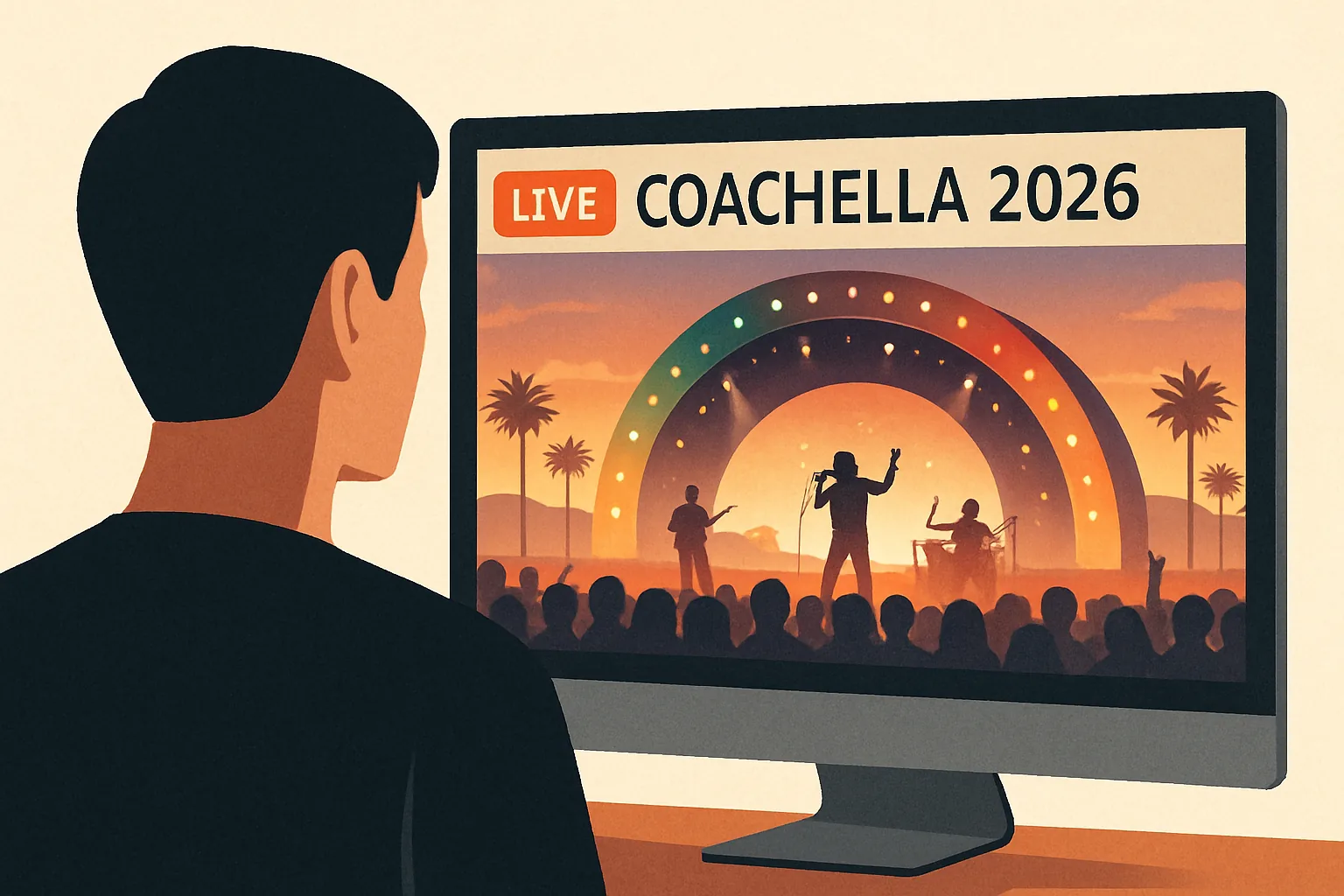
YouTube used Coachella Weekend 1, running April 10 to April 12, 2026, to make a familiar music livestream feel much bigger. Instead of offering a limited window into the festival, the platform expanded coverage across all seven stages, added 4K streams on select stages, rolled out multiview so people could watch several sets at once, layered in shopping features, and kept a 24/7 Coachella TV channel running around the event.
That is a meaningful change in what the annual Coachella stream actually is. It is no longer just a convenience for fans who cannot get to Indio. It is a full-scale digital event designed for people who are following the festival from phones, laptops, living rooms, group chats, and social feeds at the same time.
What changed this year
The headline upgrade was breadth. YouTube said it was carrying all seven stages simultaneously during Weekend 1, a notable expansion from the more selective festival-stream model people are used to. That matters because Coachella is defined by overlap. Several artists perform at once, and the in-person experience has always involved tradeoffs. A broader stream reduces that bottleneck for at-home viewers.
The added 4K option on select stages pushes the production closer to premium television than casual event coverage. Multiview is the more interesting product decision, though. It acknowledges how many people actually watch large live events now: not with perfect concentration, but with split attention, comparison behavior, and constant switching between moments that are breaking out online.
The shopping integration also deserves attention. Coachella has long been more than a music lineup; the source material describes the festival as having evolved into a “consumer wonderland,” with major brands investing heavily in surrounding activity. A stream that includes commerce tools fits that reality. It gives YouTube a way to turn live attention into immediate action rather than letting interest dissipate into posts, screenshots, and recap clips.
The 24/7 Coachella TV channel rounds out the package. Instead of relying only on live appointment viewing, YouTube built a persistent environment around the festival. That keeps the event visible even when a particular set is over, and it gives viewers a single place to drop in and out as conversation shifts.
Why this matters beyond one weekend
This is partly about music, but it is also about platform design. Big cultural events now compete not just on who is on stage, but on how well they travel through the internet. The winners are not always the events with the biggest audiences in one place. They are the ones that produce the most watchable, remixable, discussable moments across many screens.
YouTube is unusually well positioned for that kind of event. It already has the audience, the creator ecosystem, the recommendation engine, and the infrastructure for long-form live video. Coachella gives it a yearly tentpole that can absorb all of those strengths at once. The source description notes that viewers could watch sets alongside creators, which is another clue to what YouTube is building here: not a plain broadcast, but a layered viewing experience where commentary and fandom sit directly next to the performance.
That makes the stream more valuable than a simple substitute for being there. It becomes a native internet product, one that can feed reaction videos, social clips, fan discussion, and creator coverage in real time.
The practical effect on hype
There is a difference between an event being popular and an event being easy to participate in online. YouTube made Coachella much easier to participate in.
A fan no longer has to choose between following one major performance and missing everything else. A casual viewer can drop into the stream because a clip is trending, then stay because the platform has already organized the rest of the experience. Someone who was not planning to watch a festival at all can still end up spending an hour with it because the interface supports browsing, comparison, and lingering.
That matters for hype. Internet hype is often driven by low-friction entry points. The less work required to join the conversation, the larger the conversation tends to get.
A concrete example helps. Imagine a viewer at home on Friday night who opens YouTube because a Sabrina Carpenter moment is circulating online. With multiview, that person can keep the main set on one panel while checking another stage where a buzzy performance is starting. If the stream is available in 4K on that stage, the visual quality makes the jump feel more like a deliberate watch than background browsing. If creator commentary or adjacent content is already built into the experience, the viewer does not need to leave the platform to find context. That is a stronger retention loop than the old model of watching one feed and then hunting around social media to piece the rest together.
Coachella has become a media object as much as a festival
The broader source material points in the same direction. The Los Angeles Times excerpt frames Coachella as something that now extends well beyond the polo grounds, with off-site events, public pop-ups, and heavy brand activity around the festival. Another source excerpt notes that the social media content associated with Coachella often looks spontaneous but is actually shaped by weeks or months of planning by creators.
That context matters because it shows why YouTube would keep investing in the stream. Coachella already functions as a dense concentration of music, fashion, creators, sponsors, and online attention. The livestream does not sit outside that machine. It is now one of the main distribution layers for it.
In that sense, YouTube is not just broadcasting the festival. It is helping determine how the festival is experienced by a much larger audience than the one physically in Indio.
What to watch next
The immediate question is whether this expanded setup becomes the new baseline for major live culture on YouTube. If all-stage coverage, multiview, creator participation, and shopping prove sticky, they will look less like special features for Coachella and more like a template for future tentpole streams.
There is also a competitive angle. A free, polished, feature-heavy festival stream raises expectations for other live events. Audiences learn quickly. Once viewers get used to having multiple stages, better video quality, and a persistent live hub, a narrower stream starts to feel incomplete.
For marketers, creators, and operators, the signal is straightforward:
- Live events are being packaged as platform-native products, not just transmissions.
- Second-screen behavior is no longer a side effect. It is part of the design brief.
- Commerce and commentary are moving closer to the live moment rather than sitting after it.
Coachella 2026 still depends on the artists, the surprise moments, and the social momentum that follow every big festival weekend. But YouTube’s role this year was not passive. It expanded the event’s digital surface area and made the at-home version feel more complete, more habit-forming, and more central to the week’s online conversation.
That is why this year’s stream matters. It suggests that for certain cultural events, the platform experience is no longer secondary to the event itself. It is becoming part of the main show.