
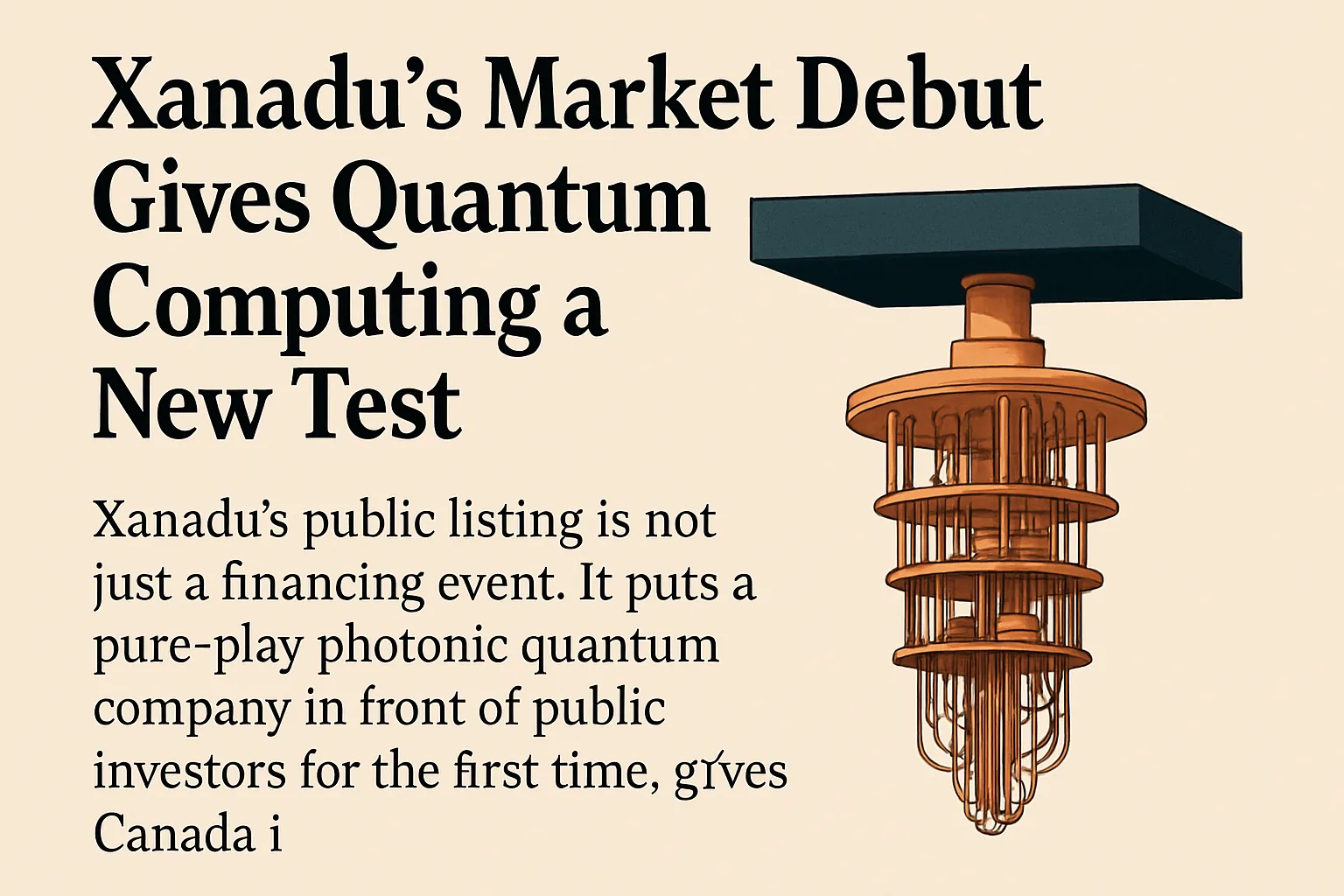
Xanadu Quantum Technologies started trading on the Nasdaq and the Toronto Stock Exchange on March 27, 2026, under the ticker XNDU, closing its first Nasdaq session up 15 percent from a $10 opening price to $11.50. That first-day gain mattered on its own. It mattered more because it arrived during a rough week for the Nasdaq, which BetaKit said had been pushed lower by wider market turmoil tied to conflict in the Middle East.
The Toronto company reached the market through its merger with Philadelphia-based SPAC Crane Harbor Acquisition Corp. The deal delivered about $302 million USD in gross proceeds, according to Xanadu, below the company’s earlier estimate of up to $500 million when the transaction was announced in November. Even so, the listing gives Xanadu something many quantum startups still do not have: public-market access, a large capital base, and a daily price attached to investor belief.
Why this listing stands out
This was not a routine debut. BetaKit notes that Xanadu is the first Canadian technology company to debut on the TSX since 2021. It is also the first pure-play photonic quantum computing company to go public.
Those are two different signals packed into one event. The first is about Canada’s capital markets. Canadian tech has gone through a long public-listing dry spell, especially for companies outside software categories that investors understand quickly. The second is about the quantum sector itself. Investors have had ways to buy into broader quantum narratives before, but Xanadu gives them a more specific bet on the photonics approach.
That distinction matters because quantum computing is not one market story with one technical path. Companies are pursuing superconducting, trapped-ion, neutral-atom, and photonic systems, among others. Xanadu’s CEO Christian Weedbrook told BetaKit that before this listing, investors could not directly invest in the photonics modality. Public-market access now turns that technical choice into an investable thesis.
What public markets are actually pricing
It is easy to read a first-day pop as a verdict on the business. It is usually more limited than that. In a case like Xanadu’s, the market is not pricing mature revenues or a settled product category. It is pricing a bundle of expectations: whether quantum demand will materialize, whether photonics will prove commercially important, whether Xanadu can execute faster than peers, and whether investors are willing to fund a company whose technical milestones may matter more than near-term operating metrics.
That makes the listing interesting beyond quantum. Public markets have been cautious about deep-tech stories that require time, capital, and scientific credibility. Xanadu’s debut suggests there is still room for that kind of company, but on terms public investors will keep revisiting quarter by quarter rather than granting on faith.
The reduced proceeds are part of that picture. Raising roughly $302 million instead of the originally touted upper range does not erase the significance of going public, but it does underline a harsher financing environment than many deep-tech companies imagined a few years ago. Access to capital is still available. It is just more conditional now.
A concrete way to think about it
Consider a pension fund, family office, or retail investor who wants exposure to quantum computing but does not want to make a broad bet on every hardware approach. Until now, that investor had limited ways to isolate a thesis around photonics. Xanadu’s listing changes that.
That does not make the investment simple. It means the market can now ask a narrower set of questions in public: if photonic quantum systems become more practical or scalable, does Xanadu benefit disproportionately? If the modality struggles, does the stock become a direct expression of that doubt? The company’s public status turns an abstract technical debate into something capital markets can track in real time.
Why this matters for Canada
Weedbrook has framed Xanadu’s listing as part of a hoped-for reversal in Canada’s tech IPO drought. That ambition is bigger than one company. For years, Canada has produced research talent, specialized technical companies, and global startup ambitions, but it has not consistently translated that into public-market outcomes at home.
Xanadu’s dual listing is notable here. It did not choose between Toronto and a US exchange; it went to both. That structure recognizes a practical reality. Canadian companies often need domestic legitimacy and US capital-market depth at the same time. Listing on the TSX gives Canada a flagship public tech story it has lacked for several years. Listing on Nasdaq places Xanadu in front of the larger investor audience that usually shapes how frontier-tech companies are valued.
Lisa Lambert, CEO of Quantum Industry Canada, told BetaKit that Canada has played an outsized role in building the quantum era and described the debut as an important step in connecting that leadership to global capital markets. That is probably the cleanest way to read the moment. Canada’s research and startup ecosystem has produced important quantum companies. The missing piece has been a durable bridge from technical leadership to public capital.
What to watch next
The first day of trading was a useful headline, but the harder questions start after the listing celebration fades.
- Whether Xanadu can use its public capital efficiently enough to keep control of its roadmap rather than financing becoming the story.
- Whether public investors stay patient with a quantum company whose milestones may be technical before they are broadly commercial.
- Whether other Canadian deep-tech firms treat Xanadu and General Fusion as evidence that public listings are open again, even if under tighter conditions.
- Whether the market starts differentiating more sharply between quantum computing approaches instead of treating the sector as a single category.
Xanadu has already crossed one threshold: it gave public investors a new type of quantum exposure and gave the TSX a rare technology debut. The harder test is what comes after visibility. Being first can attract attention. It also removes the excuse that the market was not available.
Now Xanadu has to show what a public photonic quantum company looks like when the work resumes and the ticker keeps moving.