
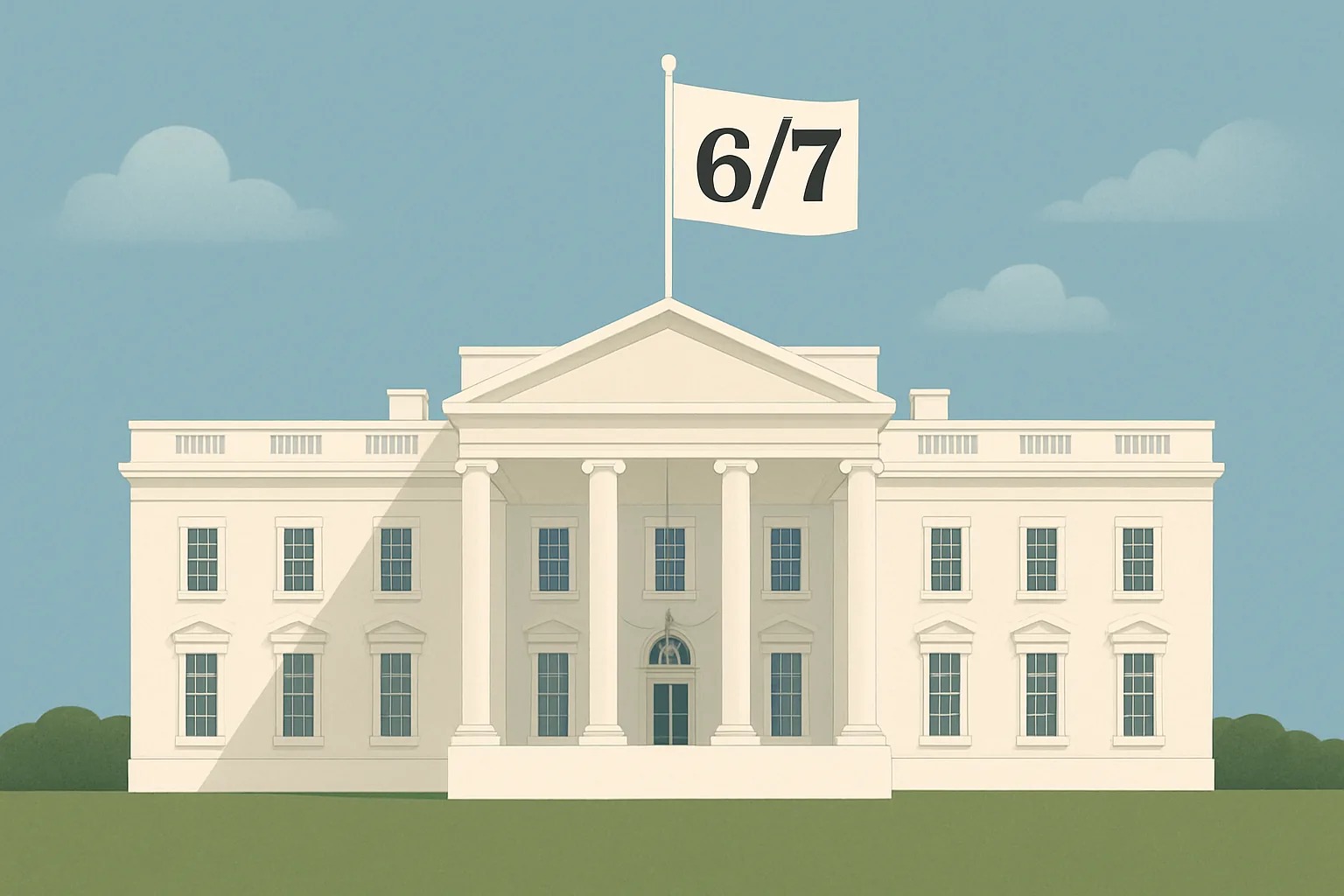
The White House marked June 7 with a meme video built around the Gen Alpha "6-7" joke, turning an intentionally baffling internet catchphrase into official government content.
The clip, posted across official White House social channels on Sunday, June 7, leaned into the date as "6/7 Day." According to TMZ, it included fast-cut visuals, an over-the-top soundtrack, Donald Trump dance clips and a surreal edit that placed Rep. Nancy Pelosi's face onto the smiling baby sun from Teletubbies.
That Pelosi image became the detail people seized on, partly because it was strange and partly because it came from an official White House account. The post was not simply a politician using a popular format. It was a government communications channel borrowing the language of meme pages, where confusion and irritation can be part of the distribution strategy.
What the 6-7 joke was doing there
The "6-7" phrase has circulated as a Gen Alpha meme: a largely meaningless verbal bit often paired with a hand motion that looks like weighing two objects. Its appeal is not in a clean punchline. It works because it is repetitive, absurd and opaque to adults. The fact that many older viewers find it annoying is part of the signal.
That makes it tempting material for social teams. A meme that already confuses adults gives a political account two possible wins. Younger viewers may recognize the reference, while older viewers may share it precisely because they dislike or do not understand it. Either reaction can push the post further.
But the same quality also makes the tactic fragile. Once a phrase becomes legible enough for institutions and restaurant chains to package it, the original audience may already be tired of it. The source material around the weekend framed this tension directly: the internet was gearing up for a June 6 and June 7 "6-7 Weekend," while also asking whether Gen Alpha still cared about the bit.
Brands joined the date-driven moment
The White House was not alone in treating the calendar as content. Texas-based Soules Kitchen launched limited "6-7" chicken nuggets priced at $6.70 during the same weekend, according to the source description.
That promotion is a cleaner commercial version of the same instinct. A restaurant can turn a meme into a limited offer without asking the joke to carry much institutional weight. The product, price and date all line up; the campaign is easy to understand even for people who do not know the full meme history.
Imagine a parent seeing the $6.70 nugget offer because their child keeps saying "six-seven" at home. The parent does not need to love the meme. The promotion gives them a small, concrete way to participate in the joke for one meal. That is a lower-risk use of internet culture than asking an official government account to perform the same joke in a political setting.
Why the White House version lands differently
Political meme-making is not new, and the Trump-era internet playbook has long treated attention as an asset even when the reaction is negative. TMZ described the 6/7 post as part of a familiar White House social strategy: internet humor, trolling and chaotic editing designed to generate reaction.
The important distinction is not whether a government account can be funny. It is what happens when official communication adopts the texture of deliberately low-context online content. A meme page can post a bizarre Pelosi-Teletubbies edit and move on. A government account carries a different expectation: even its jokes are read as signals about taste, priorities and intended audience.
For supporters, that informality can feel like proof that the account understands the modern internet and refuses stiff institutional language. For critics, it can read as unserious or degrading, especially when the content resembles what online users often call "brain rot." Both reactions are predictable, and both can help the post travel.
That is the central tradeoff. Meme fluency can make an institution seem culturally present, but it also exposes the institution to the shelf life of the meme. The faster the trend, the narrower the window between timely and embarrassing.
The practical lesson for marketers and operators
The 6/7 weekend is a useful reminder that trend participation is not one decision. It is three separate decisions: whether the audience still cares, whether the format fits the speaker, and whether the payoff is worth the loss of control once the post leaves the account.
- Timing matters: A trend tied to a date can create urgency, but it also makes late adoption obvious.
- Context changes the joke: The same meme feels different from a restaurant, a creator, a campaign account and the White House.
- Recognition is not the same as relevance: Knowing the slang does not guarantee the intended audience will reward the attempt.
Soules Kitchen's nugget promotion had a simple consumer action attached to it. The White House post had a larger cultural burden: it asked viewers to process youth slang, partisan imagery, official branding and absurdist editing in one package. That complexity is why the conversation quickly shifted from the joke itself to the fact that the White House had posted it.
What to watch next
The next question is whether official political accounts keep pushing deeper into youth meme formats, or whether the backlash around posts like this makes them more selective. The incentive to continue is obvious: chaotic clips can earn attention quickly, especially when outrage and confusion function like free distribution.
For brands, the lesson is narrower but more usable. Date-based meme activations can work when they are small, clear and easy to exit. A limited food item priced at $6.70 can disappear after the weekend. An official political post becomes part of a longer record of how an administration speaks in public.
The 6/7 Day moment may not matter because of the meme itself. It matters because it shows how quickly internet jokes now move from kid slang to restaurant promotions to the center of political communications. By the time everyone can explain the joke, the most online part of the audience may already be looking somewhere else.