
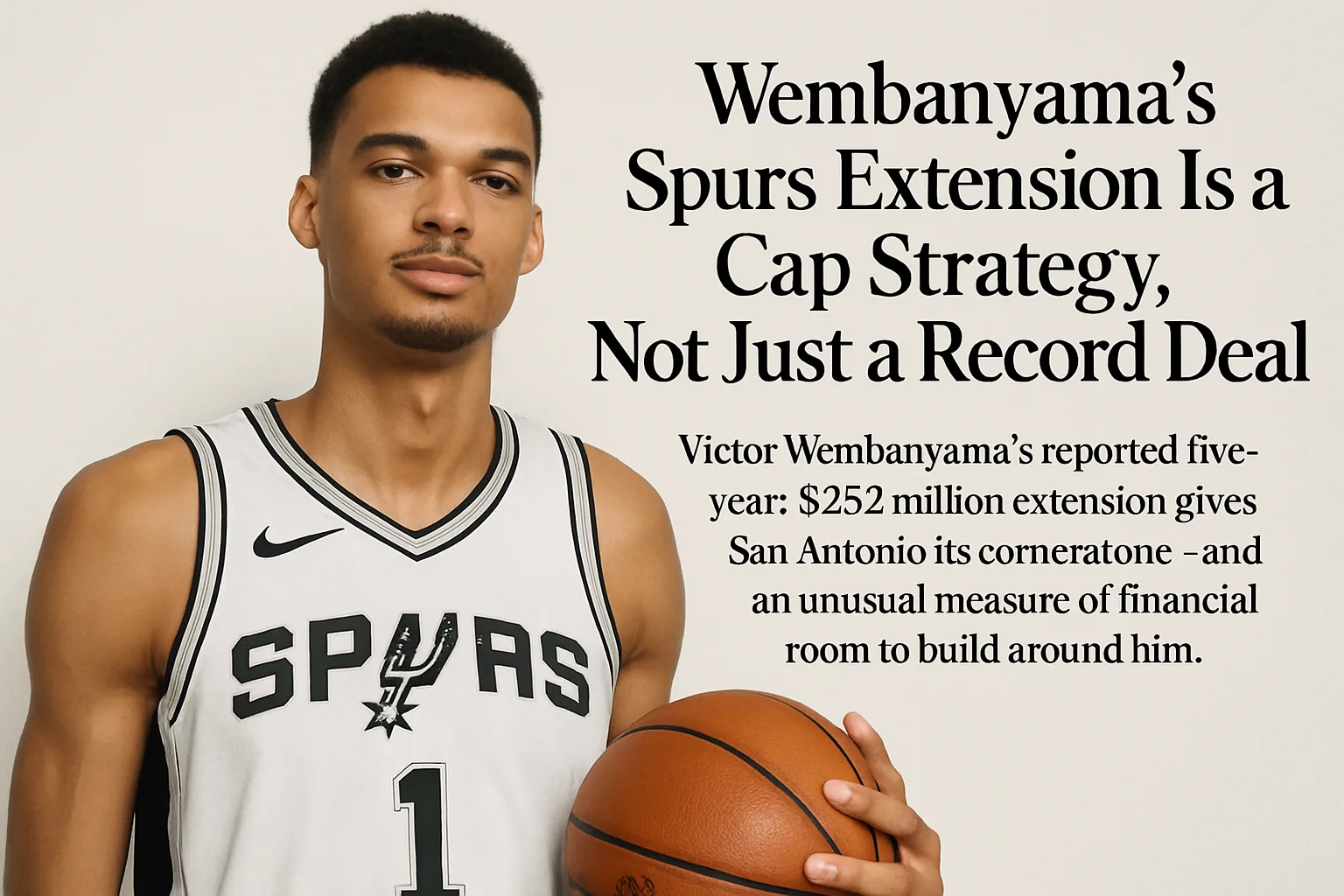
Victor Wembanyama’s reported five-year, $252 million extension with the San Antonio Spurs is the largest rookie extension in NBA history. But the figure alone misses the decision that could shape the next stage of the franchise: Wembanyama reportedly chose a 25% maximum salary rather than a deal with 30% supermax escalators that could have pushed the total above $300 million.
That is not a small contractual footnote. It is a choice that gives the Spurs a clearer financial path to keep improving a team built around a 22-year-old who has already become an All-NBA First Team player and Defensive Player of the Year.
The Spurs confirmed the multi-year extension on July 10. Reporting from ESPN’s Shams Charania put it at five years and $252 million, with a player option in the fifth season. For San Antonio, it secures its franchise player for the years when the organization expects its contention window to be fully open. For Wembanyama, it formalizes a public commitment he had already made to fans: he is staying.
The contract’s real value is the room it leaves behind
NBA salary caps turn even modest percentage differences into major roster choices. A star occupying 30% of the cap rather than 25% does not merely cost the owner more; it reduces the space available for the rest of the rotation and can make the trade-offs sharper when a team wants to retain a second star, pay a rising young player, or add veteran help.
Wembanyama’s reported decision does not hand San Antonio unlimited flexibility. The Spurs still have to make smart personnel decisions, and the cap limits every team eventually. What it does is preserve options at a moment when options are valuable.
It also changes the framing of the deal. A record rookie extension can sound like an endpoint: the star is paid, the business is settled. This one is better understood as a starting point for a roster plan. The money committed to Wembanyama is enormous because his performance warrants it; the money not committed through the escalators may prove just as consequential.
Why Wembanyama had leverage to use
Wembanyama did not make this choice from a position of uncertainty. In his third NBA season, he averaged 25 points, 11.5 rebounds and 3.1 assists in 29.2 minutes per game, while leading the league with 3.1 blocks. He shot 51.2% from the field, 34.9% from three-point range and 82.7% at the line.
Those numbers describe a rare kind of player: a primary offensive option who also changes the geometry of a game defensively. He became the first player since Shaquille O’Neal in 1999-2000 to average at least 25 points, 10 rebounds, three assists and three blocks across a full season. The Spurs were 50-14 with him in the lineup, a 64-win pace, and outscored opponents by 17 points per 100 possessions with him on the floor.
That production is why the higher-max question existed at all. The collective bargaining agreement allows certain players coming off rookie-scale contracts to qualify for a higher percentage of the cap through awards-based criteria often called the Derrick Rose Rule. Wembanyama had the stature and achievements to make a larger outcome plausible. Instead, the reported agreement favors a lower percentage.
A practical way to see the trade-off
Imagine San Antonio reaches an offseason with Wembanyama, a high-level co-star and several productive rotation players already on the books. The club then has an opportunity to add a reliable playoff-caliber contributor through free agency or a trade. In that scenario, the difference between a 25% and 30% cornerstone salary can affect whether the front office can absorb the incoming salary, retain a useful player, or must choose between the two.
There is no guarantee the saved flexibility produces the right acquisition. Cap room is only useful when paired with good scouting, timing and willingness to spend. Still, the Spurs have bought themselves a little more margin for the difficult decisions that arrive once a young contender becomes expensive.
The Spurs know the symbolism, but the work is different now
The move naturally invites comparisons with Tim Duncan, who also accepted a below-maximum arrangement with San Antonio in 2007. The comparison is useful only up to a point. Duncan’s Spurs were already champions; Wembanyama’s Spurs are building toward the stage when every roster slot and financial commitment will be judged against a title standard.
That distinction matters. Wembanyama’s deal is not evidence that a championship roster is complete, nor is it a substitute for player development or sound team construction. It is evidence that the franchise’s most important player and its front office appear aligned on the kind of flexibility required to try.
The fifth-year player option is worth keeping in view, too. It gives Wembanyama a future decision point rather than making the agreement a simple five-year lock-in from the team’s perspective. San Antonio has gained substantial continuity, but it will still need to earn the next commitment by turning its flexibility into a roster that can contend consistently.
What comes next
For the Spurs, the extension shifts the question from whether Wembanyama will be the foundation to how quickly they can build the house around him. The priorities are straightforward, even if the execution is not:
- Identify which current players fit beside a dominant two-way center when the games slow down in the playoffs.
- Use preserved cap capacity selectively instead of treating it as a reason to spend for its own sake.
- Keep enough flexibility to respond when a genuine difference-maker becomes available.
Wembanyama has already supplied the rarest asset in the NBA: a young player who can anchor an elite defense and carry a major offensive burden. By reportedly declining the richer escalator path, he has also made the team-building problem a little less restrictive. That will not make San Antonio’s decisions easy. It should make them more meaningful.