
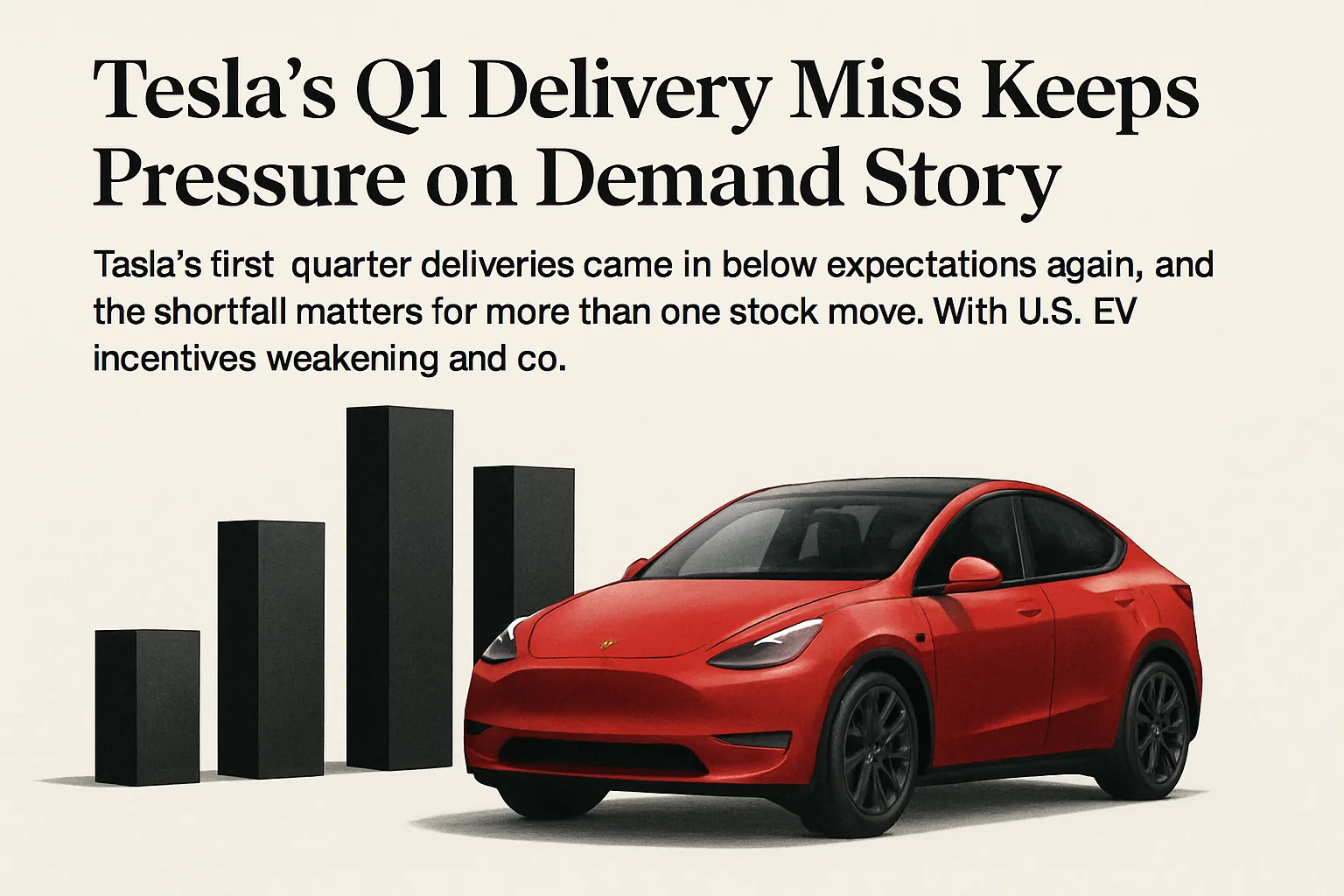
Tesla reported 358,023 vehicle deliveries for the first quarter of 2026 on April 2, missing consensus estimates that had clustered around 366,000 to 372,000. The result was also down sequentially from the fourth quarter, giving Tesla a second straight delivery miss and pushing shares lower as investors reassessed the company’s position in a rougher EV market.
The number matters because deliveries are one of the clearest real-time signals Tesla gives the market before full earnings arrive. A miss does not automatically mean demand is collapsing, but it does narrow the room for optimistic interpretation. When a company long valued as an EV growth leader falls short twice in a row, attention shifts from expansion narratives to harder operating questions: how much demand is there at current prices, how much inventory is building, and how much of the near-term sales picture depends on incentives rather than product pull?
Why the market reacted quickly
The immediate sell-off reflects two pressures hitting Tesla at once.
First, the U.S. incentive backdrop is getting less supportive. When EV subsidies or tax benefits fade, the effective purchase price rises for consumers even if the sticker price does not. That changes conversion rates at the margin, especially for buyers who were already comparing an EV against a gasoline car or a hybrid on monthly payment rather than ideology.
Second, competition is no longer a side note in the Tesla story. Investors have spent years treating Tesla as the company that set the pace for the EV category. But as more rivals fight on price, features, financing, and model variety, Tesla’s delivery numbers carry more information than they used to. A miss in a less crowded market could be shrugged off as timing. A miss in a crowded market invites questions about share, demand elasticity, and brand advantage.
What the Q1 number does and does not say
It would be too much to treat one quarter’s delivery figure as a final verdict on Tesla’s year. Quarterly deliveries can be influenced by production timing, regional shipment patterns, and the mechanics of getting cars to customers before the quarter closes.
Still, the direction is difficult to ignore. The result was below expectations and below the prior quarter, and it followed another miss. That pattern is why the conversation is changing. Investors are not just asking whether Tesla can grow. They are asking what kind of levers Tesla now needs to use to grow, and whether those levers carry a cost.
If Tesla has to rely more heavily on price cuts, financing offers, or incentives to keep volume moving, then the issue is not only unit growth. It is the quality of that growth. Higher deliveries achieved through heavier commercial pressure can help the headline number while still creating stress elsewhere, especially in margins and inventory management.
A simple example of the pressure
Consider a buyer in the U.S. looking at a Tesla and a competing EV in roughly the same budget range. If federal or state incentives become less generous, that buyer’s monthly payment may rise enough to force a pause. At that point, Tesla is not competing in an abstract innovation race. It is competing inside a narrow payment band, where financing terms, discounts, trade-in values, and wait times can decide the sale.
That is why this quarter’s delivery miss matters beyond the headline. A few thousand vehicles below expectations can signal a much larger issue about friction in the buying decision. When the market is easy, that friction gets hidden. When conditions tighten, it shows up in deliveries first.
Why April 22 matters more than usual
Tesla is scheduled to report full first-quarter results on April 22, 2026, and that is where the more useful answers should emerge. The market will be listening for three things in particular: demand commentary, inventory signals, and any update to guidance.
Demand commentary matters because the raw delivery total only shows the outcome, not the cause. Investors will want to hear whether management describes the quarter as mainly affected by temporary conditions or by a more persistent shift in customer behavior.
Inventory matters because it is often where demand softness becomes more visible. If vehicles are taking longer to move, that can force tougher pricing decisions later. A delivery miss on its own is one data point. A delivery miss paired with rising inventory would sharpen the debate.
Guidance matters because this is the point where management has to tell the market whether the year still looks intact. If Tesla sounds confident without offering much detail, investors may stay cautious. If management adjusts expectations, the stock will have to absorb a new baseline.
The broader context for Tesla
Tesla is not operating in the same environment that helped define its earlier growth run. The EV category is now dealing with a more demanding customer, a more competitive field, and less certainty around policy support. That does not mean Tesla has lost its relevance. It does mean the company is being measured against a different standard.
For years, Tesla benefited from being both a category leader and, for many investors, the cleanest public-market proxy for EV adoption itself. When that framing held, disappointing quarters could be treated as temporary noise inside a powerful long-term trend. That gets harder when the policy tailwind weakens and competitors become more credible alternatives.
The practical shift is that Tesla now has to prove not just that EV demand exists, but that its own demand remains strong enough to support the business without increasingly costly interventions. That is a narrower, more operational question than the broad “future of transport” thesis that often dominates Tesla coverage.
What to watch next
The April 22 report will matter less for polished narrative and more for operating clarity. Readers and investors should watch for:
- whether Tesla frames the Q1 shortfall as timing-related or demand-related
- any indication that inventory has increased or that sell-through is slowing
- whether management changes guidance or avoids reaffirming it clearly
- signs that competition and weaker incentives are affecting Tesla unevenly across markets or models
For now, the quarter does not settle the case against Tesla. It does, however, move the burden of proof. After a second straight delivery miss, the market is no longer looking only for growth. It is looking for evidence that Tesla can still generate that growth in a market that is less forgiving than it used to be.