
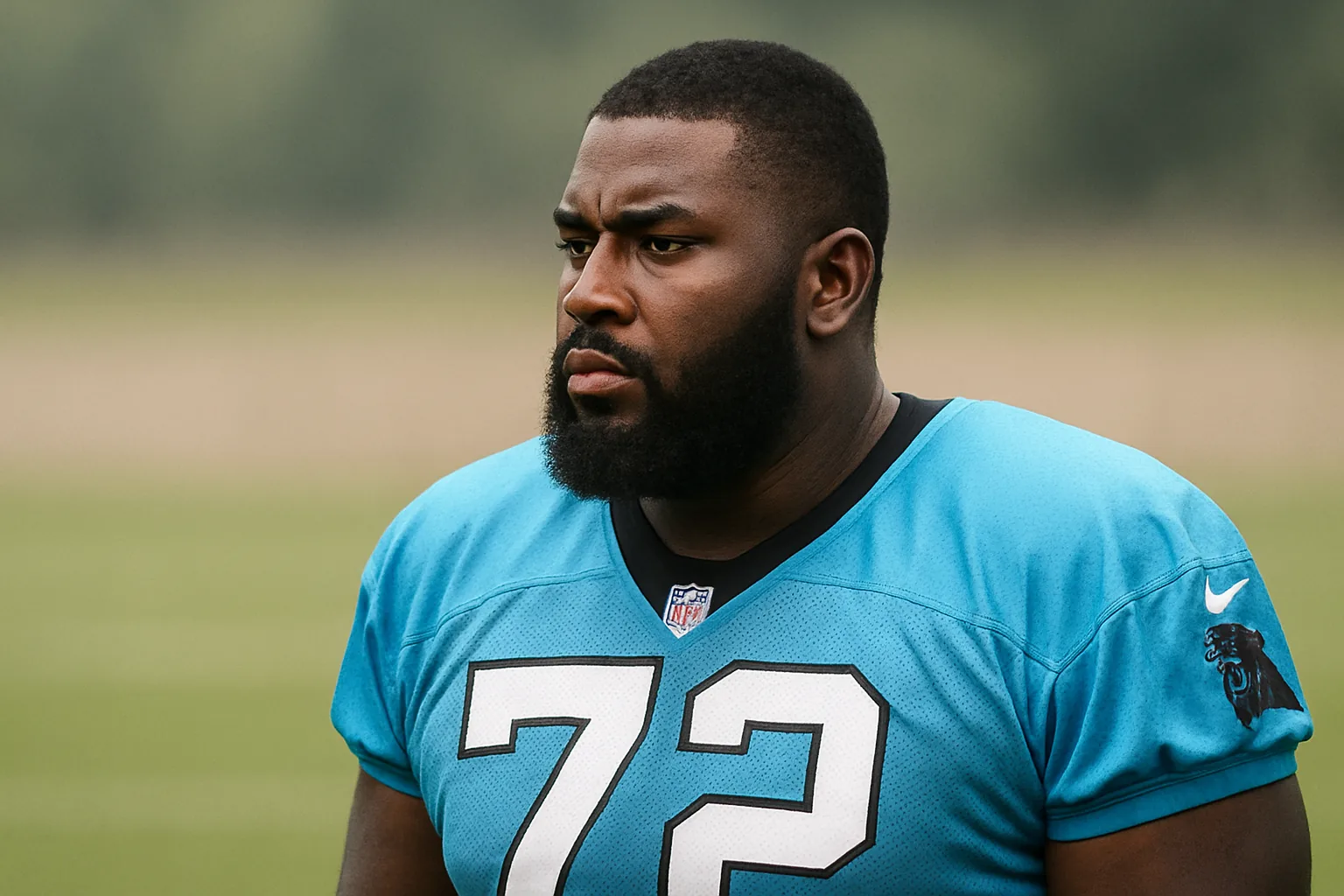
The Carolina Panthers will begin training camp without two veteran starters, but the shared roster designation masks two very different situations.
Cornerback Jaycee Horn and right tackle Taylor Moton are being placed on the reserve/non-football injury list. Horn required stitches after cutting his foot while running and is expected back early in camp. Moton, diagnosed in late June with a blood clot in his lung, will miss the start of the regular season while undergoing treatment.
According to the Panthers’ announcement, Moton was immediately placed on blood thinners, is responding well and will be assessed daily by the team’s medical staff. Carolina expects him to return during the season, although it did not provide a specific timetable.
Horn’s absence creates opportunity, not a major reshuffle
Horn’s injury appears to be the more manageable of the two. Missing early practices is not ideal, but the expectation that he will return during camp limits the need for a lasting change in the secondary.
Carolina also has veteran starter Mike Jackson available. While Horn recovers, the additional practice work can be distributed among fourth-round rookie Will Lee, Corey Thornton and Chau Smith-Wade.
Those repetitions have practical value. Young cornerbacks can be evaluated against first-team receivers and in situations that are difficult to reproduce once the regular-season preparation schedule begins. The Panthers do not need one of them to replace Horn immediately, but camp can reveal which player is best prepared to handle a larger role if another absence occurs later.
The key checkpoint is whether Horn returns as early as expected and has enough time to rebuild his workload before the season. Until that timeline changes, his placement on the list looks like a temporary interruption rather than a defining roster problem.
Moton’s diagnosis changes the early-season calculation
Moton’s absence carries greater football consequences because the Panthers already know it will extend into the regular season. The team must prepare a starting offensive-line configuration without him, not merely cover a few training-camp practices.
Carolina entered the offseason with another tackle issue involving Ikem Ekwonu. It signed veteran left tackle Rasheed Walker as cover and then selected Georgia tackle Monroe Freeling in the first round. Those additions now provide valuable depth, although the Panthers still have to determine how that depth should be arranged while Moton is unavailable.
This is where training camp becomes more than an evaluation period. Coaches need enough time with a prospective replacement to build communication across the line and learn which combinations function reliably. A tackle can win an individual matchup and still struggle if protection calls, handoffs against stunts or timing with the adjacent guard are inconsistent.
A concrete early-game consequence
Consider a third-and-long situation during the opening weeks. With an established starter at right tackle, an offense may be comfortable sending more eligible receivers into routes. With a new combination on that side, coaches could decide to keep a tight end or running back involved in protection or lean on quicker passes.
That does not mean Carolina will adopt such a plan, and the team has not announced one. It illustrates why Moton’s absence reaches beyond a single position: the quality of the replacement can affect how much flexibility the rest of the offense retains.
Depth investments now face an immediate test
Freeling’s draft status will naturally attract attention, but the relevant question is not simply whether a first-round pick can get on the field quickly. Carolina must identify the five-man line that gives the offense its best chance at the beginning of the season while preserving a workable plan for Moton’s eventual return.
Walker offers veteran depth acquired because of Ekwonu’s injury, while Freeling represents a major long-term investment. Their presence gives the Panthers choices that would have been harder to manufacture after camp began. It does not remove the cost of losing a proven starter.
The next meaningful signals will come from practice assignments and preseason lineups: who receives the first opportunities, whether one configuration gains continuity and how the team manages both tackle spots. Moton’s daily medical assessment remains the more important matter, but Carolina cannot build its opening plan around an uncertain return date.
For now, the Panthers have clarity on the broad outlines. Horn is expected to rejoin the secondary early in camp. Moton is progressing under treatment but will be absent when the season begins. One situation gives younger players extra practice work; the other will test whether Carolina’s offseason investment in offensive tackle depth can protect the offense until its veteran starter returns.