
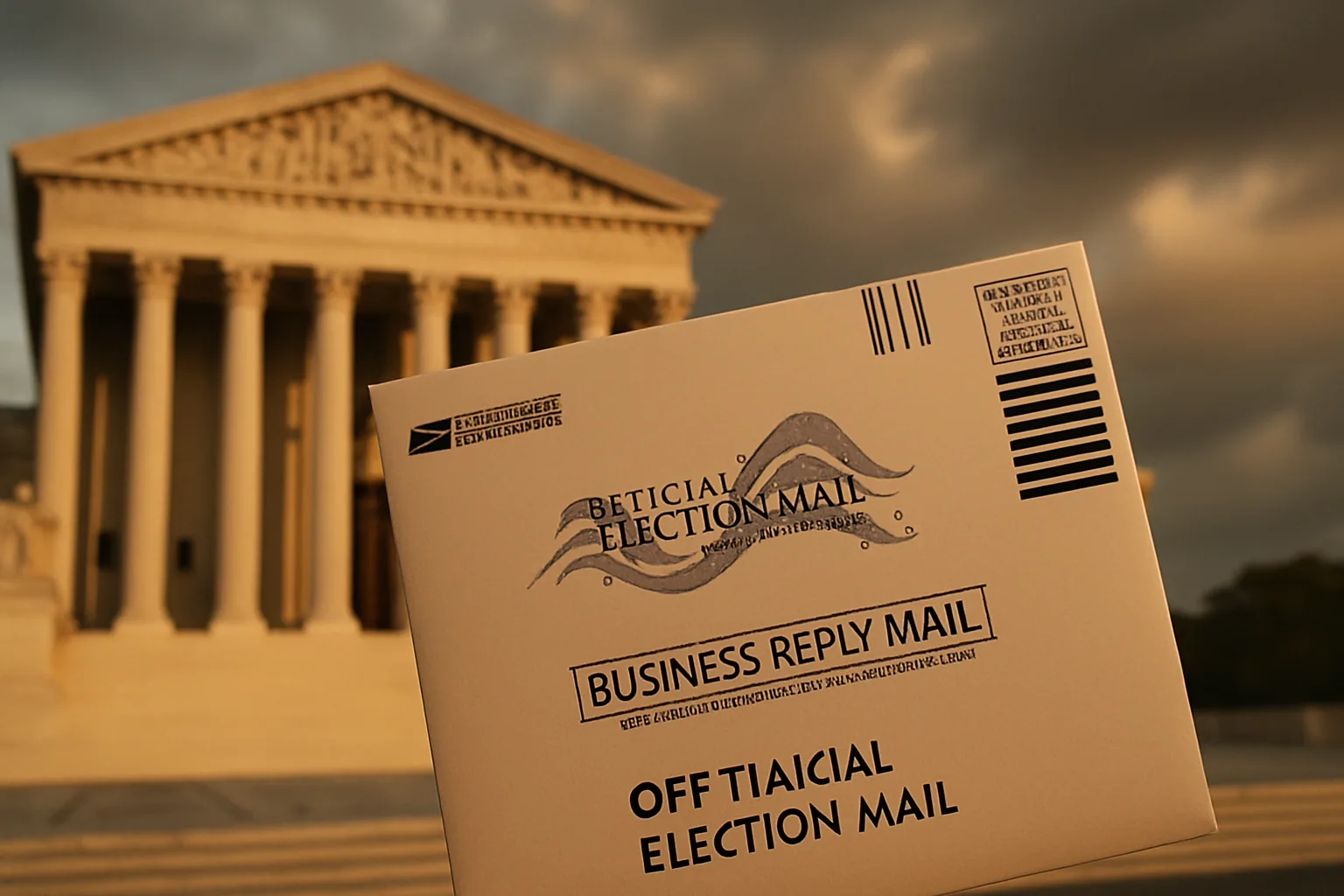
Supreme Court cases about mail voting matter because the most consequential election disputes are often not about dramatic constitutional slogans, but about procedure. Rules governing access, deadlines, verification, and ballot handling can shift who participates, how difficult voting feels, and whether certain groups face more friction than others. That is why a case that could curtail mail voting in the 2026 midterms deserves close attention even if it arrives wrapped in technical legal language.
The significance lies in how procedural rulings shape the electorate without always looking like major political events. Voters do not experience these decisions as abstract doctrine. They experience them as whether a ballot arrives on time, whether it is accepted, and whether the process feels reliable enough to trust. In that sense, election law often changes democratic participation through administrative design more than through overt exclusion.
Why mail voting remains politically charged
Mail voting sits at the center of a larger argument about convenience, security, and institutional trust. Supporters see it as a practical way to expand access, especially for voters with work, caregiving, disability, or transportation constraints. Critics often frame restrictions as necessary safeguards. The disagreement is therefore not only about ballots in envelopes. It is about what trade-offs a democracy is willing to accept in the name of participation and confidence.
This is why litigation in this area matters so much. The legal question may be narrow, but the political implications usually reach well beyond the immediate rule.
Why procedural burdens rarely fall evenly
Even small restrictions can have unequal effects. Voters with stable schedules, strong institutional familiarity, and easier access to transportation or information can absorb extra steps more easily than those already navigating multiple constraints. That means a rule that looks facially neutral may still change the electorate in practice by raising the cost of participation selectively.
Courts do not always measure those effects the same way policymakers or organizers do, which is part of what makes these cases so consequential.
A useful way to frame it is this: election procedure is political not because every rule is partisan by design, but because every rule changes the lived difficulty of participating for someone.
Why the timing matters ahead of midterms
Rulings issued before a national election cycle can influence administrative planning, campaign strategy, and voter confidence months before ballots are cast. Parties begin adapting early, and confusion itself can suppress participation if voters are uncertain about what still applies. A legal decision therefore does not need to transform the rules entirely to have meaningful practical effect.
This is one reason midterm-related election cases command so much attention. They alter the terrain on which organization, turnout, and trust are built.
What to watch next
The key questions are whether the Court narrows or broadens the practical availability of mail voting, how states interpret the ruling operationally, and whether voter education keeps pace with any change. Those implementation details will determine how large the real-world impact becomes.
That is why the case matters. It is a reminder that democratic access is often shaped quietly, through process, long before the public experiences the consequences at the ballot box.
When courts adjust election procedure, they are also adjusting the everyday conditions under which participation becomes easy, hard, or uncertain.