
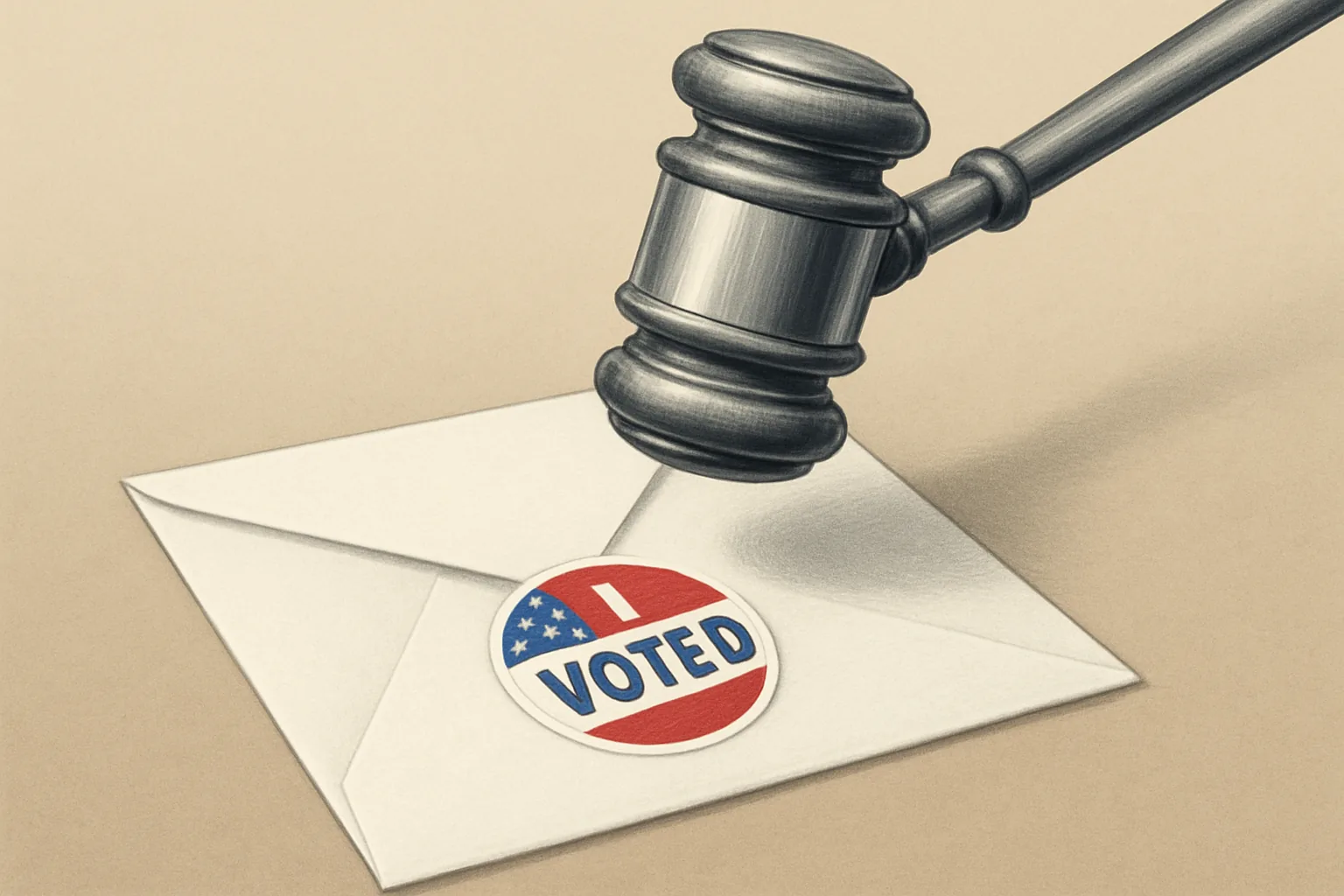
The Supreme Court’s March 23 hearing on mail ballots put a narrow-sounding election rule at the center of a much larger question: who gets to decide when a validly cast ballot stops counting.
The case, centered on Mississippi, asks whether states can count mailed ballots that arrive after Election Day if they were postmarked on time. Reporting from the hearing suggests several justices were skeptical of those grace-period laws. The practical stakes came into focus the next day, when election officials warned that a ruling against them would force fast changes before the 2026 midterms in 14 states and Washington, D.C.
That matters because this is not really a dispute about a handful of tardy envelopes. It is a dispute about whether states can treat the act of voting by mail as complete when the voter meets the deadline, or only when the postal system does.
What is actually at issue
Some states require mail ballots to be received by Election Day. Others allow a short grace period, usually on the condition that the ballot was postmarked by Election Day. Those laws are meant to handle a simple problem: voters can do everything right and still lose their vote because mail delivery is not perfectly predictable.
The challenge now before the Court could wipe out that flexibility. If the justices conclude that ballots arriving after Election Day cannot be counted, even when mailed on time under state law, the result would not just affect Mississippi. It would set a national constraint on how states administer mail voting.
That is why election officials are already talking about implementation, not just legal theory. A decision landing close to the midterms would leave little room to update deadlines, voter guidance, ballot-tracking language, staff procedures, and public education.
Why this matters beyond the courtroom
The immediate issue is administrative, but the consequences are political and civic.
Mail voting works only when voters understand the rule and trust that following it is enough. Grace-period laws give states a buffer between voter action and postal delivery. Remove that buffer, and the burden shifts sharply onto voters, who would need to mail ballots earlier to protect themselves against delays they cannot control.
That sounds modest until you think about how people actually vote. Not everyone mails a ballot a week early. Some voters wait until late in the window because they are busy, uncertain, traveling, caregiving, or simply relying on the deadline printed by the state. In places where postmark-by-Election-Day rules are currently valid, those voters are following the rules as written.
If the Court says that is no longer enough, the legal change would be clean. The operational change would not be. States would have to retrain election workers and rewrite instructions fast, while voters would be asked to internalize a stricter standard in the middle of a federal election cycle.
A concrete example
Take a voter in a grace-period state who fills out a mail ballot on the Monday before Election Day and sends it that afternoon. The ballot is postmarked on time, exactly as state law requires. But the mail takes an extra day or two, and the ballot reaches election officials after Election Day.
Under a grace-period system, that vote may still count because the voter met the deadline the state set. Under the rule the Court appears open to, that same ballot would be rejected.
The difference is not whether the voter acted lawfully. It is whether the postal delay becomes the voter’s problem.
The political backdrop is obvious, but the institutional point is bigger
The Associated Press notes that these laws have been a target of President Donald Trump. That gives the case a familiar partisan frame. But the deeper significance is institutional: the Court may be deciding how much room states have to manage the mechanics of modern elections.
Election administration has always involved timing rules, receipt rules, cure rules, and counting rules. States make those choices because voting is not one uniform act. In-person voting, early voting, absentee voting, and mailed ballots each create different logistical problems.
A ruling against grace periods would narrow that state discretion at a point where mail voting has become a normal part of election administration, not an exception. Even states that do not rely heavily on late-arrival windows would need to pay attention, because the reasoning could shape future disputes over ballot deadlines and processing rules.
What election officials are worried about
The warning from officials the day after the hearing is notable because it shifts the conversation from ideology to operations. Courts can announce a rule in one sentence. Election systems then have to translate that sentence into forms, websites, envelopes, training manuals, public hotlines, and voter behavior.
If 14 states and Washington, D.C., need to adjust quickly, several pressures appear at once:
- Voter instructions may need to change so people mail ballots earlier than they do now.
- Election offices may need new messaging campaigns to avoid avoidable ballot rejection.
- Any confusion could fall hardest on voters who already depend most on mail voting or who have less room to absorb a missed deadline.
That last point is important even without stretching beyond the source. Any rule that eliminates a grace period makes timing less forgiving. Less-forgiving systems tend to produce sharper consequences for ordinary delays.
What to watch next
The first thing to watch is the scope of the eventual ruling. The Court could issue a narrow decision tied closely to the legal question before it, or a broader one that leaves states with little room to preserve any post-Election-Day receipt window.
The second is timing. A decision that arrives with limited lead time before the 2026 midterms would create a harder transition than one that gives states months to adjust their rules and voter communications.
The third is the public explanation from states that would be affected. If the rule changes, the most important political argument may not happen in court filings at all. It may happen in the plain-language guidance states send to voters: when ballots must be mailed, whether drop boxes or in-person return options become more important, and how voters are supposed to avoid losing a ballot they believed was timely.
The legal issue before the Court is crisp. The real-world effect is not. If the justices strike down grace-period laws, the 2026 midterms will not just run under a different counting rule. They will run under a different assumption about responsibility: the voter must not only vote on time, but also outpace the mail.