
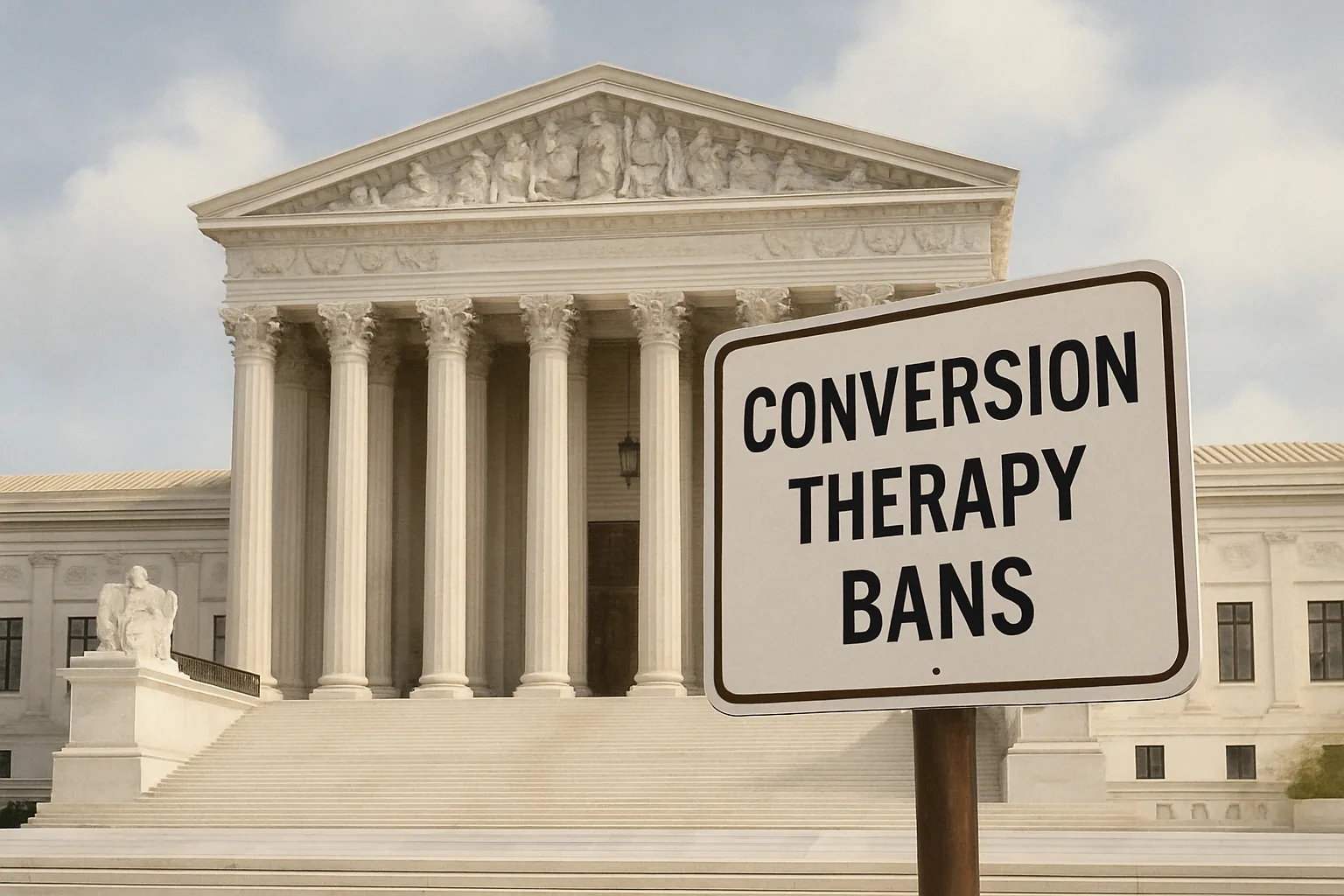
The Supreme Court’s March 31 ruling in Chiles v. Salazar sharply changes the legal terrain around state bans on conversion therapy for minors. In an 8-1 decision, the court said Colorado’s law, as applied to a licensed counselor’s talk therapy, likely violates the First Amendment because it regulates speech based on viewpoint.
That matters beyond Colorado. About two dozen states have adopted similar restrictions, often built on the idea that licensed therapy can be regulated as professional conduct. The court did not accept that framing here. Instead, Justice Neil Gorsuch’s opinion treated the case as one about speech itself, and specifically about the state allowing one therapeutic message while forbidding another.
The immediate legal result was narrow but consequential. The justices did not issue a final nationwide rule invalidating every conversion-therapy ban. They sent the case back to the 10th Circuit and said the lower courts failed to apply the level of First Amendment scrutiny the Constitution requires when a law appears to discriminate by viewpoint. That is a serious problem for Colorado, because laws subjected to that standard rarely survive.
What the court actually decided
The opinion is easy to misread if it is flattened into a culture-war headline. The court did not declare conversion therapy effective, reputable, or harmless. The source material describes the practice as discredited, and the ruling does not dispute that characterization. The justices instead focused on whether the government can ban a category of conversations between counselor and client because it disfavors the direction or goal of that speech.
Gorsuch wrote that Colorado’s law “censors speech based on viewpoint.” That phrase is the center of the case. A state has wider latitude when it regulates conduct, licensing, or medical procedures. It has much less room when it decides that one side of a counseling conversation is permissible and the other is forbidden.
The coalition behind the ruling is notable too. Gorsuch wrote for the court, but liberal Justices Elena Kagan and Sonia Sotomayor joined the result through Kagan’s concurrence. That does not erase the ideological stakes, but it does suggest the free-speech issue was strong enough to attract support beyond the court’s conservative bloc. Justice Ketanji Brown Jackson dissented.
Why this matters outside Colorado
The ruling places other state laws in immediate doubt because many were drafted with the same basic theory: that states may prohibit licensed mental-health professionals from trying to change a minor’s sexual orientation or gender identity through counseling. If those laws are challenged as speech restrictions rather than professional-conduct rules, states now face a tougher constitutional test.
This is the practical shift. Before this case, states defending these bans could argue they were regulating a harmful practice within the ordinary power to oversee licensed professionals. After this decision, challengers have a clearer path to say the state is not just regulating therapy standards. It is policing which viewpoints a therapist may express in session.
That does not mean every law will fall in exactly the same way. Statutory wording matters. So do the details of how a law defines prohibited conduct, what exceptions it contains, and whether it reaches speech, physical interventions, or both. But the court has signaled that a broad category of state counseling regulations is now vulnerable.
The line the court did not cross
Just as important is what the ruling did not settle. The source material makes clear that the decision targets talk therapy. It does not resolve how far states may go in restricting physical interventions or other forms of treatment. That distinction will now matter more in legislation, litigation, and political messaging.
Lawmakers who want to preserve protections for minors may have to draft more carefully, separating speech-based restrictions from non-speech medical regulation. Opponents of these laws, meanwhile, will likely press the point that once a state enters the therapy room and permits one message while banning another, it risks crossing into unconstitutional censorship.
That line is not just technical. It will shape how future laws are defended. A statute framed as a ban on a therapist’s words is now in greater danger than one framed around procedures, informed consent, licensing standards, or demonstrable misconduct.
A concrete example of what changes
Consider two simplified scenarios grounded in the court’s reasoning.
In the first, a licensed counselor speaks with a minor who wants help reducing same-sex attraction or becoming more comfortable with a birth sex they no longer identify with. If state law forbids that conversation because it aims in one direction, while allowing counseling that affirms the opposite outcome, the court now sees a serious First Amendment problem.
In the second, a state regulates a physical intervention or a non-speech treatment protocol for minors. The March 31 ruling does not answer whether that restriction is constitutional, because the opinion was aimed at talk-based therapy. That difference will define the next round of lawsuits.
This example is why the decision will ripple through legislatures. The constitutional weakness is not simply that the state regulated therapists. It is that the regulation appears tied to the message being conveyed.
The political response will be fast, and messy
The source material notes swift political reactions, which is unsurprising. The issue sits at the intersection of LGBTQ+ rights, child welfare, religious liberty, professional licensing, and free speech. Each side now has a talking point that is partly true and partly incomplete.
Supporters of the ruling will say the court defended the First Amendment against government-enforced orthodoxy. Critics will say the decision weakens protections against a practice many medical and advocacy groups regard as harmful. Both reactions fit the moment, but neither fully captures the legal significance.
The real story is that the court has changed the argument’s structure. The next fights are less likely to turn on whether conversion therapy is broadly accepted or condemned. They are more likely to turn on how the law classifies therapy itself: speech, conduct, medical treatment, or some mix of the three.
What to watch next
The first thing to watch is the remand to the 10th Circuit. Colorado still gets a chance to defend its law under the stricter standard the Supreme Court says should apply, but the odds are difficult.
The second is copycat litigation. States with similar laws should expect new challenges, especially where statutes explicitly target counseling conversations rather than non-speech conduct.
The third is legislative revision. Some states may try to narrow their laws to reduce viewpoint-discrimination problems. Others may hold their ground and invite a more direct confrontation in the courts.
What the Supreme Court did here was not to settle the country’s argument over conversion therapy. It did something more specific and, in legal terms, more disruptive: it told states that if they want to regulate this area, they may not be able to do it by deciding which therapeutic viewpoints are allowed inside the counseling room.