
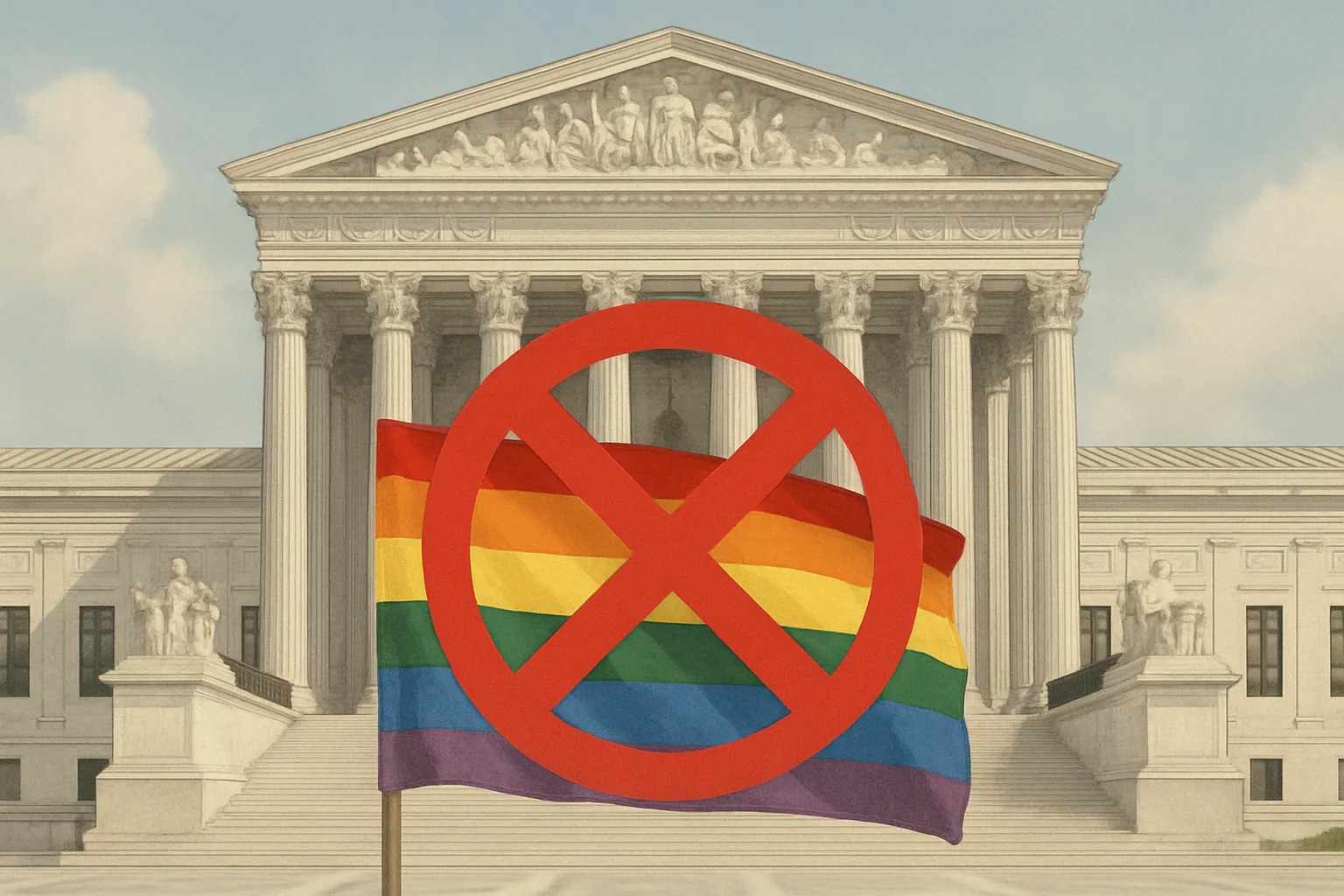
The Supreme Court has made Colorado’s ban on conversion therapy for minors far harder to defend, and it may have done the same to similar laws in about two dozen states.
In an 8-1 decision issued March 31, the Court sided with a Christian counselor who argued that Colorado’s 2019 law, as applied to talk therapy, violates the First Amendment. The justices did not hand down a final nationwide rule wiping out every state ban. Instead, they sent the case back to a lower court with a clear instruction: evaluate the law under strict scrutiny, the most demanding form of constitutional review.
That shift matters because few laws survive that standard. In practical terms, the Court has not finished the legal fight, but it has changed the battlefield.
What the Court actually said
Justice Neil Gorsuch, writing for the majority, said Colorado’s law “censors speech based on viewpoint.” That phrase is doing most of the work here. The Court is treating the state’s restriction on counseling conversations not simply as professional regulation, but as a form of speech regulation tied to what can and cannot be said in therapy.
Gorsuch also wrote that the First Amendment “stands as a shield against any effort to enforce orthodoxy in thought or speech in this country.” That framing pushes the case beyond a narrow dispute over licensing rules. It places the law inside one of the Court’s most speech-protective constitutional categories.
The lineup was notable. Liberal Justices Elena Kagan and Sonia Sotomayor joined the majority, suggesting this was not a conventional ideological split where the conservative bloc moved alone. The broad vote strengthens the signal to lower courts that the issue is serious and that older assumptions about these laws may no longer hold.
Why this is bigger than Colorado
Colorado is the immediate case, but the real stakes sit elsewhere. Roughly two dozen states have enacted bans on conversion therapy for minors. If those laws also depend on restricting what licensed counselors may say in talk therapy sessions, they now face a much steeper constitutional climb.
That does not mean every ban automatically falls. It does mean states will have to justify these laws under a test designed to be hard to satisfy. Strict scrutiny generally requires the government to show not just an important interest, but a compelling one, and to prove the law is narrowly tailored to achieve it.
States defending these bans will likely point to the same core argument they have made for years: conversion therapy is discredited and harmful, especially for minors. Supporters of the laws also argue that states routinely regulate licensed professions to protect patients. The Court’s opinion does not erase those concerns. But it says those public-health arguments are not enough to avoid the First Amendment problem once the law is understood as viewpoint-based speech regulation.
That distinction is what could reshape policy. A state may believe it is regulating professional conduct. The Court is warning that, at least for talk therapy, it may instead be controlling speech.
What this means in practice
A simple example shows why the ruling matters beyond legal theory.
Imagine a licensed counselor working with a 16-year-old who is distressed about sexual orientation or gender identity. If state law allows one set of therapeutic conversations that affirm the minor’s identity but forbids another set aimed at changing it, the state may view that as a health-and-safety rule. After this ruling, challengers can argue the law turns on the viewpoint expressed in the session itself.
That is the constitutional opening the counselor in the Colorado case used, and the Supreme Court accepted it.
For lawmakers, the immediate problem is that many existing statutes were built around exactly that distinction. They were designed to stop a discredited practice by prohibiting certain therapeutic goals or messages. If courts now see those bans as viewpoint discrimination in speech, legislatures may need to rethink how the laws are written, what conduct they target, and whether talk therapy can be restricted in the same way at all.
The political fallout starts now
The policy reaction was immediate for a reason. Advocates for LGBTQ+ youth see the ruling as a direct threat to protections they consider basic and overdue. State officials, meanwhile, are left to decide whether to keep defending existing statutes, rewrite them, or search for narrower approaches that might survive judicial review.
The decision also lands in a larger pattern. In recent years, the Court has repeatedly shown willingness to treat speech claims expansively, including in disputes involving professional regulation, religious plaintiffs, and contested social policy. This case fits that trajectory. Even when the subject is a licensed profession and a politically charged issue, the Court is prepared to ask whether the government is punishing speech because of the message it carries.
That does not resolve the underlying moral or medical debate. It does shift where future battles will be fought. Instead of arguing only about whether conversion therapy is harmful, states may now have to answer a tougher constitutional question: how do you protect minors without writing a law that a court sees as suppressing disfavored speech?
What to watch next
The next step is the lower court review. Because the Supreme Court sent the case back rather than fully disposing of it, the legal record is not closed. The lower courts now have to apply strict scrutiny to Colorado’s law as it relates to talk therapy.
Three things are worth watching:
- Whether Colorado can persuade the courts that its law survives strict scrutiny despite the Court’s skepticism.
- Whether other states face immediate copycat challenges to their own bans.
- Whether legislatures try to rewrite existing statutes to focus more narrowly on conduct, licensing standards, or other regulatory tools rather than directly restricting counseling speech.
The important point is that the Supreme Court has not merely tweaked the legal test. It has made the First Amendment central to this fight. For supporters of these bans, that is a serious setback. For opponents, it is an opening with national consequences.
And for everyone else, the lesson is straightforward: when the Court classifies professional counseling as protected speech and sees the state as regulating viewpoint, the question is no longer just whether a law is well-intentioned. It is whether it can survive the Constitution’s hardest exam.