
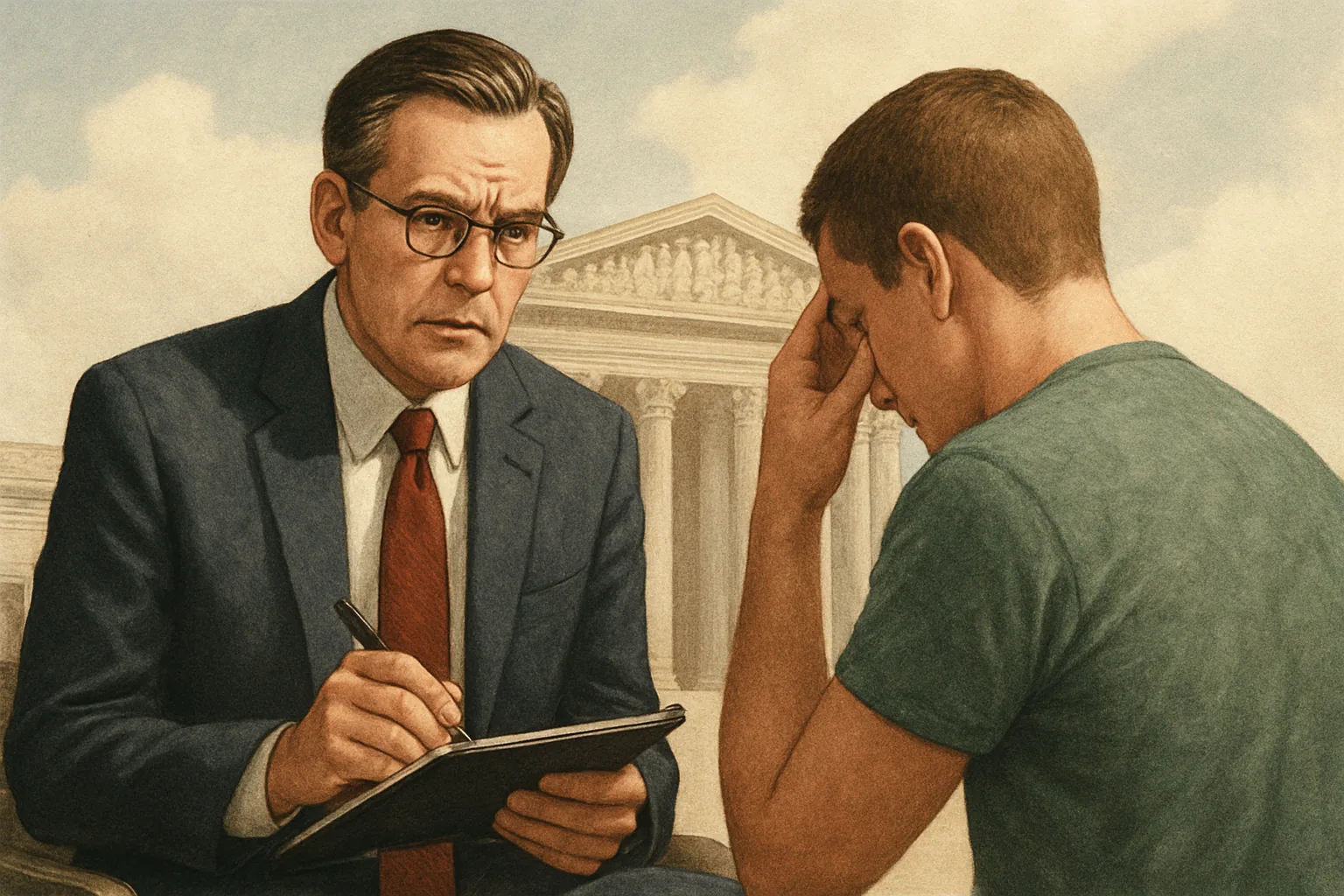
The U.S. Supreme Court has dealt a major blow to Colorado’s ban on conversion therapy for minors, ruling 8-1 that the law, as applied to a counselor’s talk therapy, is presumptively unconstitutional because it targets speech based on viewpoint.
That distinction matters. The court did not say conversion therapy is sound, effective, or socially desirable. The source material describes the practice as discredited. What the justices said instead is that Colorado cannot regulate a counselor’s speech in this setting without facing a much more demanding First Amendment test than lower courts used before.
The immediate result is procedural but important: the justices vacated the lower-court ruling and sent the case back for review under heightened scrutiny, a standard few laws survive. In practical terms, that means Colorado’s law is in serious trouble, and so are similar laws in roughly two dozen other states if they rest on the same legal theory.
What the court actually decided
Justice Neil Gorsuch, writing for the court, said Colorado’s law “censors speech based on viewpoint.” The court’s formal holding, as provided in the source material, was that the law banning conversion therapy, when applied to the petitioner’s talk therapy, regulates speech based on viewpoint and that lower courts failed to apply sufficiently rigorous First Amendment scrutiny.
The vote was not close. Gorsuch was joined by a broad majority that included liberal Justices Elena Kagan and Sonia Sotomayor. Justice Kagan also wrote a concurrence, joined by Sotomayor. Justice Ketanji Brown Jackson dissented.
That lineup is part of the story. Cases framed as fights over LGBTQ+ rights often break along familiar ideological lines. This one did not. The majority’s cross-ideological makeup suggests the court saw the case less as a direct referendum on LGBTQ+ policy and more as a speech case about what the government can tell licensed professionals they may or may not say in a conversation.
Why this matters beyond Colorado
Colorado is not an outlier. The source says about two dozen states have banned conversion therapy for minors. Many of those laws were written on the assumption that states have wide room to regulate professional conduct, especially when minors are involved and lawmakers say they are preventing harm.
The Supreme Court’s ruling does not erase that concern. It changes the legal terrain underneath it. If a ban is treated as viewpoint-based speech regulation rather than ordinary professional regulation, the state’s burden becomes much heavier. It is no longer enough to say the legislature acted in the interest of child welfare. The state now has to justify why this specific speech restriction can survive a much tougher constitutional review.
That shift could ripple quickly. Laws that once looked settled because lower courts treated them as regulation of professional practice may now have to be defended as speech restrictions. For states that copied one another’s language or logic, one adverse ruling can suddenly make a whole category of laws look vulnerable.
The legal line the court is drawing
The decision also sharpens a recurring constitutional fight: when does regulating a profession become regulating speech?
States license doctors, lawyers, therapists, and other professionals all the time. They can prohibit fraud, punish malpractice, and set standards of care. But this case pushes on the boundary between conduct and conversation. Colorado argued it was regulating a therapeutic practice. The majority, based on the source material, treated the law as targeting what a counselor says depending on the viewpoint expressed.
That is why the opinion may matter well beyond conversion therapy. Once the court labels a law viewpoint-based, it is no longer dealing with routine occupational rules. It is dealing with one of the most constitutionally suspect forms of speech regulation.
A concrete example of what changes
Consider a licensed counselor meeting with a teenager and parents. If the state allows affirming conversations about a young person’s sexual orientation or gender identity but forbids counseling speech aimed at changing or suppressing those feelings, the court appears to see that as a viewpoint problem, not just a medical one.
That does not mean every counseling restriction is unconstitutional. It does mean the state has a harder job if the law turns on which perspective the counselor expresses in the room. After this ruling, courts reviewing these laws will likely focus less on the label “professional regulation” and more on the mechanics of the conversation being restricted.
What the ruling does not settle
The court did not issue a broad declaration that every conversion-therapy ban is unconstitutional. It ruled on Colorado’s law as applied to a counselor’s talk therapy and sent the case back. That leaves room for more litigation over how states draft and defend these laws.
States may now try to argue that some restrictions target conduct rather than viewpoint, or that certain licensing rules can be written more narrowly. Opponents of the bans, meanwhile, have a clear constitutional template: characterize the law as a content- and viewpoint-based speech restriction and force the state to survive heightened scrutiny.
That next phase matters because the case is not ending with this decision. It is moving into a tougher round for Colorado and potentially opening a path for new challenges elsewhere.
What to watch next
There are three practical questions after this ruling.
- Whether lower courts read the decision narrowly, applying it only to Colorado’s specific statute and facts, or broadly to similar bans around the country.
- Whether states try to revise existing laws to frame them more explicitly as regulation of professional conduct rather than therapist speech.
- Whether this opinion becomes a building block for challenges to other licensing rules that affect what professionals can say to clients or patients.
That last point may outlast the conversion-therapy fight itself. The strongest immediate consequence is for state bans affecting counseling for minors. The longer-term consequence may be a more speech-protective court doctrine for licensed professionals generally.
For supporters of conversion-therapy bans, the ruling is a serious setback because it puts a widely shared policy goal into a constitutional box that is hard to escape. For civil libertarians, including some who may dislike the underlying practice, the opinion reinforces a familiar First Amendment principle: the government is on dangerous ground when it permits one side of a contested conversation and forbids the other.
The court has not resolved the moral or medical debate. It has changed the legal one. That is enough to reshape the next wave of litigation.