
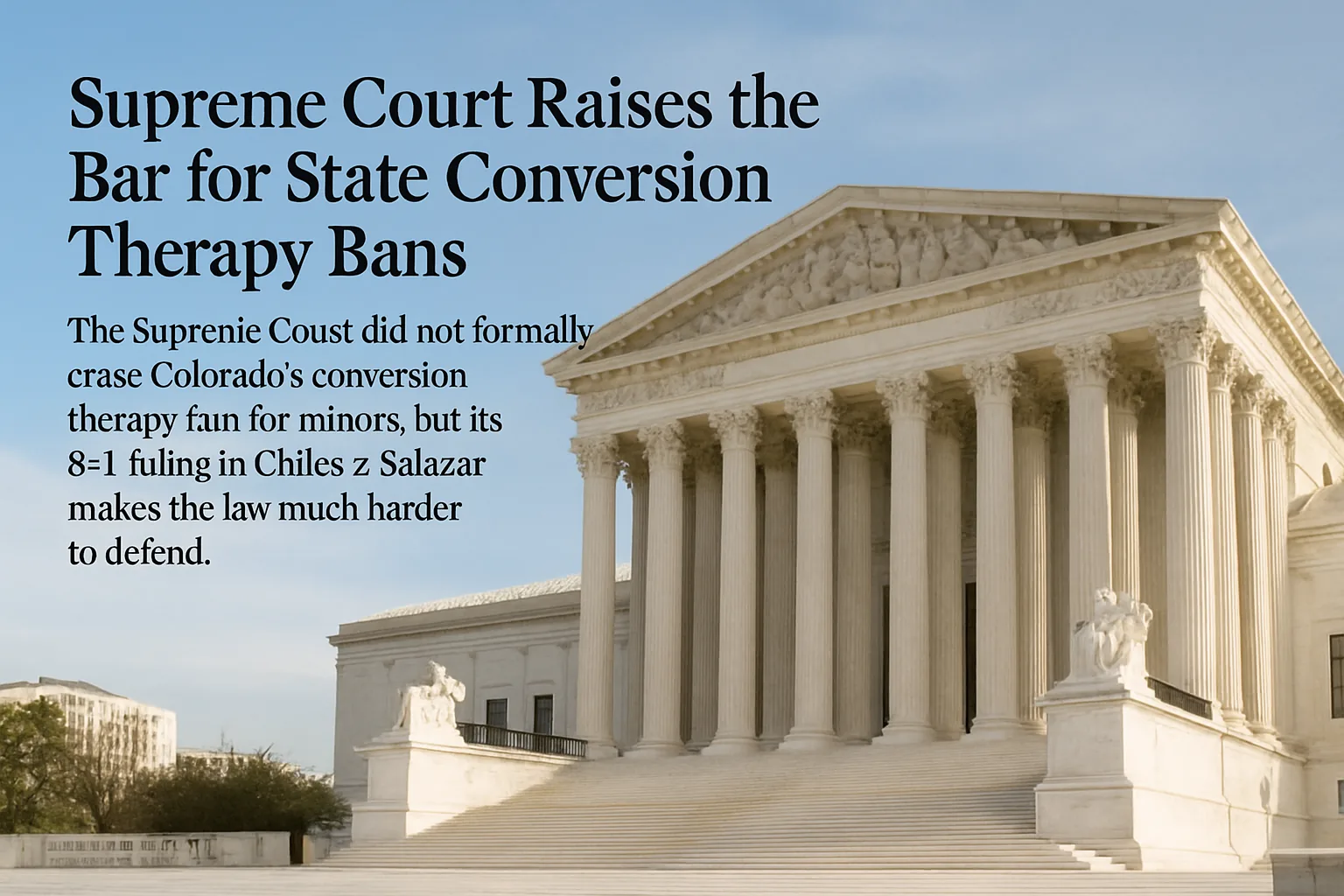
The Supreme Court has handed opponents of state conversion therapy bans their strongest ruling yet. In Chiles v. Salazar, an 8–1 majority said lower courts used the wrong constitutional test when they upheld Colorado’s 2019 ban on licensed counselors providing talk-based conversion therapy to minors, and sent the case back for another look under strict scrutiny, the toughest standard in First Amendment law.
That procedural posture matters, but so does the Court’s language. Justice Neil Gorsuch’s opinion did not just say the 10th Circuit moved too quickly. It said Colorado’s law, as applied to counselor Kaley Chiles, appears to regulate speech based on content and viewpoint. That is the kind of framing that makes a law exceptionally hard to defend.
The practical result is straightforward: Colorado’s ban was not immediately wiped off the books, but the state now faces a much steeper constitutional climb. And because more than 20 states have passed similar restrictions, the ruling reaches well beyond one counseling practice in one state.
What the Court actually did
Chiles, a licensed counselor, argued that Colorado’s law barred her from engaging in conversations her clients wanted to have. She said she does not try to “convert” clients, but works with their stated goals, which can include reducing unwanted sexual attractions, changing sexual behaviors, or seeking what she describes as harmony with their physical body.
The Court sided with her on the central First Amendment question. The majority concluded that the law targets what a counselor may say depending on the viewpoint expressed in therapy. If a law allows one set of conversations but forbids another because of the perspective conveyed, the Court signaled, ordinary deference to professional regulation is not enough.
That is why the justices reversed the 10th Circuit and required strict scrutiny on remand. Under that test, Colorado must show the law serves a compelling interest and is narrowly tailored to achieve it. The source material makes clear the majority also strongly hinted the statute may fail that test.
Justice Ketanji Brown Jackson dissented. Her warning was not abstract. She argued the ruling could open the door to unsafe care by limiting the ability of states to supervise licensed professionals. That objection captures the case’s real tension: whether the state is regulating medical practice, or censoring speech inside a professional relationship.
Why this matters beyond Colorado
This decision is bigger than one counselor’s challenge because it touches a recurring legal fault line: how much First Amendment protection licensed professionals have when the service itself is delivered through speech.
States regulate doctors, lawyers, therapists, and financial advisers all the time. Usually that power is broad. But when a regulation is framed in a way that appears to permit one message and prohibit another, the Court is increasingly skeptical. In Chiles, the justices treated that distinction as central rather than incidental.
That shift matters for two reasons.
- First, it weakens the old assumption that “professional speech” can be regulated under a lighter constitutional standard simply because it happens in a licensed setting.
- Second, it puts legislatures on notice that if they want to police harmful counseling practices, they may need to define the prohibited conduct far more carefully than by describing disfavored conversations.
That does not mean every state ban automatically falls tomorrow. It does mean defenders of those laws now have to argue on much more hostile terrain.
A concrete example of the stakes
Consider the narrow setup described in the case: a minor seeks counseling and wants to discuss reducing certain sexual feelings or aligning conduct with personal or religious commitments. Under Colorado’s law, according to Chiles’ challenge, a licensed counselor could face restrictions based on the direction of that conversation.
The Court’s concern is that the state was not merely setting safety rules for therapy sessions. It was deciding which viewpoint a counselor could support once the session turned into speech. If that is the right description, the constitutional problem is not just about conversion therapy. It is about whether the government may sort permitted and forbidden ideas inside a one-on-one professional exchange.
That is why the ruling will draw attention from far outside LGBTQ policy debates. Any profession built around advice, persuasion, or verbal guidance can see the shape of the argument.
What states are likely to do next
The source material points to swift political and policy responses at the state level, and that is the most plausible next chapter. States that already have similar bans now face a choice: defend existing laws under strict scrutiny, rewrite them, or look for other regulatory routes.
Those routes could include focusing more heavily on licensing standards, informed consent, disciplinary rules, or conduct-based restrictions that are less obviously tied to viewpoint. The Court’s opinion, at least as described in the source, does not remove state authority altogether. It raises the cost of using speech restrictions as the main tool.
That distinction is important for lawmakers. If a state wants to argue that a practice is harmful to minors, it may now need a record and a statute structured tightly enough to survive the Court’s demand for narrow tailoring. Broad bans justified by professional consensus may no longer be enough when the regulated service is conversation itself.
What to watch in the lower courts
The next phase is not ceremonial. On remand, lower courts will have to apply strict scrutiny rather than the more forgiving standard used before. That means the factual record, the state’s evidence, and the statute’s exact fit all become more important.
Three questions now matter most.
- Can Colorado show a compelling interest in restricting this category of counseling speech to minors?
- Can it prove the law is narrowly tailored rather than overbroad?
- Will courts view similar bans in other states as materially different, or essentially vulnerable for the same reason?
Even before those answers arrive, the Supreme Court has changed the balance of power. Supporters of these bans are now defending not just the wisdom of the policy, but the constitutional premise that the state may prohibit one therapeutic message while allowing another.
That is a much harder case to make after Chiles v. Salazar. The ruling leaves Colorado’s law standing for the moment in a technical sense, but politically and legally it has already put those bans under serious pressure.