
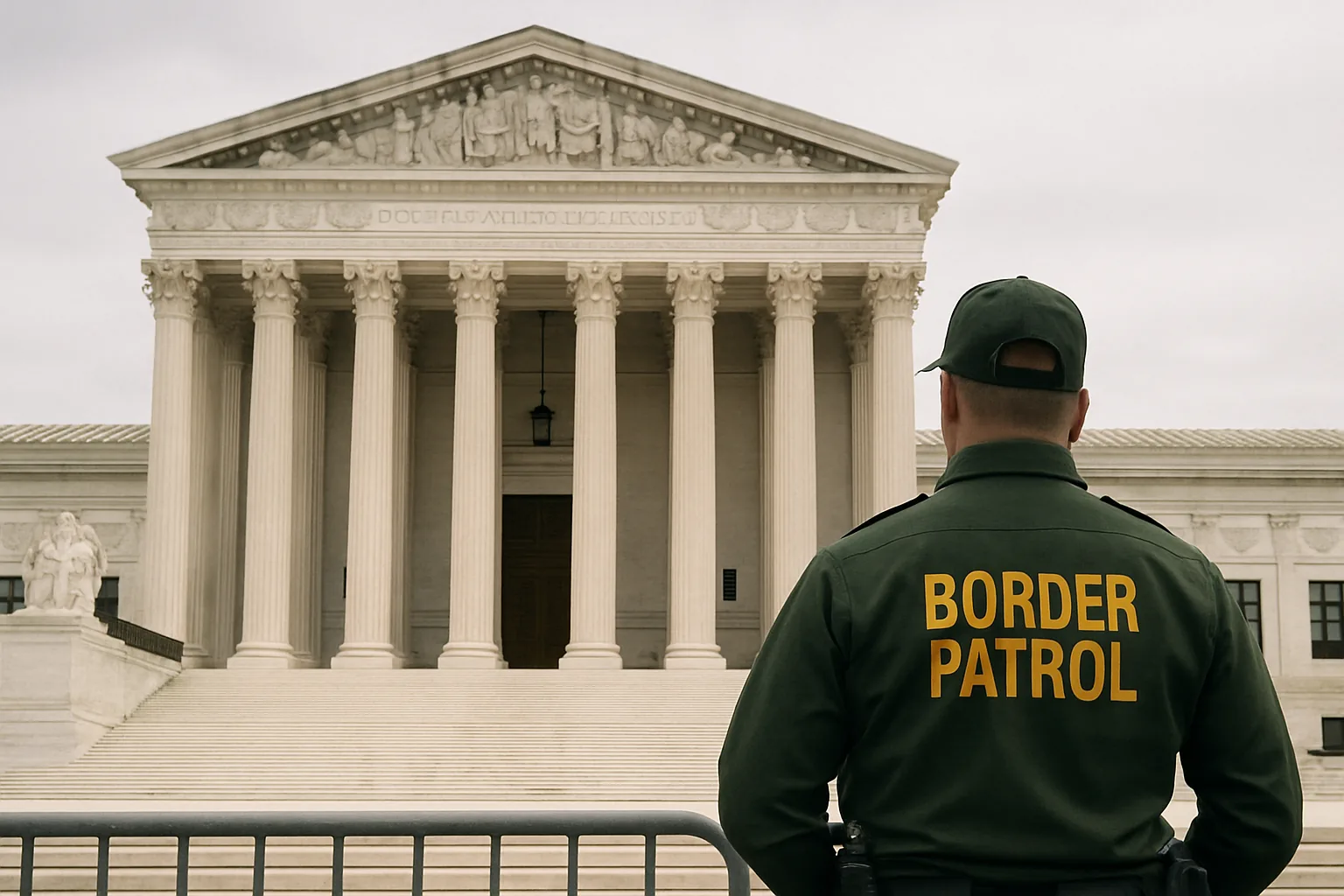
The Supreme Court’s latest immigration case turns on a narrow question that could reshape a very large part of border policy: when, exactly, does a person gain the right to seek asylum under U.S. law?
On March 24, 2026, the justices heard arguments over the legality of the border practice known as “metering,” which let officials stop some migrants from approaching ports of entry to ask for asylum. The policy has been rescinded, but the case still matters because the administration wants room to use it again. A ruling in its favor would not just revive one tactic. It could reset the legal line for when asylum obligations begin.
That is why this case matters beyond the policy’s name. Metering sounds administrative, almost procedural. In practice, it concerns whether the government can keep asylum seekers in Mexico long enough to say their legal rights have not attached yet.
What the Court is being asked to decide
The government’s position is straightforward: asylum processing duties apply only after a person physically enters the United States. If someone is still on the Mexican side of the border, even at or near a port of entry, the government says that person has not legally “arrived” in the way the Immigration and Nationality Act requires.
Challengers argue the statute works differently. Their reading is that migrants who present themselves at a port of entry are already within the law’s protection and must be inspected and processed rather than blocked from access. That dispute over the word “arrive” sits at the center of the case.
The case reaches the Supreme Court after a 2024 ruling from the Ninth Circuit found metering unlawful. If that decision stands, future administrations would face tighter limits on using the same approach under a different operational label.
Why this is bigger than a retired program
Cases over obsolete policies often fade into technical cleanup. This one does not. The administration told the Court that metering is an important tool for managing surges at the southern border. So the legal fight is really about future discretion: whether officials may slow or block access to asylum at the front end when crossings increase.
That matters because border enforcement often depends less on sweeping new statutes than on where the government draws operational lines. If the Court accepts the government’s view, officials could have broader authority to control access before a formal asylum claim is ever processed. If the challengers win, the government may still manage crowds and staffing constraints, but not by treating people at ports as though they have not yet triggered legal duties.
The distinction sounds fine-grained. It is not. It affects whether a queue is just a queue, or whether it becomes a legal barrier.
A practical example of the dispute
Consider a migrant family that reaches a port of entry after traveling across Mexico and waits at the gate to request asylum.
Under the challengers’ view, that family has done the critical thing the law contemplates: it has arrived at a place where asylum claims are supposed to be received, so officials must begin processing. Under the government’s view, if the family has not yet physically crossed into the United States, officers may turn it back or hold it outside the line of formal entry without triggering the same statutory obligation.
That is the real-world consequence of the case. It is not only about who ultimately qualifies for asylum. It is about who gets access to the process in the first place.
The justices’ divide matters
According to the source material, conservative justices appeared open to the government’s argument that asylum rights attach only after physical entry into the country. At the same time, several justices seemed unconvinced by the administration’s position during oral argument, underscoring that the outcome is not obviously settled.
That split is important because this is not a classic fight over national security power alone. It is also a statutory interpretation case. The Court is being asked to decide what Congress meant in the Immigration and Nationality Act, and those cases can produce unusual alignments. A justice who is generally deferential on border enforcement may still hesitate if the text appears to require processing at ports of entry.
Oral arguments do not guarantee a result, but they do reveal the pressure points. Here, the pressure point is whether the government can define the threshold of “arrival” so narrowly that access to the asylum system begins only after officials allow someone through.
Why the terminology matters
Immigration policy is full of bland terms that hide the real stakes. “Metering” is one of them. It suggests orderly flow management, like spacing cars onto a highway. But in legal terms, the practice reaches further. It can determine whether a migrant is treated as an asylum applicant the government must process, or as someone still outside the system altogether.
That is why this case may shape future policy even if the exact program does not return in the same form. Administrations change labels and procedures all the time. What tends to last is the legal rule underneath. If the Court says the government may block access before physical entry, that principle could support later restrictions built on the same logic.
What to watch next
The eventual opinion will likely do more than answer whether one discontinued policy was lawful. It may clarify how much control the executive branch has over the gateway to asylum claims at ports of entry.
- If the Court sides with the government, future administrations may have more room to reinstate metering or similar practices during border surges.
- If the Court sides with the challengers, the ruling would reinforce the idea that presenting at a port of entry triggers processing duties under the statute.
- Either way, the opinion could become a reference point in later fights over border access, asylum processing, and executive power.
The broader political fight over asylum is not going away. But this case is unusually focused, and that is what gives it force. A single legal definition, applied at the gate, can decide whether the asylum system functions as a screening process or as something easier to keep just out of reach.