
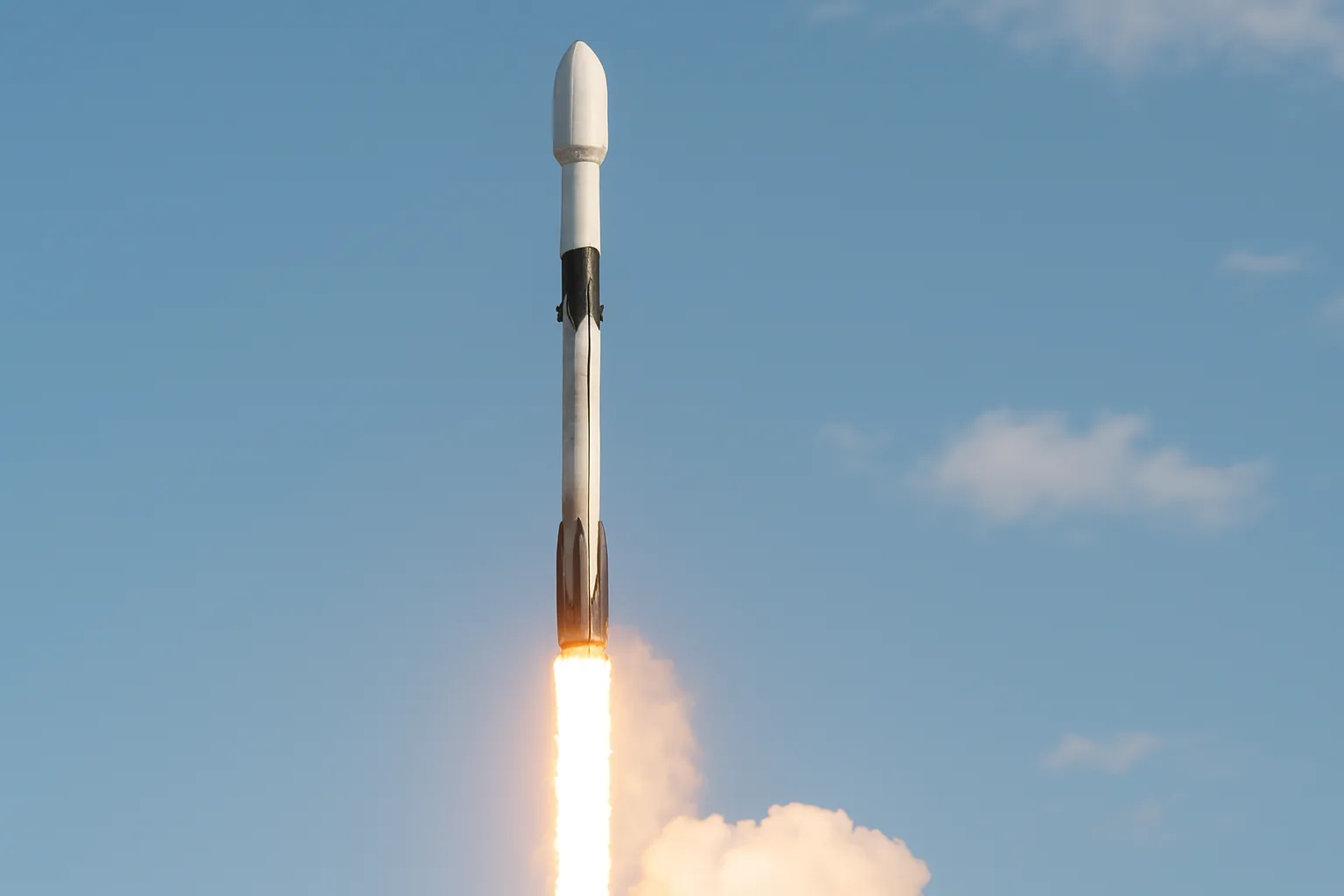
SpaceX’s Transporter-16 mission put 119 payloads into sun-synchronous orbit on March 30, 2026, and that number is the point.
A Falcon 9 lifted off from Space Launch Complex 4 East at Vandenberg Space Force Base at 4:02 a.m. PDT, carrying a mix of commercial, research, and government payloads. After deployment, the first-stage booster, B1093, landed on the droneship Of Course I Still Love You in the Pacific Ocean. It was the booster’s 12th flight.
On paper, this was a familiar SpaceX mission: reusable rocket, precise orbital insertion, booster recovery. In practice, Transporter-16 says something more important about the current launch market. A large part of the smallsat economy no longer treats access to orbit as a rare, custom event. It is starting to look more like scheduled infrastructure.
What happened on Transporter-16
According to the source material, Falcon 9 launched south from Vandenberg toward a targeted sun-synchronous orbit, or SSO. Once the upper stage reached that orbit, it carried out four engine burns. Payload deployment started about 55 minutes after liftoff and continued until about 2 hours and 31 minutes into the mission.
That deployment timeline matters because rideshare missions are not just about lifting a large number of satellites at once. They are about releasing them in a controlled sequence, into the right orbital conditions, while balancing the needs of many customers sharing one vehicle.
Transporter missions are part of SpaceX’s SmallSat Rideshare Program, which the source describes as offering operators reliable access to space at a lower cost than a dedicated launch. That tradeoff has become one of the defining features of the market: customers give up some schedule and mission customization in exchange for a much cheaper ride to a highly useful orbit.
Why sun-synchronous orbit keeps attracting demand
Sun-synchronous orbit is not just another destination. It is one of the most commercially useful orbits for Earth observation, remote sensing, climate monitoring, mapping, and defense-related collection. Satellites in SSO pass over parts of Earth at roughly the same local solar time, which helps operators compare images and measurements under consistent lighting conditions.
That makes a dense rideshare to SSO especially revealing. It suggests demand is not coming from one narrow customer type. It reflects a broad set of users who all want affordable access to a practical working orbit.
If Transporter-16 had carried a handful of payloads, the story would mostly be about launch execution. At 119 payloads, the story shifts to market structure. There are enough organizations now building spacecraft, funding missions, and planning services in orbit that a high-volume shared launch can be filled repeatedly.
What this means for the launch business
SpaceX did not invent rideshare, but it has helped make rideshare feel normal at scale. That changes expectations for everyone else.
A mission like Transporter-16 pressures the rest of the launch market in two ways. First, it reinforces price competition. If a satellite operator can reach SSO on a shared Falcon 9 mission for less than the cost of a dedicated launch, the operator needs a strong reason to pay for bespoke service. Second, it raises the standard for cadence and predictability. Customers planning satellites, ground systems, financing, and insurance want a route to orbit they can plan around.
This does not mean dedicated small launch is obsolete. Some payloads still need custom timing, unusual inclinations, or rapid response. But large rideshare missions keep shrinking the set of cases where a dedicated rocket is the obvious economic choice.
That is one reason these Transporter flights matter beyond the launch pad. They affect satellite design cycles, constellation planning, and even investor assumptions about how quickly a company can get hardware into orbit.
A concrete example of the market effect
Consider a small Earth-imaging startup building its first two satellites. A dedicated launch could give it more control over timing and orbital details, but that option may be hard to justify financially. A rideshare mission to SSO changes the math. If the startup can accept the program’s schedule and deployment profile, it gets into the orbit it actually needs for imaging work without paying for an entire rocket.
That does not remove risk. The company still has to design around integration requirements and shared-mission constraints. But Transporter-16 shows why the rideshare model has become so attractive: for many missions, the lower-cost path is no longer a compromise that barely works. It is the default way to start operating.
The reusability piece still matters
The booster on this mission, B1093, flew for the 12th time after previously supporting nine Starlink missions and two Tranche 1 Transport Layer missions, according to the source. Reusability is no longer the novelty angle it was a few years ago, but it remains central to how missions like this can be offered at scale.
When a vehicle flies repeatedly and returns successfully, launch becomes easier to package as a recurring service rather than a one-off event. Transporter-16 depended on that logic. A high-volume rideshare mission only works economically if the launch provider can keep its own operational model efficient and repeatable.
The booster landing on Of Course I Still Love You was therefore not just a flourish at the end of the mission. It was part of the business system that makes this kind of launch cadence possible.
What to watch next
The key question after a mission like this is not whether SpaceX can fill one more rideshare. It is how far the model can keep expanding before customers push harder for alternatives.
A few things are worth watching:
- Whether demand for SSO rideshares stays broad across commercial, research, and government buyers.
- How often operators accept shared-launch constraints instead of paying for dedicated service.
- Whether rival launch providers can compete on price, schedule, or specialized mission profiles rather than pure volume.
- How much continued booster reuse supports the cadence customers now expect.
Transporter-16 does not settle those questions, but it sharpens them. A 119-payload mission is evidence that the market for low-cost, precisely targeted orbital access is not theoretical. It is active, crowded, and operational now.
That may be the most important takeaway. The mission was successful in the narrow launch sense. More than that, it showed that a large share of the space industry is building itself around the assumption that access to orbit can be frequent, standardized, and affordable enough to plan a business on top of it.