
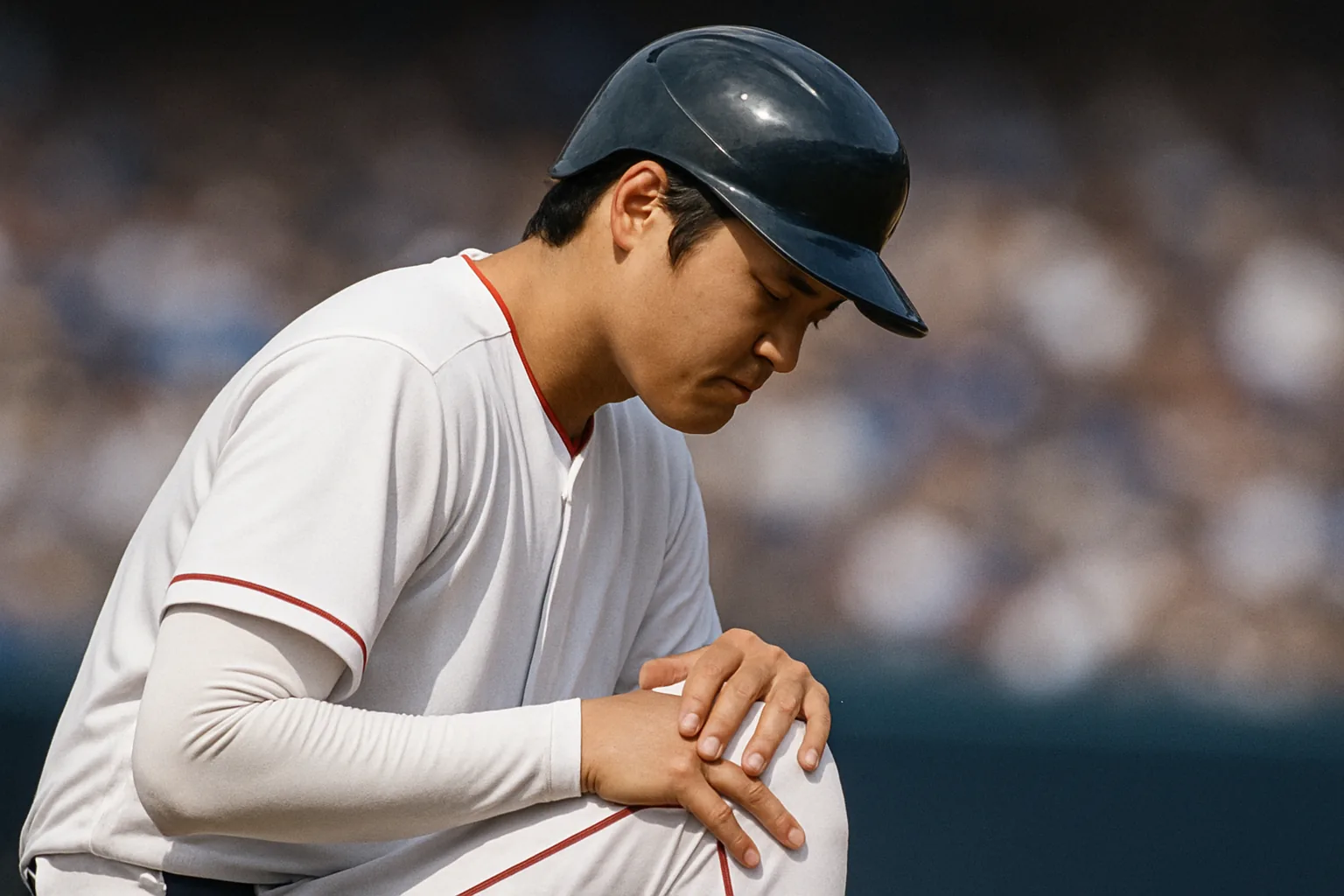
Shohei Ohtani left the Dodgers’ June 11 win over the Pittsburgh Pirates because of inflammation in his left knee, turning an otherwise useful 8-6 road victory into a familiar kind of Dodgers stress test: how cautious should a contender be when its best player says something does not feel right?
The answer, at least that night, was immediate caution. Ohtani had reached base four times and was due up again in the seventh inning with Los Angeles protecting a two-run lead. Instead of letting him take another plate appearance in a leverage spot, manager Dave Roberts sent Santiago Espinal to pinch-hit.
Roberts later described the issue as discomfort behind Ohtani’s knee, around the area where the hamstring attaches. The team announced it as left knee inflammation. Roberts said the move was precautionary and framed it as a matter of being smart rather than pushing through a possible soft-tissue problem.
What Happened
The injury did not have an obvious single moment. Roberts speculated it may have happened in the fourth inning, when Ohtani started to take off for second base before a foul ball sent him back. The discomfort was not raised the previous night, and Roberts said he did not hear about it during the game until around the sixth inning.
That timing matters. Ohtani was not removed after a visible collision, awkward slide, or limp that forced an instant stoppage. He kept playing, kept reaching base, and only came out when the Dodgers had enough information to decide the risk was no longer worth it.
The knee also came with history attached. Ohtani had surgery on the same knee in 2019 to address a bipartite patella, though Roberts noted this discomfort was in a different area of the knee. That distinction helped lower the immediate alarm, but it did not erase the concern. With a player like Ohtani, any lower-body issue has a wider meaning than a normal day-to-day injury note.
Why the Dodgers Treated It Carefully
For most hitters, a sore knee is already a problem. For Ohtani, the Dodgers have to think in layers. His value is not limited to one swing in one inning. It is his ability to get on base, hit for power, run enough to pressure defenses, and, when healthy in that role, carry the added complexity of being a two-way star.
That is why the seventh-inning decision is the useful part of the story. Ohtani had been one of the Dodgers’ best offensive players that night. Pulling him removed a premium bat from a close game. But the Dodgers were not choosing between Ohtani and a generic bench bat in the abstract. They were choosing between one more plate appearance and the possibility that a minor knee issue could become something more disruptive.
A concrete way to view it: if a hitter feels tightness behind the knee while accelerating, the next danger point is not only a swing. It could be leaving the batter’s box, trying to beat out a grounder, scoring from second, or stopping hard on a base path. A single competitive instinct can turn a manageable irritation into a multi-week absence. That is the type of trade the Dodgers were trying to avoid.
The Return Lowered the Temperature
The immediate concern eased after Ohtani received a precautionary day off and returned on June 13 against the Chicago White Sox. His performance made the short-term picture look much better: he homered to open the game and walked three times, a clear sign that the issue had not stripped away his offensive timing or plate discipline.
That return did not make the original decision meaningless. It made the decision look like the kind of small intervention teams hope prevents a bigger one. A one-game pause is easier to absorb than a lingering leg problem that changes a player’s swing mechanics or reduces his willingness to run.
The Dodgers also had reason to avoid public overreaction. Roberts downplayed the injury, and the team’s posture suggested low long-term concern. Still, “not serious” and “irrelevant” are not the same thing. In June, with months of baseball still ahead, the smartest injury management often looks boring in the moment.
What It Means for Los Angeles
The Dodgers are built to win games even when one star sits for a night. That depth is part of the point of their roster. But Ohtani is not a normal absence. His presence changes how opposing pitchers approach the top of the lineup and how the Dodgers sequence pressure across a game.
For Roberts, the episode is also a reminder that Ohtani’s workload has to be managed through small decisions, not only major medical updates. Pinch-hit here. Rest there. Avoid asking him to sprint on a knee that has just started barking. Those choices can look conservative until the alternative arrives.
The practical implications are straightforward:
- Lineup flexibility matters. The Dodgers need credible options ready when Ohtani is removed from a game unexpectedly.
- Base-running risk is part of the calculation. A knee issue affects more than hitting; it changes every acceleration and stop.
- Short rest can be a feature, not a setback. A precautionary day off can preserve weeks of availability.
What to Watch Next
The key question is not whether Ohtani can play after the knee inflammation. He already did. The better question is whether the Dodgers continue to manage him normally or start trimming small pieces of his workload: fewer aggressive stolen-base attempts, quicker removals in lopsided games, or more deliberate rest days around travel.
None of that would necessarily signal panic. It would signal that the Dodgers understand the math of their season. Ohtani’s value is too large to treat discomfort as something to test for toughness points.
For now, the episode sits in the category every contender prefers: a scare, a brief pause, a strong return, and no public sign of a major problem. But it also revealed the operating principle Los Angeles will need all year. With Ohtani, the Dodgers are not just protecting a lineup spot. They are protecting the player who shapes the entire ceiling of their season.