
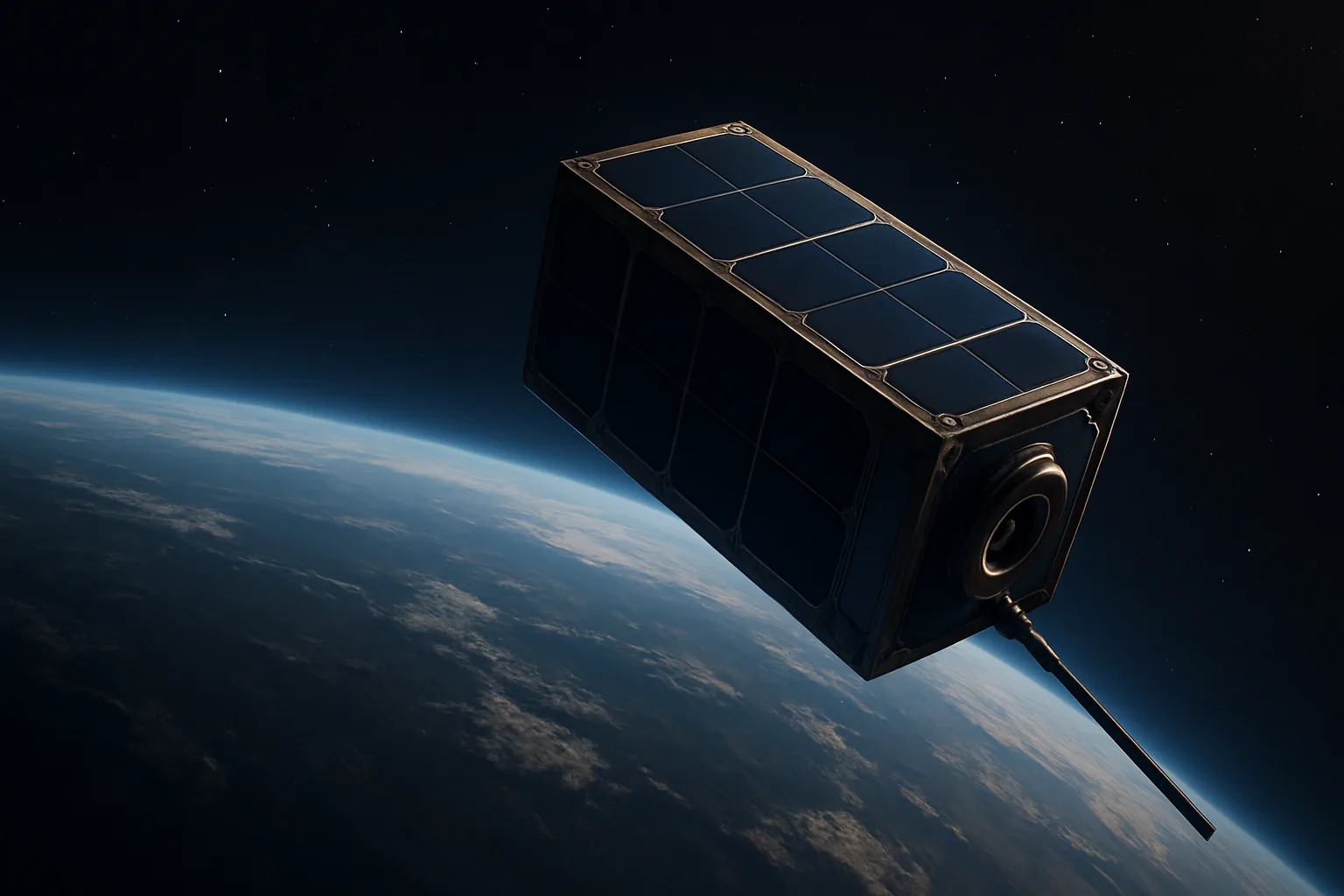
Canadian startup SBQuantum is preparing to send a quantum diamond magnetometer into low-Earth orbit on March 30 aboard a Spire satellite launched on a SpaceX Falcon 9 rideshare mission. On paper, that sounds like a niche hardware update. In practice, it is a useful snapshot of how new space technology gets validated now: not by waiting years for a full standalone mission, but by attaching a specialized instrument to an existing commercial platform.
The device itself is compact, described as roughly the size of a quart of milk. Spire is supplying the satellite platform, ground-station access, and data-processing support. That division of labor is the real story. SBQuantum brings the sensor. Spire brings the route to orbit and the operational backbone.
Why the hosted-payload model matters
For a company developing an advanced instrument, space is both an opportunity and a bottleneck. A sensor might look compelling in the lab and still struggle to prove itself in the harsh realities of orbit. Building a full satellite mission just to answer that question is slow and expensive. Hosted payload arrangements cut through that problem.
That is what makes this mission notable. SBQuantum does not need to become a full spacecraft operator to test a space application. It can focus on whether its quantum magnetometer performs as expected, while Spire handles the satellite bus, operations, and data chain needed to run the test.
A simple comparison helps. Instead of opening a whole restaurant to test one new dish, SBQuantum is getting a place in an existing kitchen with staff, utilities, and distribution already in place. That makes iteration faster and lowers the cost of proving whether the technology deserves a larger role in future missions.
What the sensor is trying to prove
The company’s magnetometer is designed to measure magnetic fields with high precision using diamond-based quantum sensing. The immediate aim of this flight is demonstration, not a grand commercial rollout. The question is whether the instrument can operate reliably in orbit and produce data good enough to justify broader use.
If it can, the appeal is obvious. Better magnetic-field measurements can be relevant to Earth observation, navigation, and other applications where precision matters and sensor drift is a constant problem. Space is a natural proving ground because it forces hardware to deal with radiation, temperature changes, power constraints, and the operational discipline of an actual mission.
Why Spire is a logical partner
Spire has spent years building a business around small satellites, hosted payloads, and repeatable space operations. That makes it a useful partner for hardware startups that do not want to spend their first serious funding rounds reinventing satellite infrastructure. In this case, Spire is doing more than offering a ride. It is also handling the support systems that turn an instrument test into a mission.
That matters because data validation is often where promising hardware gets stuck. Launching is only one step. You also need command-and-control, downlink, processing, and a way to interpret the output in a mission context. Spire gives SBQuantum that operational layer.
What to watch after launch
The near-term milestone is simple: does the sensor survive launch, power on, and return usable measurements? If it does, the more interesting question becomes whether the data quality is strong enough to support future commercial or government demand.
That is the real threshold for a mission like this. A successful demo is not valuable because it sounds futuristic. It is valuable because it reduces uncertainty. Investors, partners, and customers can move faster once the technology has real orbital performance behind it.
SBQuantum’s upcoming flight is therefore bigger than one small payload. It shows how the path to space is changing for specialized hardware companies. The combination of commercial rideshare launches, hosted payload platforms, and outsourced operations means a startup can test serious technology in orbit without pretending to be a full end-to-end space company on day one.