
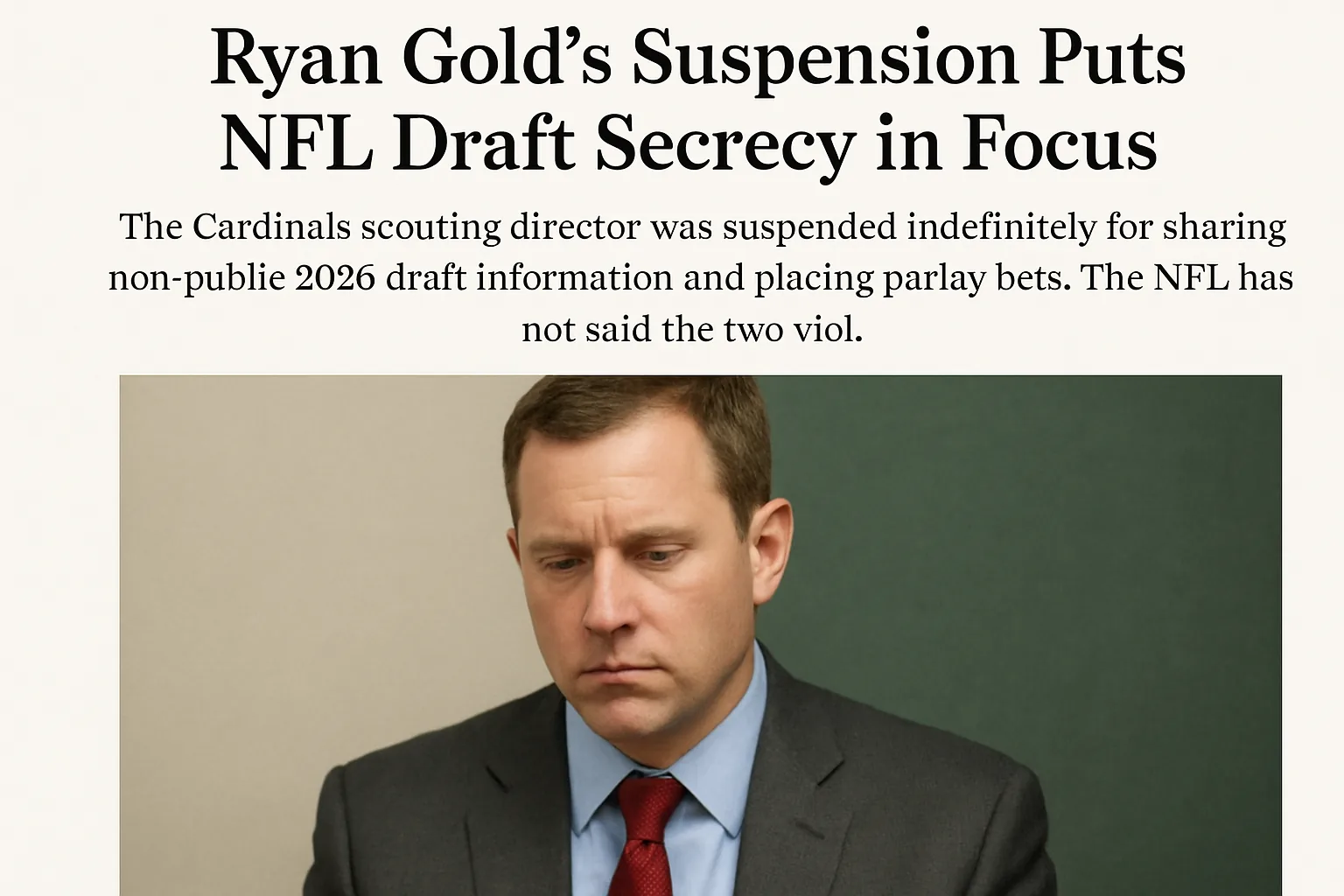
The NFL has suspended Arizona Cardinals director of college scouting Ryan Gold indefinitely after concluding that he shared confidential information about the team’s 2026 draft selections before they were announced and participated in parlay betting on NFL and college games.
The league’s July 17 announcement did not identify the recipient of the draft information or disclose details about Gold’s wagers. It said there was no reason to believe an NFL game was compromised and no indication that another Cardinals employee, coach or player knew about or participated in the activity.
Gold has the right to appeal. For now, the suspension removes a longtime personnel executive from Arizona’s football operation just before training camp and leaves several important questions unanswered.
Two violations that should not be conflated
The NFL described two separate findings: Gold provided non-public information about forthcoming draft selections, and he placed parlay bets on NFL and college games.
That wording matters. The league did not say Gold bet on the draft, used confidential information to make his wagers or passed information to someone who then placed a bet. It also did not say his parlays involved the Cardinals. Without further evidence, joining those details into a single betting scheme would go beyond what the investigation publicly established.
The league nevertheless treats both activities as integrity risks. Its policy prohibits NFL personnel from participating in or facilitating sports gambling and from giving non-public information to third parties. According to the NFL, the policy is reviewed annually with league personnel.
A simple example shows why the distinction matters. Imagine an employee tells someone, shortly before a selection is announced, which player a team intends to draft. That disclosure gives the recipient an informational advantage, regardless of whether a wager is ever placed. If the same employee separately bets on a college football parlay, that is another policy violation—but it does not prove the draft tip influenced the bet.
The Gold case contains both categories of conduct. The NFL’s announcement does not publicly connect them.
Why draft information is an integrity issue
Public discussion of sports-gambling rules often centers on point spreads, player performance and whether someone can influence a game. Gold’s case reaches beyond the scoreboard.
Draft decisions are time-sensitive league information. Clubs invest heavily in scouting, internal evaluations and selection strategy, while fans, media companies and betting operators closely follow the event. A personnel executive does not need the ability to change a play on the field for an unauthorized disclosure to damage confidence in the process.
That explains how the NFL can say no game was affected while still imposing an indefinite suspension. Competitive integrity includes the handling of information around official league events, not only the conduct of games themselves.
The practical lesson for sports organizations is that gambling compliance cannot stop at telling employees where they may place a bet. It also has to address the information available to them:
- Who needs access to draft plans and other time-sensitive decisions?
- How clearly are employees told that passing information to friends or other third parties is itself prohibited?
- Can an organization investigate suspected leaks through communication and access records?
The NFL said its review included interviews and an examination of electronic records. That does not establish that the Cardinals’ internal controls failed, but it illustrates why information governance and gambling enforcement now overlap.
Personnel face stricter betting limits than players
Gold’s role is also important because NFL gambling rules are not identical for every person associated with the league.
In a 2024 explanation of its policy and monitoring program, the NFL said coaches, staff and other personnel were not permitted to bet on any sports. A 2025 reminder concerning players, by comparison, said players could legally bet on non-NFL sports away from club property and team travel.
That distinction means the inclusion of college games in Gold’s parlays does not make the conduct incidental. As a scouting executive, he fell under the broader restriction applied to club personnel. His access to confidential football information adds another layer that does not exist for an ordinary bettor.
The league says its gambling education program has reached more than 20,000 people associated with the NFL. Gold’s suspension suggests the next compliance challenge is not simply distributing rules. It is managing the combination of betting access, sensitive information and employees whose work places them close to both.
What the suspension means for Arizona
Gold was entering his 13th season with the Cardinals. He became director of college scouting in June 2025 after three seasons as assistant director and four as a college scouting coordinator.
That history makes this more than the temporary absence of a junior employee. Arizona has lost an experienced member of its scouting structure, although the team has not announced in the cited report how Gold’s responsibilities will be reassigned.
The Cardinals said they fully supported the league’s decision, emphasized that the case involved one employee and returned their public focus to training camp and the 2026 season. The NFL said the club cooperated fully with the investigation.
Those statements draw a firm boundary around the known scope of the case. There is currently no public evidence of wider organizational involvement.
What remains unresolved
An indefinite suspension is open-ended, but it is not necessarily permanent. The NFL did not announce a minimum term, conditions for reinstatement or a schedule for Gold’s possible appeal.
Further proceedings could clarify who received the draft information, when it was shared and whether the recipient did anything with it. Details about the size, timing and subjects of Gold’s parlays also remain undisclosed.
Until then, the most significant conclusion is narrower than speculation around the case: the NFL found both unauthorized disclosure and prohibited betting by a senior scouting employee, while finding no indication that a game, play or other Cardinals personnel were involved. The appeal process—and any additional information the league chooses to release—will determine whether that account becomes more detailed.