
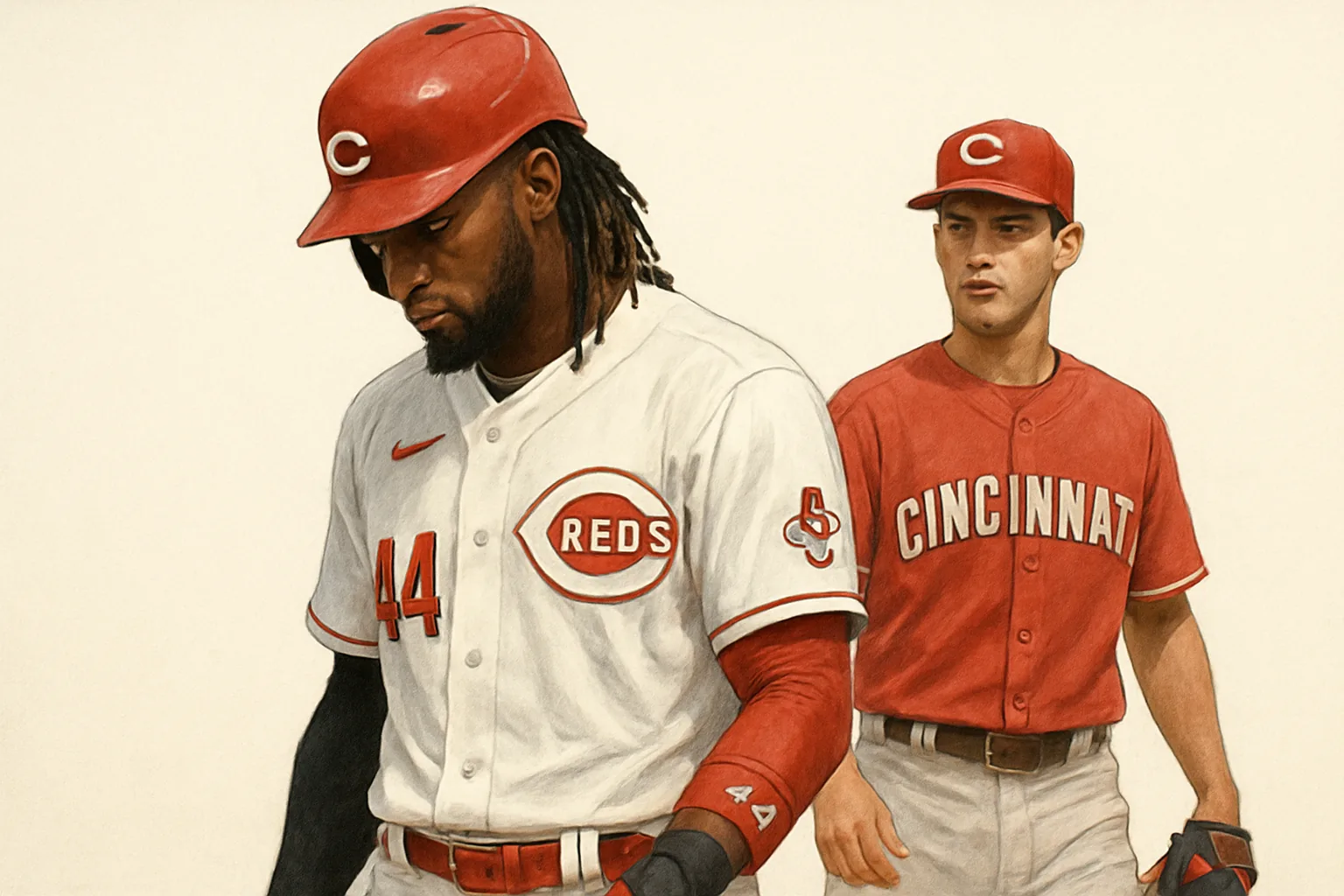
The Cincinnati Reds placed Elly De La Cruz on the 10-day injured list Monday with a right hamstring strain, ending one of the club’s most durable recent runs and forcing a fast adjustment at shortstop.
De La Cruz left Sunday’s 6-4 win over the Atlanta Braves after feeling tightness while running to first base on a fifth-inning single. An MRI on Monday revealed a strain, with the initial return timeline set at two to four weeks.
Manager Terry Francona described the injury as “kind of between a Grade 1 and 2” and said De La Cruz helped himself by stopping before the injury worsened. The Reds also recalled infielder Edwin Arroyo from Triple-A Louisville, selected left-hander Brandon Leibrandt from Triple-A, and designated right-hander Yunior Marte for assignment.
Why the absence is bigger than one lineup spot
De La Cruz is not a replaceable player in the ordinary sense. He is batting .280 with 12 home runs this season, but the raw line only captures part of the issue. Cincinnati also loses a switch-hitting shortstop whose speed changes how pitchers, catchers, and defenses manage the game.
That matters because hamstring injuries are uniquely awkward for a player like De La Cruz. His value is not limited to standing in the box and driving the ball. It also comes from stretching singles, threatening stolen bases, taking extra bases when outfielders hesitate, and covering difficult ground on the left side of the infield.
Even a quick return does not automatically mean an immediate return to full impact. The Reds have to think beyond whether he can swing a bat. They need him to accelerate, stop, cut, and defend without turning a short absence into a longer one.
Francona said De La Cruz did not want to go on the injured list, but the club chose caution. That is the sensible part of the decision. A 10-day IL stint can feel frustrating when a player walks off the field on his own, yet the alternative is asking a franchise player to test a compromised hamstring every time he leaves the batter’s box.
A durability streak ends
The injury also stops De La Cruz’s consecutive-games streak at 276, the sixth-longest by a Reds player in the expansion era, which began in 1961. His run dated back to July 30, 2024.
That streak says something important about how Cincinnati had been able to build its daily lineup. For nearly two seasons, the Reds could write De La Cruz into the shortstop spot and organize the rest of the infield around him. Losing that predictability is not the same as losing one hot bat for a few games. It forces a chain reaction.
Every day without De La Cruz affects defensive positioning, bench usage, late-game substitutions, and the way the Reds manufacture offense. If Cincinnati trails by a run in the eighth inning, the absence is felt in a specific way: there is no De La Cruz at the plate who can reach base and immediately become a scoring threat from first. The opposing pitcher can work through the inning without that extra layer of pressure.
What Edwin Arroyo brings into the picture
Arroyo’s promotion gives the Reds a cleaner baseball fit than a pure stopgap. He is a highly regarded infield prospect and defender, and his call-up gives Cincinnati a chance to keep a legitimate shortstop profile in the majors while De La Cruz heals.
The timing is demanding. Arroyo is not arriving into a quiet developmental cameo. He is stepping into a roster hole created by one of the team’s defining players. That does not mean he has to replace De La Cruz’s production; almost no available option would. The more realistic goal is narrower: play dependable defense, avoid giving away at-bats, and help the Reds keep the infield stable.
For a young player, that can be a useful first assignment because the job is clear. Arroyo does not need to imitate De La Cruz’s electricity. If he turns routine chances into outs, handles major league velocity, and gives the lineup competitive plate appearances, the promotion can work even without immediate star-level offense.
A practical example: if Arroyo starts at shortstop against a right-handed starter and bats near the bottom of the order, the Reds can ask him to lengthen the lineup rather than carry it. A seven-pitch at-bat, a clean double-play turn, or a single that flips the order back to the top can matter during a two-week stretch. That is not glamorous, but it is exactly how clubs survive injuries to premium players.
The roster move behind the headline
The Reds’ additional moves underline that this was not only a one-for-one injury replacement. Brandon Leibrandt was selected from Triple-A, while Yunior Marte was designated for assignment. That gives Cincinnati another left-handed pitching option and clears a roster spot in the process.
Those secondary moves are easy to overlook because De La Cruz is the main story, but they show how injuries rarely stay contained to one position. A club dealing with a sudden loss often uses the moment to rebalance the roster around immediate needs: infield cover, bullpen availability, and matchup flexibility.
For Cincinnati, the next few weeks are about limiting the damage. The Reds do not need Arroyo to become a headline every night. They need the pitching staff to absorb tighter margins, the rest of the lineup to replace some of De La Cruz’s production collectively, and the defense to avoid turning a short-term injury into a broader slide.
What to watch next
The first question is whether De La Cruz’s recovery stays near the short end of the two-to-four-week timeline. Francona said it would not surprise him if the shortstop returned quickly, citing how he responds and heals. Still, hamstring strains can be sensitive, especially for players whose games rely heavily on speed.
The second question is how much runway Arroyo receives. If he looks comfortable defensively, Cincinnati may be able to ride out the absence without forcing awkward alignments. If the bat is overmatched early, the Reds will have to decide how much offensive tradeoff they can accept for infield defense.
The third question is whether Cincinnati changes how aggressively it runs once De La Cruz is back. A player can be activated and still be managed carefully. The Reds may have to decide when to let him push for extra bases and when to pull back, particularly in the first week after his return.
For now, the Reds have avoided the worst-case language around the injury. De La Cruz stopped before the play turned into something more severe, and the club’s public timeline leaves room for a relatively short absence. But even two weeks without him is a real test. Cincinnati’s response will show how much depth sits behind its most dynamic player.