
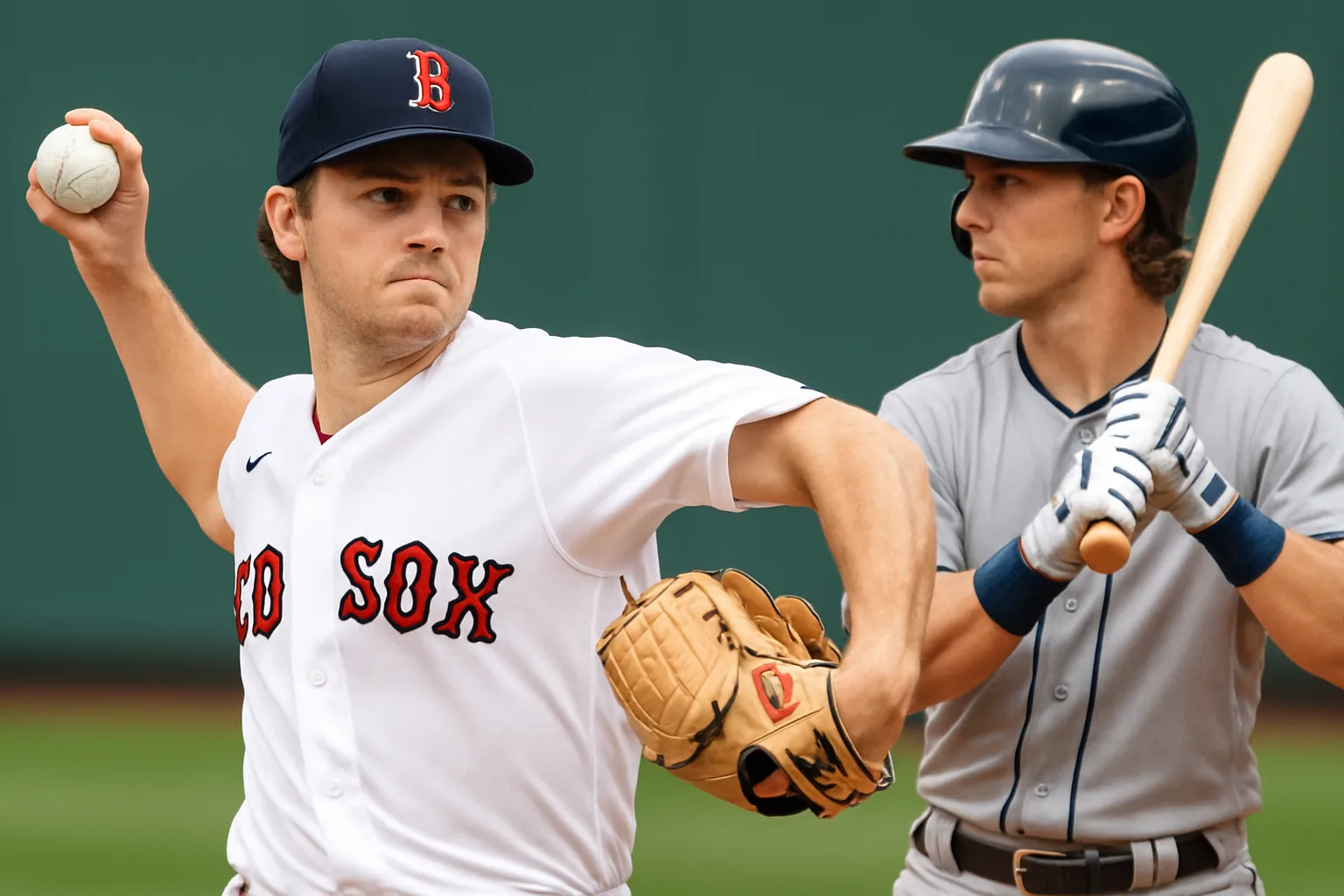
The Red Sox acquired infielder Curtis Mead from the Nationals late Saturday night, sending promising left-handed starter Connelly Early to Washington in a direct exchange of strengths and weaknesses.
Boston gains a 25-year-old right-handed hitter enjoying his best major league season. Mead is batting .254 with an .856 OPS, 17 home runs, and 48 RBIs, production that answers a clear need for a club that has struggled to score consistently.
Washington receives a 24-year-old starter with a 3.24 ERA across 21 starts since his major league debut. Early had posted a 3.44 ERA in 17 starts this season before left elbow inflammation sent him to the injured list in July.
It is an unusually clean fit. The Nationals have led baseball in scoring but need starting depth. The Red Sox own the second-lowest ERA in the American League but have lacked enough offense to complement their pitching.
What Mead changes in Boston’s lineup
Mead’s value is not limited to his home-run total. His .351 on-base percentage represents a substantial improvement from the .300 mark he produced over parts of his first three major league seasons. That development suggests Boston is acquiring a more complete hitter than his earlier record indicated.
He has been especially effective against left-handed pitching, batting .276 with an .897 OPS in those matchups. For a contender, that skill can matter beyond a conventional everyday role. Opponents frequently adjust their bullpens around platoon advantages late in games, and a productive right-handed bat gives Boston another way to counter those moves.
The Red Sox plan to use Mead at second base while keeping Caleb Durbin, whose defense has reached Gold Glove caliber, at third. Mead has played primarily third base this season but also has experience at first and second, giving the team room to adjust its infield without displacing its best defender.
A simple game situation illustrates the appeal. If Boston faces a left-handed starter, Mead can remain in the lineup at second while Durbin handles third. The Red Sox add a hitter with strong numbers against lefties without weakening the hot corner or relying on a short-term bench substitution. Mead’s versatility makes the offensive upgrade easier to accommodate.
The cost makes this more than a depth move
Early is not a distant prospect whose major league value must be imagined. He has already shown that he can start effectively at the highest level, going 8-7 with a 3.24 ERA since debuting last season. Young, controllable starters with that record are difficult to replace and expensive to acquire.
His elbow inflammation complicates the assessment, although the information available at the time of the trade offered some encouragement. Early had restarted a throwing program and was approaching a bullpen session after not pitching since June 30. The Nationals are accepting the uncertainty attached to his recovery because his longer-term value could exceed that of a position player moved to address a more immediate roster need.
Boston is making the opposite calculation. A low team ERA does not make Early expendable in the literal sense; injuries and declining performance can quickly erode pitching depth. It does, however, give the Red Sox a stronger base from which to trade an arm for offense.
That distinction matters. Boston did not merely add a useful hitter. It converted a scarce young starter into a player expected to enter the regular infield, signaling that the club sees its inability to score as a problem substantial enough to justify real risk.
Why Washington can afford to move Mead
Trading a breakout hitter from baseball’s highest-scoring team may initially seem counterintuitive. Washington’s roster imbalance explains it. Additional offense has diminishing value when the lineup is already producing at an elite level, while insufficient starting depth can expose the team over a long season.
Early offers a possible multi-year answer rather than a temporary patch. If his elbow responds well and his early major league performance proves sustainable, Washington will have turned a player acquired only months earlier into a young rotation piece.
Mead’s rapid movement between organizations is notable. Tampa Bay traded him to the White Sox on July 31, 2025, as part of a four-player deal. Washington acquired him from Chicago on March 28, 2026, for catching prospect Boston Smith. The Red Sox deal is his third trade in less than a year.
That history does not necessarily reflect poorly on Mead. His improved power and on-base production have made him increasingly useful, while his defensive flexibility allows clubs to view him in several roster configurations. Washington appears to have used that rising value to pursue the harder-to-find asset it needed most.
What will determine the winner
The immediate evaluation will center on whether Mead helps stabilize Boston’s offense. His power should translate directly, but the more important question is whether his improved plate results persist. A .351 on-base percentage makes him a broader offensive contributor; regression toward his previous .300 level would narrow his impact considerably.
For Washington, every judgment begins with Early’s health. His return timetable, velocity, command, and ability to carry a starter’s workload will matter more than the short-term comparison of box-score production. Elbow inflammation introduces risk, even when a pitcher has resumed throwing.
The trade may ultimately benefit both clubs because they are operating on different timelines and solving different constraints. Boston gets the hitter it can use now and preserves a strong defensive alignment. Washington gives up current offense from a position of abundance to acquire a starter who could remain valuable for years.
But the exchange is not cost-free symmetry. Boston has placed a meaningful bet that Mead’s breakout is durable and that its remaining pitching can withstand the loss of Early. Washington has bet that a young left-hander coming back from an elbow issue can become the rotation piece his first 21 starts suggest. Those two uncertainties—not the obvious roster fit—will decide how the deal is remembered.