
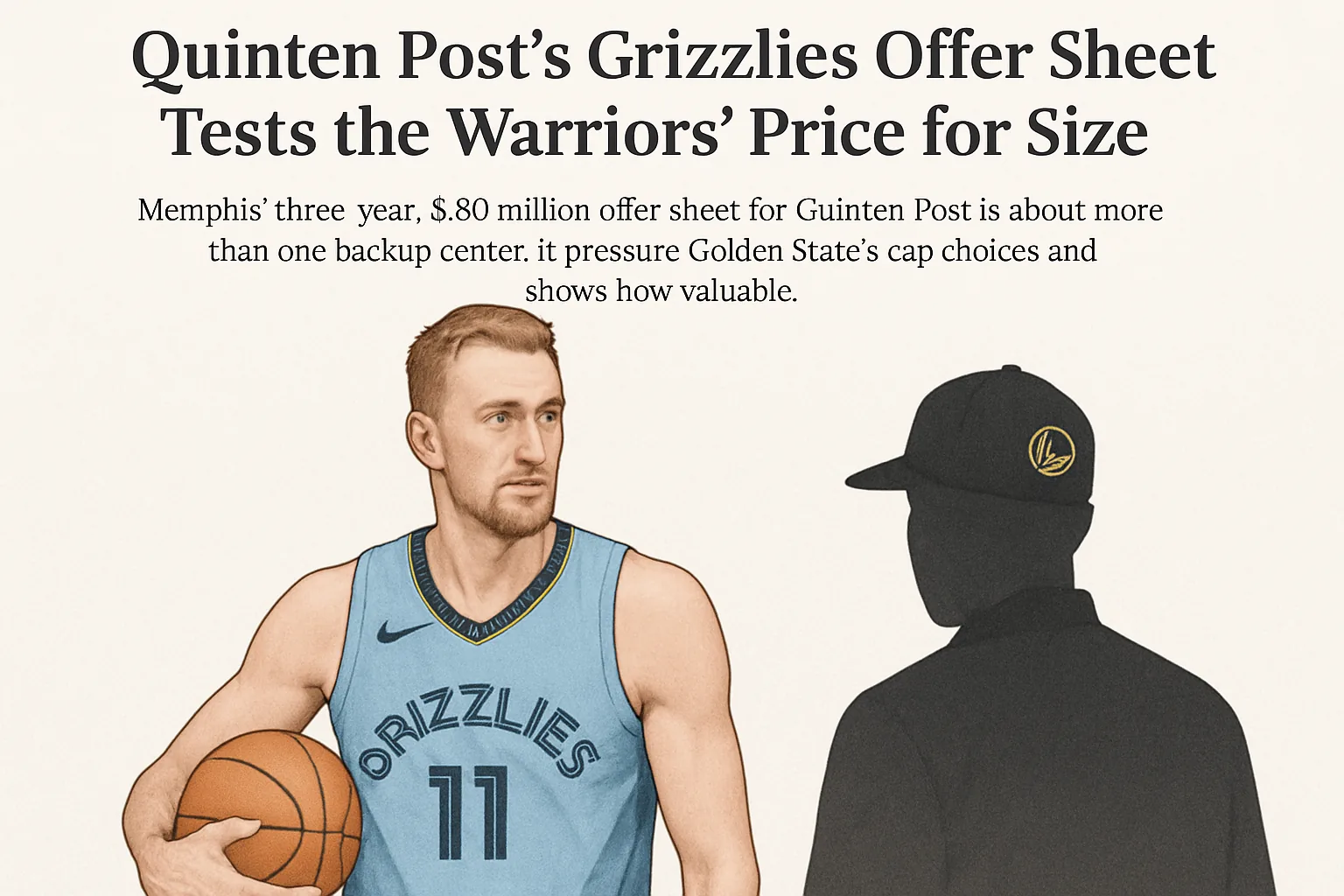
Quinten Post has signed a three-year, $30 million offer sheet with the Memphis Grizzlies, putting the Golden State Warriors on a short clock: match the deal within 48 hours or let the restricted free agent center leave.
According to the NBC Sports report, the Warriors have until 11:59 p.m. ET on Tuesday to decide. The annual price, roughly $10 million, is the real issue. Post is not being priced like a star, but he is being priced like a useful rotation big in a conference where size has become harder to fake.
What Memphis Is Trying to Buy
The Grizzlies already have Zach Edey at center and have agreed to trade for Isaiah Stewart as another frontcourt piece. That makes the Post offer sheet interesting. Memphis is not chasing a starting center out of desperation; it is trying to deepen a specific type of roster inventory.
Post gives Memphis another traditional five, a bigger body behind Edey, and a bench option who can absorb regular-season minutes without forcing the team to downsize every time matchups get heavier. The NBC Sports source notes that Post is expected to come off the bench if Golden State does not match.
That role matters. In the West, backup center minutes can become playoff-relevant very quickly. Teams have to survive stretches against Nikola Jokic, Victor Wembanyama, Chet Holmgren, Walker Kessler and other long or powerful frontcourt players. Even when a backup big is not part of a closing lineup, he can keep a game from tilting during the middle six minutes of a quarter.
Why the Warriors’ Decision Is Uncomfortable
Post took a step forward in his second season, especially on defense, while averaging 7.7 points and 4 rebounds in a little more than 17 minutes per game. Those numbers do not scream must-keep player on their own. The complication is that Golden State would not simply be matching the player; it would be matching the cap commitment.
A $10 million annual salary for a second-unit center can be reasonable if the player fills a clear need. It can also become difficult if the team is trying to preserve flexibility for bigger moves. The source specifically notes that matching may be too expensive for the Warriors, especially if they are going to pursue LeBron James or other targets.
That is the squeeze restricted free agency is designed to create. Memphis can make Golden State choose between keeping a developing player it knows well and protecting its room for larger roster swings. The Warriors do not get to negotiate this number down once the offer sheet is signed. They either accept the terms or lose the player.
A Small Example of the Basketball Logic
Imagine a regular-season game in Memphis where Edey picks up two early fouls against a team with a physical frontcourt. Without another traditional center, the Grizzlies might have to shift smaller, ask Stewart to handle more center minutes, or change the defensive coverage earlier than planned.
With Post, the bench has a cleaner option. He does not need to dominate the matchup. If he gives Memphis 14 to 18 stable minutes, contests at the rim, rebounds his area, and keeps the team from overusing its primary bigs, the signing has practical value. That is the kind of role that often looks modest in a box score but meaningful over 82 games.
Why Offer Sheets Are Rare Now
The Post situation also stands out because restricted free agent offer sheets have become uncommon. NBC Sports notes that the last player to sign an offer sheet that was not matched was Bogdan Bogdanovic in 2020, when he went from Sacramento to Atlanta.
Most restricted free agency cases are resolved before this point. Teams and players often settle on a number that works for both sides, though the leverage can favor the incumbent team. In other cases, teams arrange a sign-and-trade rather than risk an offer sheet forcing a binary decision.
That is why Memphis’ approach is notable. It is using the system directly. If the Grizzlies like Post at this price, the offer sheet gives them a chance to acquire him without waiting for Golden State to cooperate on a trade. If the Warriors match, Memphis still forced a conference rival to spend real money on a non-star center.
The Cap Mechanics Matter
The source reports that Post’s offer sheet would come out of Memphis’ Non-Taxpayer Mid-Level Exception if Golden State does not match. That is not just accounting trivia. It affects how the Grizzlies structure the rest of their offseason work.
The NBC Sports report says Memphis will likely tie the Isaiah Stewart acquisition into the Santi Aldama trade, with the final arrangement expected to become a four- or five-team deal. That kind of structure is common when teams are trying to make several roster moves fit under the salary-cap rules at once.
For readers who do not follow cap mechanics closely, the practical point is simple: Memphis is not just adding Post in isolation. It is trying to assemble its frontcourt while keeping multiple transactions legal and workable under league rules. The larger the trade structure becomes, the more moving parts there are before the roster picture is fully settled.
What to Watch Next
The next step is Golden State’s matching decision. If the Warriors match, Post stays and Memphis has to look elsewhere for another bench big. If they decline, Post joins a Grizzlies frontcourt that already includes Edey and is expected to include Stewart.
For Golden State, the question is whether Post’s development and positional value justify the cost. His defensive growth gives the Warriors a reason to consider matching, but the price may interfere with more ambitious roster plans.
For Memphis, the offer sheet signals a preference for size that can hold up across matchups. The Grizzlies are not waiting until the playoffs to discover whether they have enough bodies at center. They are paying now to avoid being too thin later.
The final decision will say something about both teams. Memphis has already shown what it thinks a young, playable backup center is worth. Golden State now has to decide whether that same player is worth the same number inside its own plan.