
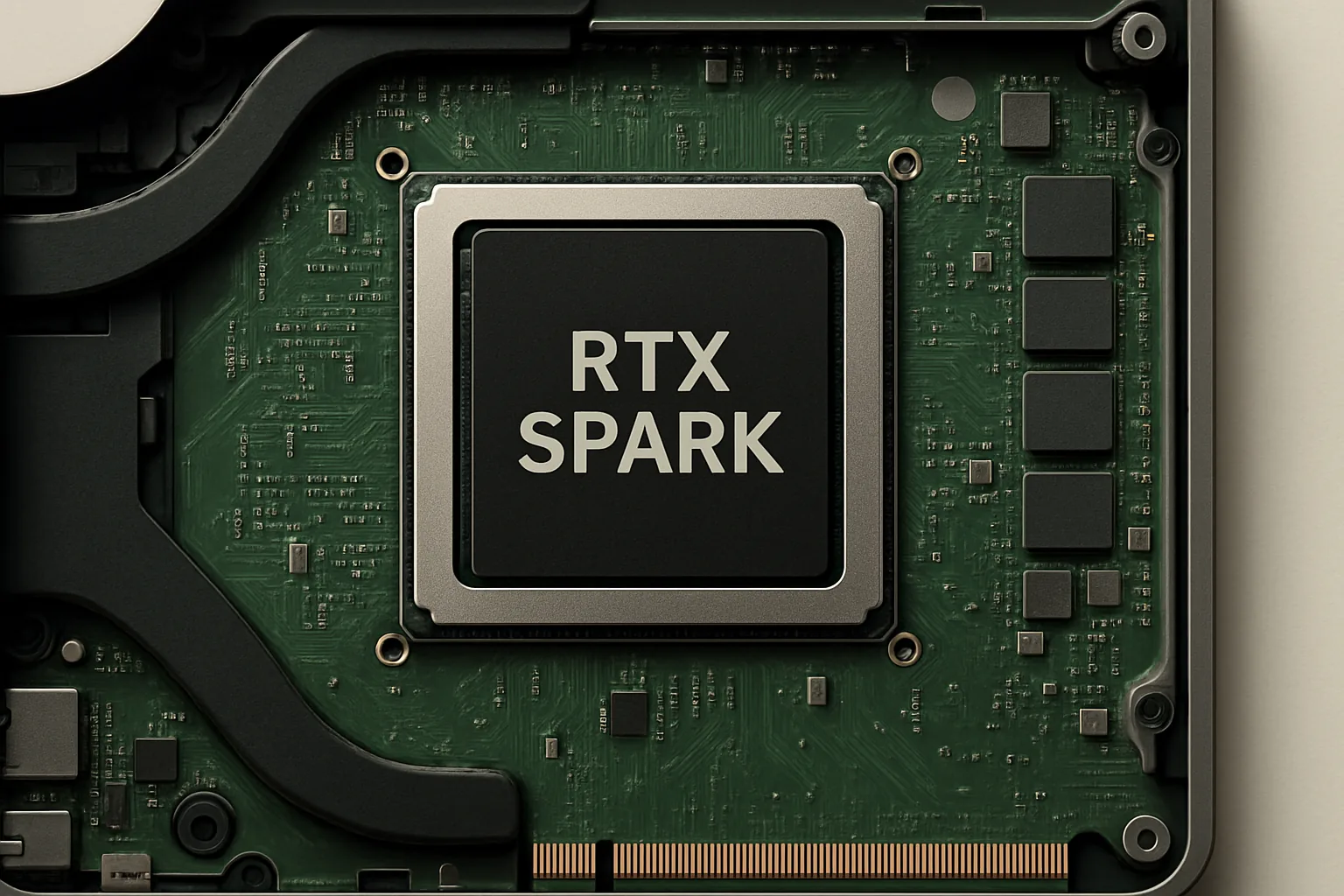
Nvidia has introduced the RTX Spark, a new PC “superchip” designed to bring powerful AI processing directly into laptops and desktops running Microsoft Windows.
Unveiled at Computex in Taipei, the chip combines a 20-core Grace CPU with a Blackwell GPU, 6,144 CUDA cores, up to 128GB of unified memory, and claimed performance of up to 1 PFLOP for FP4 AI workloads. Nvidia says the hardware is intended to let AI agents run locally on PCs rather than depending mainly on cloud servers.
The launch matters because it shifts the AI PC debate from simple assistant features toward a more demanding question: can a personal computer become a machine where software agents operate across the interface on the user’s behalf?
What Nvidia Is Trying To Change
Most consumer AI tools today still behave like apps or chat windows. A user types a prompt, receives an answer, and then manually copies, clicks, edits, uploads, or confirms the next step. Nvidia’s pitch for RTX Spark is more aggressive. It suggests that AI agents could navigate the PC itself, reducing reliance on traditional mouse and keyboard interactions.
That does not mean the mouse disappears overnight. It means Nvidia is positioning the PC as an environment where agents can take action across applications, files, creative tools, games, and local data with enough processing power to do useful work on the device.
The company says the chip was developed after three years of collaboration with Microsoft, with help from Taiwan’s MediaTek. Major PC makers are expected to use RTX Spark in upcoming Windows-on-Arm devices, including ASUS, Dell, HP, Lenovo, Microsoft Surface, and MSI, with Acer and Gigabyte models expected later. The source material also points to Microsoft-branded hardware such as a Surface Laptop Ultra as part of the planned device wave.
Why Local AI Matters
The important word in Nvidia’s announcement is “locally.” If an AI agent must send every major task to the cloud, the user experience depends on network quality, server cost, latency, and data movement. Running more of the workload on the device changes the trade-offs.
For users, local processing can mean faster responses and less dependence on a remote service. For businesses, it could make AI features easier to justify for workflows involving sensitive files, customer records, internal plans, or creative assets. For PC makers, it gives them a clearer reason to sell a new class of premium machines at a time when ordinary laptop upgrades often feel incremental.
The hardware details are part of that story. A chip with a Blackwell GPU, thousands of CUDA cores, and large unified memory is not just for drafting emails. Nvidia is aiming at heavier workloads: agents that can reason over local files, generate or edit media, assist developers, and support gaming or creative applications without handing every step to a cloud model.
A Practical Example
Consider a small design studio preparing a client pitch. On a conventional laptop, a designer might collect reference images, open a presentation tool, resize assets, export mockups, write captions, check file names, and send a draft to teammates. AI can already help with pieces of that process, but the person still stitches the workflow together.
On the kind of PC Nvidia is describing, an agent could theoretically work across those steps: search local project folders, summarize the client brief, prepare image variations, assemble a first presentation draft, and flag missing assets. The human still reviews the output, but the machine is doing more than answering questions. It is acting inside the desktop workflow.
That is the difference between “AI in a PC” and “an AI PC” in the stronger sense Nvidia wants to define.
The Competitive Stakes
RTX Spark puts Nvidia more directly into a contest with Intel, Apple, Qualcomm, and AMD for the next identity of the personal computer. Each company has a different advantage. Apple controls its hardware and software stack tightly. Qualcomm has pushed Arm-based Windows laptops with battery life as a central selling point. Intel and AMD remain deeply embedded in the PC ecosystem. Nvidia brings unmatched credibility in AI acceleration and a large developer base around CUDA.
The partnership with Microsoft is especially important. AI agents that are supposed to navigate Windows need operating-system support, developer tools, security controls, and user permission models. A powerful chip alone is not enough. If agents are going to click, move, read, write, and act inside a user’s PC, the platform has to make those actions understandable and controllable.
That is also where the risk sits. An autonomous agent that can operate a computer is useful only if users trust it not to expose data, break workflows, or act beyond its authority. Nvidia’s performance claims help explain what may be possible; Microsoft’s role will help determine whether it feels safe and manageable.
What To Watch Next
The first test will be the actual devices expected from major manufacturers. Thin-and-light machines with high AI throughput would make Nvidia’s pitch more credible, especially if they also handle battery life, heat, price, and app compatibility well.
The second test is software. Buyers will not upgrade for a spec sheet alone. They will need visible agent workflows that save time in ordinary tasks: managing files, editing media, preparing documents, coding, gaming, research, or business operations.
Three practical questions will decide whether RTX Spark becomes a meaningful PC category or another impressive chip announcement:
- Can agents work across real desktop apps without constant failures or confusing permission prompts?
- Can local AI performance justify premium pricing for everyday professionals, creators, and small businesses?
- Can Microsoft and PC makers make the experience feel trustworthy when agents are acting inside a user’s machine?
Nvidia chief executive Jensen Huang said the company is reimagining the PC for the first time in 40 years. The claim is intentionally large. The near-term reality will be more practical: whether RTX Spark PCs can make on-device AI agents useful enough that people notice the computer behaving differently, not just faster.