
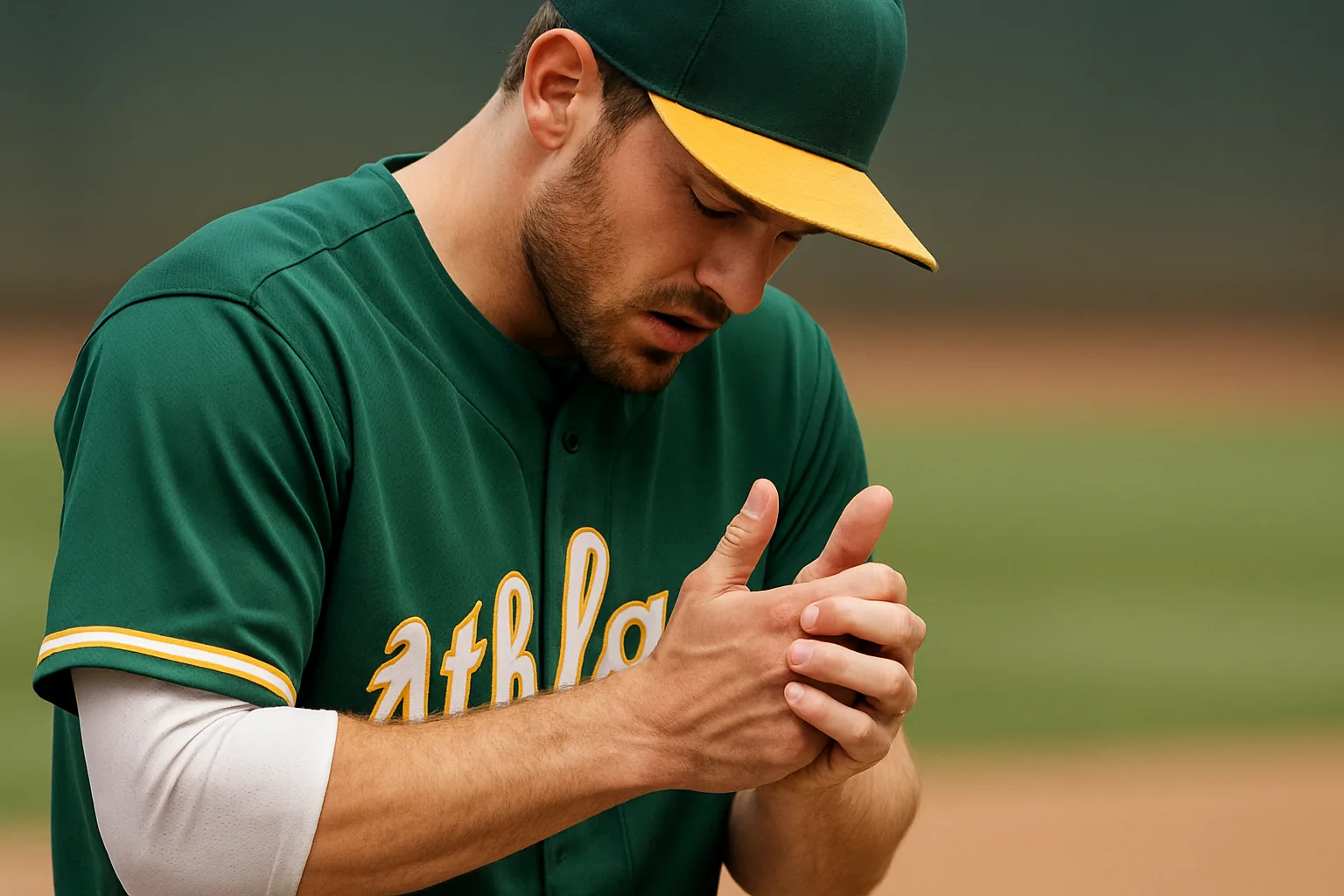
Nick Kurtz will miss his first MLB All-Star Game after the Athletics placed their first baseman on the 10-day injured list with a right thumb capsule strain. The move, announced July 11 and retroactive to the previous day, takes the American League’s voted starter at first base out of the event and removes a central bat from Oakland’s lineup heading into the break.
The timing is especially rough because Kurtz was not selected as a novelty pick or a reserve. At 23, he had earned the starting job through a season that combined power, production and unusually strong plate discipline: a .266 average, 20 home runs, 66 RBIs and an AL-leading 76 walks.
That walk total matters. It tells a fuller story than the home-run count alone. Kurtz has not merely supplied damage when pitchers challenge him; he has forced opposing staffs to make decisions, extending innings and creating opportunities for the hitters behind him. A thumb injury threatens precisely the part of a hitter’s game that requires confidence in the hands: controlling the bat, handling velocity and driving pitches without hesitation.
An All-Star absence with a practical cost
The All-Star Game loss is the visible part of the news. The larger issue is what the injury does to the Athletics’ everyday offense. Oakland does not have the luxury of replacing an All-Star first baseman with another established middle-of-the-order hitter simply by filling the roster spot.
The club recalled catcher Brian Serven from Triple-A Las Vegas in the corresponding move. Serven had been productive there, hitting .308 with 18 doubles, seven home runs and 41 RBIs in 55 games, but his recall does not represent a like-for-like answer at first base. It is a roster adjustment; the lineup solution still has to be worked out on the field.
That distinction is worth keeping in mind. Teams often announce a corresponding transaction that fills a 26-man roster opening, while the actual replacement for an injured regular comes through a mix of position shifts, matchups and redistributed playing time. The Athletics will have to cover both Kurtz’s defensive position and the on-base presence he brought to the heart of the order.
Why a thumb injury can change an at-bat
For a power hitter, a thumb problem is more than an inconvenience. The hands help control the barrel and absorb the force of contact. Even a player who remains available can find it harder to turn on inside pitches or drive the ball with the same authority. In Kurtz’s case, the club opted for the injured list rather than asking him to play through it.
Consider a simple late-inning scenario: Kurtz is at the plate with runners on base, and a pitcher works carefully because Kurtz has already shown he will take a walk. If the pitcher misses over the plate, Kurtz has the power to punish it. Without him, the opposing pitcher may face a different matchup entirely—one with less history of commanding that same caution. The effect is not limited to one plate appearance; it can alter how an inning is pitched.
There is no reported timetable beyond the 10-day designation, and neither Kurtz nor Athletics manager Mark Kotsay spoke to reporters after the move. That leaves the immediate focus on recovery rather than a definitive return date. The club will be hoping the break provides useful healing time, but a minimum stay on the injured list should not be confused with a guarantee that he will be ready at the first opportunity.
Another interruption for a young cornerstone
This is only the second injured-list stint of Kurtz’s career. He previously missed time in May 2025 with a strained left hip flexor. The current issue is different, but it comes after a rapid rise in which Kurtz won AL Rookie of the Year last season by batting .290 with 36 homers and 86 RBIs.
That prior season established the ceiling. His 2026 line suggests he was building on it in a slightly different way, with the league-leading walk total adding another layer to his offensive value. Missing the All-Star Game interrupts a major career milestone, but the more meaningful question for the Athletics is whether this becomes a short pause or curbs the rhythm of a player carrying a large share of their offensive burden.
What to watch after the break
- Kurtz’s return date: The club has identified the injury but has not announced when he will resume baseball activities or return to the lineup.
- How Oakland replaces his at-bats: The key measure will be who plays first base and how the batting order changes, not simply the catcher recalled to fill the roster opening.
- Whether his approach changes on return: Kurtz’s walks and power have made him difficult to pitch to. Any early reduction in those traits would be worth watching after a hand-related injury.
The immediate disappointment is clear: the American League loses its elected starting first baseman. For Oakland, though, the real concern starts when regular games resume. Kurtz’s absence is a test of how much lineup pressure the rest of the roster can absorb while one of baseball’s most productive young hitters recovers.