
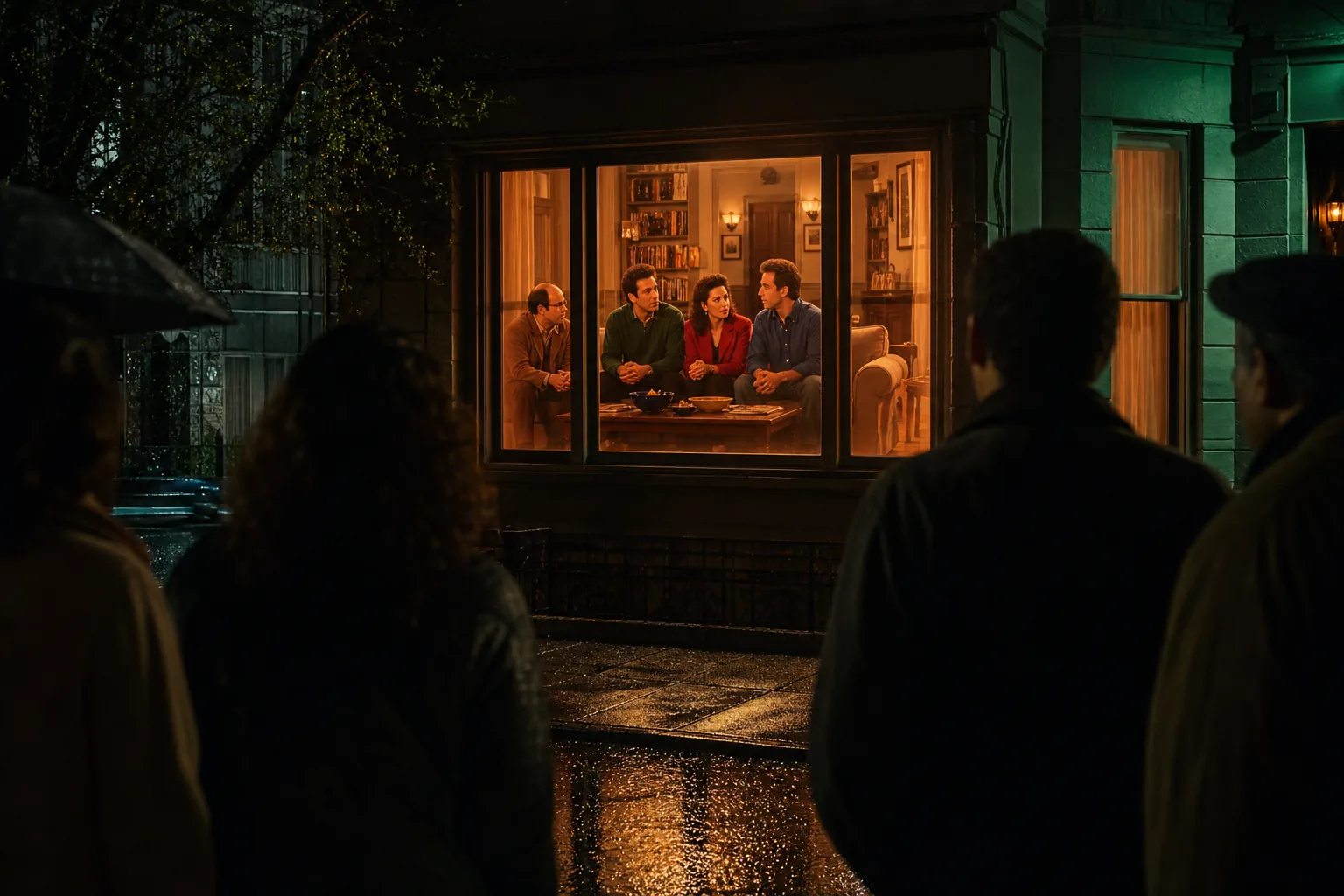
Netflix will remain the streaming home of Seinfeld for another five years after Sony Pictures Television renewed its licensing agreement for all 180 episodes of the sitcom. Sony also extended Paramount’s exclusive U.S. basic-cable rights for three years, covering Comedy Central, TV Land and other Paramount cable networks. Financial terms were not disclosed.
The arrangement keeps a series that debuted in 1989 working across two very different television businesses: on-demand streaming and scheduled linear cable. That matters because it challenges a persistent assumption about the streaming era—that the most important programming is always the newest, most exclusive release.
For Netflix, a long-running, recognisable comedy can perform a job that originals often cannot: it gives subscribers something easy to start, revisit and leave on in the background, with no need for a launch campaign or a weekly release schedule. For Sony, the owner of the show, separate streaming and cable agreements extend the earning life of an established asset rather than tying its value to a single outlet.
A 1980s sitcom with a current audience
Seinfeld first arrived on Netflix and Comedy Central in 2021, following deals Sony signed in 2019 with Netflix and Viacom, before Viacom’s merger with CBS and its later rebrand as Paramount Global.
Its audience remains unusually broad. Nielsen found that 60 million Americans were exposed to at least one minute of Seinfeld on streaming or linear television in the first half of 2026. That measure should not be confused with 60 million people completing episodes or watching regularly. But it is still meaningful evidence of reach for a show that ended its original run decades ago.
The series has assets that travel well across generations: a deep 180-episode catalogue, instantly identifiable characters, highly reusable premises and dialogue that has entered everyday language. Terms such as “regifting” and “double-dipping” are part of the show’s cultural afterlife, not merely references remembered by its original viewers.
Sony Pictures Television chairman Keith Le Goy described the comedy as exceptional intellectual property that continues to create value for partners while reaching new viewers. The renewed deals give that claim a commercial shape: the property is not being preserved only as a classic; it is being actively distributed where contemporary audiences still spend time.
Why library programming is strategically useful
Streaming services need new releases to generate attention, but attention is not the same thing as day-to-day use. A large library title can make a service feel more dependable between major premieres. Sitcoms are especially suited to that role because episodes are relatively short, self-contained and easy to watch out of order.
Seinfeld also reduces a programming risk familiar to every platform: not every viewer wants to commit to a new drama, learn a new fictional world or wait for another episode. A known comedy supplies a low-friction alternative.
Consider a typical evening: a subscriber opens Netflix but does not want to choose a two-hour film or begin an eight-episode series. They put on a familiar Seinfeld episode while cooking, then watch another. That session may not create the public conversation of a new hit, but it adds viewing time and reinforces the sense that Netflix has something reliably watchable. The same programme can later reach a cable viewer who encounters it in a scheduled Comedy Central block.
This is why the cable extension is as revealing as the Netflix renewal. The rights are not simply moving from an older medium to a newer one. Sony has maintained separate uses for the same library, allowing streaming access to coexist with exclusive U.S. basic-cable carriage. The show’s value comes partly from its flexibility.
Ownership still matters in a licensing market
Netflix’s decision is also a reminder that its catalogue is built from a mix of owned programming and licensed titles. Licensing a proven series gives the service access to a major audience draw without owning the underlying property. The trade-off is that the owner retains leverage at renewal time.
For Sony, keeping ownership means it can negotiate with different buyers for different rights and time periods. The company has now extended Netflix’s streaming window and Paramount’s cable window, rather than treating one agreement as the show’s only route to viewers.
That distinction becomes important as media groups balance the desire for exclusivity against the revenue available from third-party licensing. An owner with a lasting hit does not necessarily gain most by keeping it inside a single corporate ecosystem. Where rights and windows permit it, multiple distribution partners can produce a broader return.
What the renewal says about “legacy” TV
Calling a series “legacy content” can make it sound secondary to new programming. The Seinfeld agreement points to a different reality: a mature catalogue title can be a working product with a continuing audience, not a dormant archive item.
Not every older show has this kind of commercial life. A five-year streaming renewal depends on more than nostalgia; it requires a catalogue with enough episodes, recognition and repeatability to stay useful after the initial licensing splash has faded. Seinfeld has all three, along with decades of cultural familiarity.
For viewers, the immediate effect is straightforward: all 180 episodes will remain available on Netflix, while Paramount’s cable networks retain their U.S. basic-cable rights. For the industry, the more interesting point is that a 37-year-old sitcom still supports distinct deals across streaming and linear TV. In an era defined by constant new-release churn, that is a valuable kind of durability.
Join the discussion
You’ll appear as Guest. Links are removed automatically.
No comments yet. Start the conversation.