
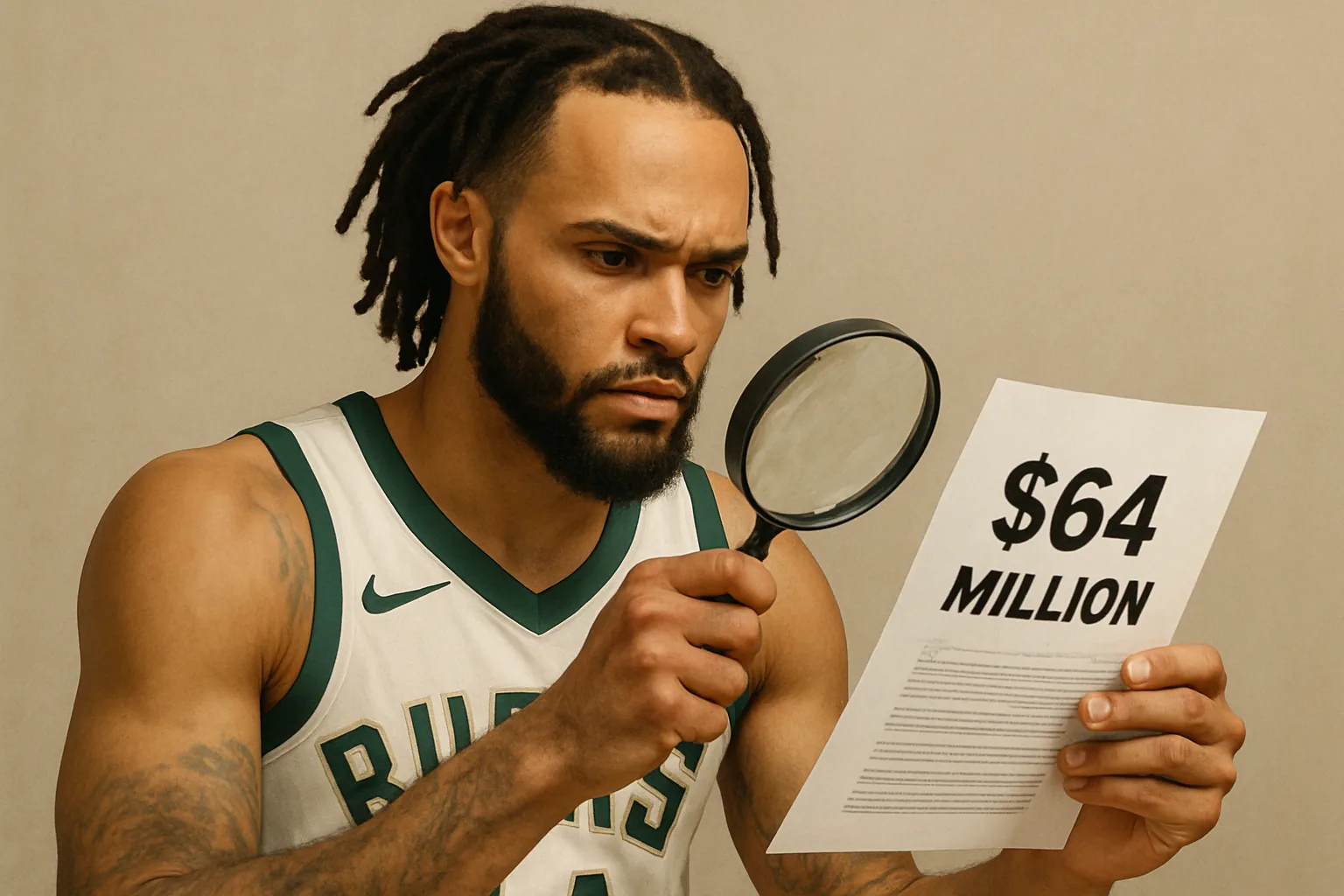
The NBA is examining the circumstances behind Gary Trent Jr.’s new four-year, $64 million contract with the Milwaukee Bucks, according to NBC Sports. The issue is not simply that Milwaukee may have overpaid. The league is looking at whether the contract was the final step in an arrangement made before Trent spent two seasons playing for the Bucks on low-cost deals.
That distinction matters. NBA teams can make generous offers, misjudge a player’s value or pay a premium for continuity without violating the collective bargaining agreement. They cannot ask a player to accept less now in exchange for a guaranteed reward later if the arrangement is designed to work around the salary cap.
No violation has been established. For now, the contract’s unusual progression has created the question the league must answer: is this merely an aggressive basketball decision, or evidence of a prior agreement?
Why the contract attracted scrutiny
Trent entered the summer of 2024 after completing a three-year, $52 million contract. He then joined Milwaukee for the minimum and remained with the Bucks on another inexpensive contract the following season.
His performance does not provide an obvious explanation for the subsequent jump. Trent averaged 8.1 points while shooting 38.7% from the field in 2025-26. NBA.com lists his three-point percentage at 36%, down from 41.6% the previous season.
Milwaukee nevertheless gave the 27-year-old a fully guaranteed four-year deal worth $64 million. Its first-year salary reportedly starts around $15 million, close to the $15.044 million non-taxpayer mid-level exception established for 2026-27.
The combination is what drew attention around the league: two discounted seasons, a weaker second year and then four years of guaranteed money at a sharply higher salary.
Early Bird rights explain the mechanism, not the intent
After Trent spent two consecutive seasons with Milwaukee, the Bucks obtained his Early Bird rights. Those rights gave the team a lawful way to exceed the salary cap to retain him. They are designed to help teams keep their own players rather than lose them simply because they lack cap space.
Using that exception is not suspicious by itself. The concern would be an earlier promise that connected Trent’s discounted contracts to the later raise.
Consider a simplified example. A capped-out team tells a player, “Accept a small contract for two seasons. Once we hold your Early Bird rights, we will give you a much larger four-year deal.” Each contract might fit within an available exception when viewed separately. The prior promise would still defeat the cap’s purpose by turning several contracts into one concealed arrangement.
Remove the promise, however, and the sequence can be legal. A player may voluntarily take less to join a preferred team. That team can later decide to pay him more after acquiring the necessary rights. Timing and salary progression may invite scrutiny, but they do not prove coordination.
Milwaukee has a plausible market-value defense
There is at least one reported counterargument. When disclosing the agreement, ESPN’s Shams Charania said another team had explored a sign-and-trade involving roughly comparable money. If another bidder was prepared to pay Trent at this level, Milwaukee can argue that it matched the market rather than settling an old obligation.
The strength of that explanation will depend on details that are not public. An inquiry is not necessarily a firm offer, and no team or proposed trade structure has been identified publicly. Investigators would need to determine how advanced those discussions were and whether the interest independently supports the final contract price.
The league may also examine communications among the Bucks, Trent and his representatives. The contract’s shape can motivate an inquiry; proving circumvention generally requires something more persuasive than an unconventional valuation.
Why the case matters beyond one contract
The NBA’s cap system relies on multiyear restrictions that apply consistently across teams. If a club could quietly defer compensation until it acquired a player’s Bird rights, those restrictions would become easier to evade.
That would give teams a way to assemble more talent during a competitive window: persuade a player to accept a discount, use the resulting flexibility elsewhere and repay the player after the required service period. Rival teams following the cap as intended would be operating at a disadvantage.
There is a second problem for the league. Legitimate discounts and prohibited arrangements can look similar from the outside. Veterans accept below-market contracts for playing time, location, role or a chance to contend. A later raise does not retroactively make the first decision improper. Enforcement therefore depends on evidence of an understanding, not public disbelief about the final number.
The current CBA gives the league meaningful remedies when circumvention is proven, potentially including fines, lost draft picks or a voided contract. Those possibilities make the inquiry consequential for Milwaukee, but they should not be mistaken for a prediction that punishment is coming.
The deal also carries a basketball cost
Even if the contract survives untouched, Milwaukee has committed substantial guaranteed money to a player coming off a diminished season. That decision arrives as the post-Giannis Bucks reshape their roster around acquired players and recent draft picks.
Trent also enters a crowded perimeter group that includes Tyler Herro, Caris LeVert, Jaime Jaquez Jr. and first-round pick Brayden Burries. The competition for minutes makes the four-year guarantee harder to evaluate as a simple payment for an indispensable role.
That roster context does not establish a cap violation. It does explain why the contract looked so unusual to other executives: the salary, term, recent production and depth chart all point in different directions.
What to watch next
The decisive developments will be evidence of any earlier commitment, confirmation of the reported rival interest and the league’s description of the process. A finding that Milwaukee simply paid an aggressive market rate would close the matter without changing the broader rules.
A finding of a prior agreement would carry wider consequences. It would warn teams that acquiring Bird rights through discounted contracts cannot be paired with an off-book promise of future compensation—even when every individual contract appears permissible on its own.
Until the league completes its review, the proper label is an unusual contract under scrutiny, not a proven scheme. The $64 million figure prompted the questions. What Milwaukee and Trent understood during the preceding two years will determine the answer.