
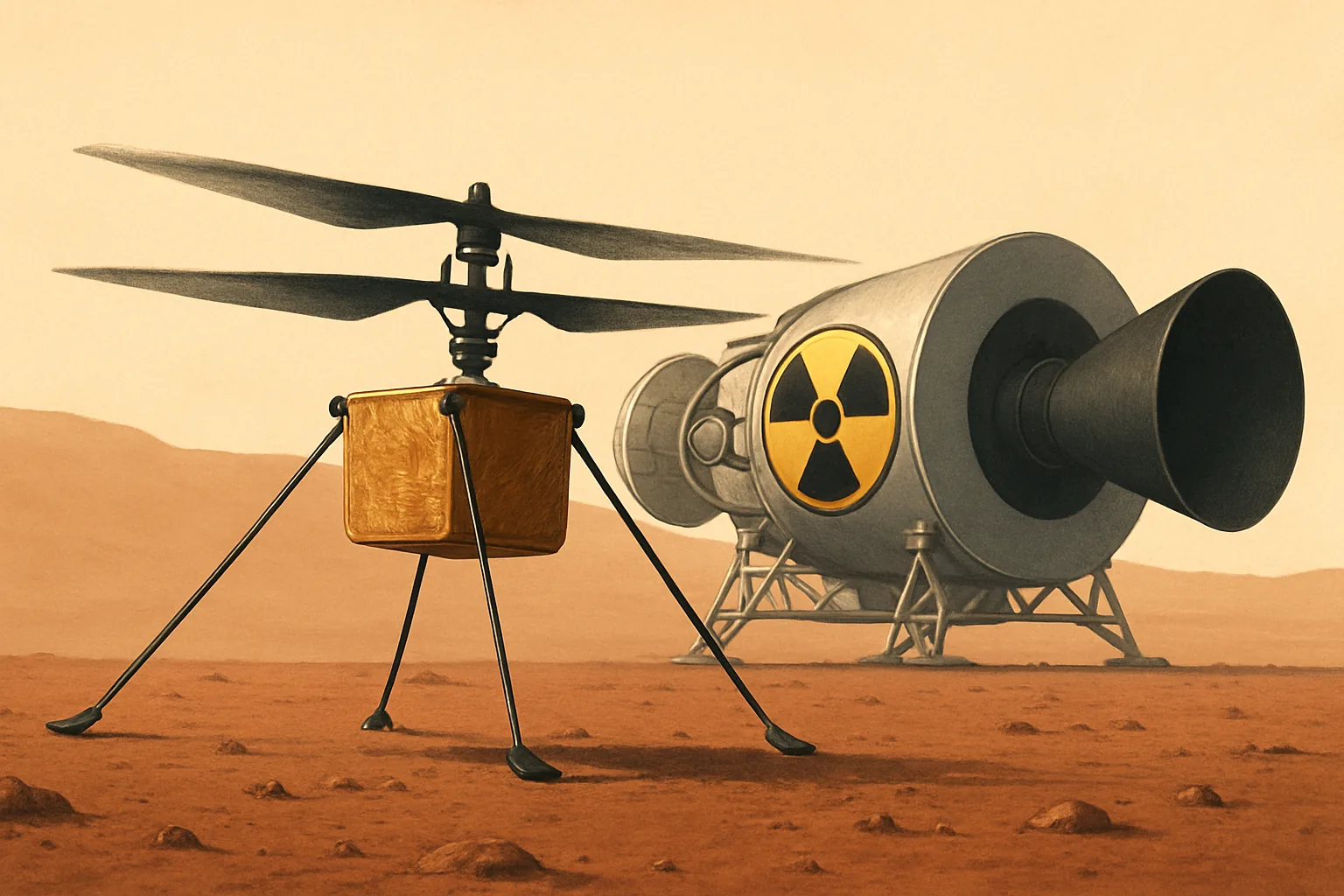
NASA says it will launch the Skyfall Mars mission in December 2028, sending three small helicopters to the Red Planet aboard a spacecraft called Space Reactor-1 Freedom. The helicopters are easy to picture. The harder part, and likely the more important one, is Freedom itself: NASA is calling it the first nuclear-powered interplanetary spacecraft, built to demonstrate advanced nuclear electric propulsion in deep space.
That makes this announcement bigger than a new Mars drone story. It is also a statement about what kind of exploration NASA thinks it will need next.
Why the spacecraft matters more than the payload
Skyfall has a clear mission. According to NASA's March 24 briefing, the helicopters will carry cameras and ground-penetrating radar to scout a future human landing site on Mars. They are meant to assess slopes and hazards for human-scale landers and to map subsurface water ice, including where deposits are, how deep they are, and other characteristics that matter for future crews.
That is already a meaningful step beyond Ingenuity, the helicopter that arrived with Perseverance in 2021. Ingenuity proved powered flight on another world could work. Skyfall, as described in the source coverage, would use that idea for a more operational job: prospecting terrain for human exploration.
But the reporting makes plain that NASA sees Freedom as the centerpiece. Space.com quoted the agency saying SR-1 Freedom will establish flight heritage for nuclear hardware, help set regulatory and launch precedent, and activate the industrial base for future fission power systems across propulsion, surface missions, and long-duration missions. That is not how agencies talk about a one-off stunt. That is how they talk about a platform they want to normalize.
Nuclear electric propulsion, or NEP, is different from the radioisotope power systems NASA has used for decades on missions such as Voyager. The source explains the distinction clearly: RTGs generate electricity from radioactive decay, but they are not propulsion systems. NEP, by contrast, uses a fission reactor to generate electricity that powers efficient electric thrusters. In NASA's framing, this is useful not only because it works far from the sun, but because it potentially fits a much wider range of missions.
Skyfall is also a Mars site-survey mission in disguise
The practical logic of the mission is unusually direct. Before NASA can talk seriously about sustained human activity on Mars, it needs better local intelligence about landing conditions and accessible resources. Water ice matters for obvious reasons: life support, fuel production, and basic mission architecture all look different if usable ice is shallow, patchy, abundant, or absent.
A simple way to think about it: imagine NASA has two candidate landing zones that look acceptable from orbit. One has smoother-looking terrain but uncertain ice deposits. The other appears rougher, but may have more accessible subsurface ice. Orbiters can narrow that choice, but not settle it. A small helicopter fleet that can scout hazards close-up and use radar to characterize the shallow subsurface could change the risk picture before humans ever arrive.
That is the sort of job robotic precursors are supposed to do. In that sense, Skyfall fits neatly into a more mature phase of Mars planning. It is not just about proving a machine can fly. It is about reducing uncertainty where uncertainty is expensive.
What this says about NASA's direction
The timing matters. The Space.com report notes that the Skyfall announcement came as NASA also said it was pausing the long-planned Gateway lunar station and shifting focus toward building surface infrastructure for a moon base. In related March 24 coverage, Space.com reported NASA's plan for a phased lunar base through 2032, with an estimated cost of roughly $20 billion, and a greater emphasis on landers, rovers, habitats, logistics, and supporting systems.
That makes Freedom look less like an isolated technology experiment and more like part of a wider pattern. NASA is leaning toward systems that support sustained operations: surface power, transport, logistics, and mission architectures that can keep working after the first demonstration flight. The agency's own description of NEP in the source material points in that direction, linking the technology not just to robotic missions but also to moon-base operations and later journeys deeper into the solar system.
There is also a program-management angle here. New propulsion technologies are often discussed in abstract terms for years without ever becoming normal hardware. NASA's language around precedent and industrial base suggests it knows that the barrier is not only engineering. It is also regulation, supply chains, contracting, launch approval, and repeated use. A successful first mission would not solve all of that, but it would move the conversation from slides to flight history.
What to watch next
The caveat in the source coverage is important: the architecture is not yet final. Space.com reported that NASA may continue flying SR-1 Freedom deeper into the solar system after it deploys the Mars helicopters, but that possibility remains undecided. That uncertainty is normal for an early mission concept, and it also tells you where to focus.
- Watch whether NASA keeps describing Freedom as a one-mission delivery vehicle or as a reusable deep-space asset.
- Watch for firmer details on power level, thruster performance, and mission profile. Those will say more about NEP's practical value than the headline phrase "nuclear-powered spacecraft."
- Watch the Mars scouting objective closely. If NASA keeps emphasizing terrain safety and water-ice mapping, Skyfall will look increasingly like a precursor to human missions rather than a standalone science oddity.
For now, the cleanest read is this: Skyfall gives NASA a concrete reason to fly a capability it wants for much bigger reasons. The helicopters are the visible part of the mission. Freedom is the bet underneath it.