
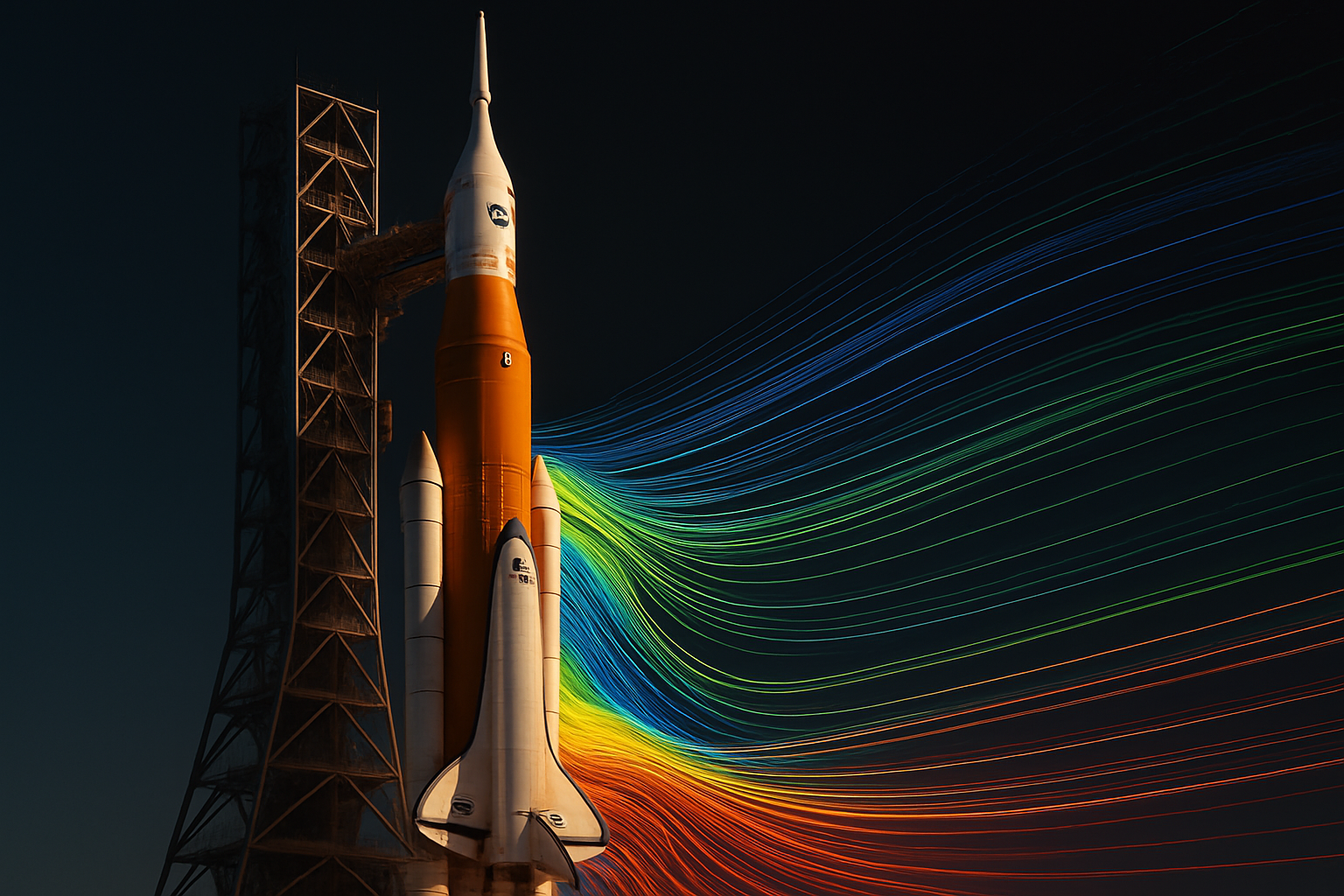
Stories about launch readiness often focus on the visible moment when a rocket leaves the pad, but the deeper engineering story usually unfolds much earlier. Simulation work matters because major missions depend on risks being understood before hardware is asked to perform in the real world. For Artemis II, that means the invisible labor of modeling airflow, stability, and structural behavior is not peripheral to the mission. It is part of what makes launch confidence possible in the first place.
This is especially important for a crewed lunar mission, where the tolerance for preventable uncertainty is far lower than in a routine satellite launch. NASA is not merely trying to get a vehicle off the ground. It is trying to ensure that every phase of ascent behaves within expectations tight enough to protect human life and preserve mission objectives under intense scrutiny.
Why simulation work carries so much weight
Complex rockets move through changing aerodynamic environments in a matter of minutes, and small misjudgments can magnify quickly when combined with speed, vibration, and structural load. Simulation helps engineers explore those conditions repeatedly before the actual event occurs. It allows them to refine assumptions, identify edge cases, and improve confidence where physical testing alone would be too limited, expensive, or risky.
That makes the work more than a technical complement to launch preparation. It is a central part of how modern aerospace organizations earn the right to believe their systems are ready.
Why Artemis II raises the stakes
Artemis II is not just another mission on a crowded manifest. It carries symbolic and operational significance as part of the broader return to crewed deep-space ambition. That means every element of readiness is read at two levels: engineering adequacy and institutional credibility. If NASA emphasizes advanced simulations, it is partly because the public story of preparedness now depends on showing rigorous control over complexity, not simply expressing optimism.
The more visible and historic the mission, the more important the prelaunch evidence of discipline becomes.
A useful way to frame it is this: simulations matter because in high-stakes spaceflight, confidence has to be built out of repeated encounters with uncertainty before the real encounter arrives.
Why invisible preparation is often underrated
The public tends to reward spectacle, while engineering organizations survive on anticipation. Most mission success is created in design reviews, modeling environments, and iterative problem-solving sessions that never look cinematic. Yet these are exactly the places where launch-day surprises are reduced. The stronger the preparation, the less visible it can appear from the outside.
This is one reason articles about simulation work are worth taking seriously. They show where reliability is actually manufactured in complex systems.
What to watch next
The important questions are whether the modeling leads to meaningful refinements, how NASA communicates residual risk, and whether later milestones reinforce the sense that technical readiness is being earned systematically rather than narratively. In missions like Artemis II, credibility grows through evidence of disciplined preparation.
That is why this work matters. It highlights how major space efforts succeed not only through powerful hardware, but through the patient reduction of uncertainty long before ignition.
For missions this ambitious, launch day is only the visible end of a much larger chain of engineering decisions already made.