
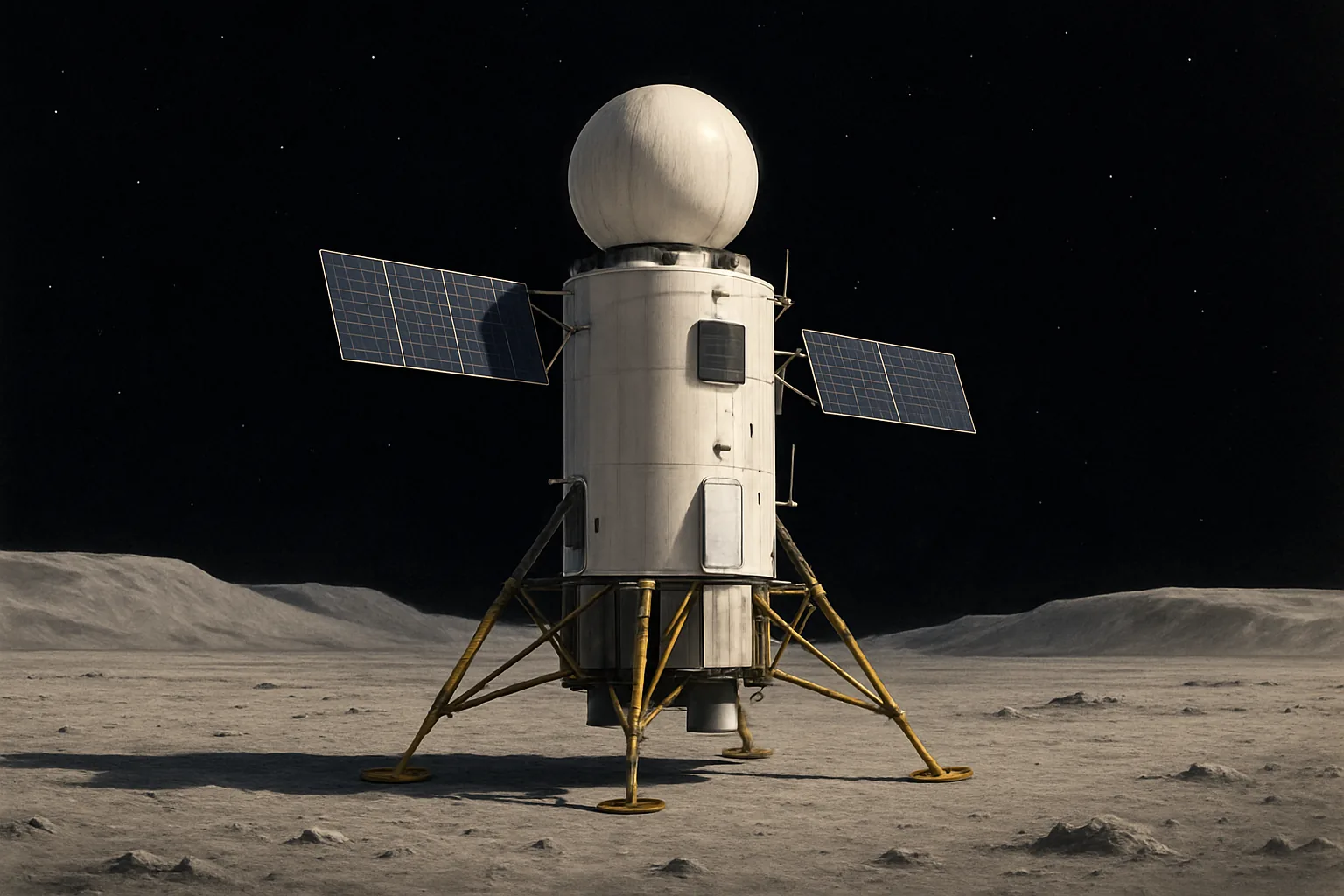
NASA has moved Gateway out of the center of its Artemis plans and put the lunar surface in front. The shift emerged in late March 2026 coverage around the agency’s "Ignition" update and follow-on remarks tied to Artemis II, with Space.com reporting that NASA is sidelining the long-planned lunar-orbiting station in favor of building up a moon base and increasing the pace of crewed surface missions.
That is a bigger change than dropping one piece of hardware. Gateway was supposed to be the organizing hub of the post-Apollo moon program: a station in lunar orbit where crews, cargo, logistics flights, and partner hardware would meet before missions headed down to the surface. If NASA is now treating that orbital stop as optional, the architecture of Artemis changes with it.
What changed
Space.com’s March 24 report said NASA is officially sidelining Gateway to focus on establishing a base on the moon’s surface. The report also noted that the agency said this does not rule out returning to an orbital outpost later. A separate Space.com update described Gateway as no longer launching next year, while NASA pushes development of a moon base and a nuclear-powered spacecraft called Freedom.
NASA’s own Artemis update from March 3 already pointed in this direction, even before the Gateway decision became explicit in press coverage. The agency said it wants a higher mission cadence, a standardized Space Launch System configuration, an added demonstration mission in 2027, and a path to roughly one lunar mission per year after that. NASA also said Artemis V is when it expects to begin building its moon base.
In other words, the center of gravity is moving from orbital assembly to repeated surface operations. That matters because schedules, vehicle designs, and international contributions were built around the older sequence.
Why Gateway was hard to keep defending
Gateway was not a symbolic side project. NASA has described it as the first space station around the moon and a core part of Artemis. Its international structure was also unusually heavy. NASA’s public Gateway materials list major partner contributions including ESA’s Lunar I-Hab habitation module, Lunar View refueling and logistics module, and Lunar Link communications system; JAXA’s planned habitation components and logistics support; and the Canadian Space Agency’s Canadarm3 robotics system. Northrop Grumman was building HALO, the Habitation and Logistics Outpost.
That sounds strong on paper. It also means Gateway carried the burden of coordination, interfaces, orbital operations, and launch timing across multiple governments and contractors before astronauts could get much practical value from it on the surface.
NASA now appears to be making a blunter calculation: if the political goal is Americans landing on the moon, then staying there, every major element has to justify itself against surface cadence. Gateway struggled on that test. An orbital station may still be useful, but a moon base produces a simpler political story and, potentially, a more direct engineering path to permanent lunar presence.
There is also a timing issue. NASA’s March 3 architecture update emphasized near-term transportation systems, a 2027 demonstration mission closer to Earth, and the first lunar landing under the new plan in early 2028. That is a tempo story. Gateway is infrastructure that asks NASA to invest in long setup time before surface operations become routine. The revised Artemis framing suggests the agency would rather spend that time on hardware that shortens the path to repeated landings.
A concrete example of what this changes
Consider a commercial lunar lander provider. Under the older Artemis logic, part of the job was fitting into a system that included Orion in lunar orbit and Gateway as future infrastructure for logistics, habitation, communications, and docking. Under NASA’s revised setup, the next critical milestone is a 2027 Earth-orbit demonstration of commercial lander capabilities, followed by direct preparation for surface missions.
That changes what “ready” means. Instead of optimizing around an eventual orbital station network, the provider has stronger reason to optimize for faster test cycles, surface reliability, propellant margins, docking demonstrations, and operations that help NASA reach the moon more often. The technical work does not become easy. It becomes narrower and more immediate.
The awkward part: partners and suppliers built for Gateway
The sharpest consequence may land outside NASA headquarters. Gateway was one of the cleanest ways to give allies and industry a durable role in Artemis. A module, a robotic arm, a logistics service, or a communications system can anchor years of procurement, staffing, and political commitment. A surface-first program is still open to partners, but it redistributes where those contributions fit.
That creates immediate uncertainty for companies and agencies whose hardware was tied to Gateway rather than directly to a moon base. Some of that work may be repurposed. Some may be delayed. Some may have to be reframed as surface support instead of orbital infrastructure. NASA has not closed the door on revisiting Gateway later, but “later” is not the same thing as keeping the current industrial plan intact.
There is a diplomatic angle too. Artemis has always been sold as a coalition project, not just a national program. Gateway helped make that argument visible because partners had named, physical elements in the architecture. If the program shifts decisively toward surface sorties and base construction, NASA will need a new way to show where those partner contributions fit and when they matter.
What to watch next
The next useful question is not whether Gateway is philosophically dead. It is whether NASA can make the surface-first version of Artemis look operationally cleaner within the next year.
- Watch for how NASA reassigns or re-describes Gateway-linked partner hardware.
- Watch whether commercial lander milestones move faster once the orbital station is no longer treated as a near-term dependency.
- Watch how NASA talks about Artemis V and the first elements of a moon base, because that will reveal what “base” means in practice: short-stay habitat, logistics node, power system, or something more ambitious.
For now, the important point is simple. NASA is no longer asking the world to imagine lunar orbit as the essential middle step. It is asking whether the faster route to a lasting moon presence starts on the ground. If that holds, Gateway will be remembered less as the backbone of Artemis than as the architecture NASA decided it could not afford to make central anymore.