
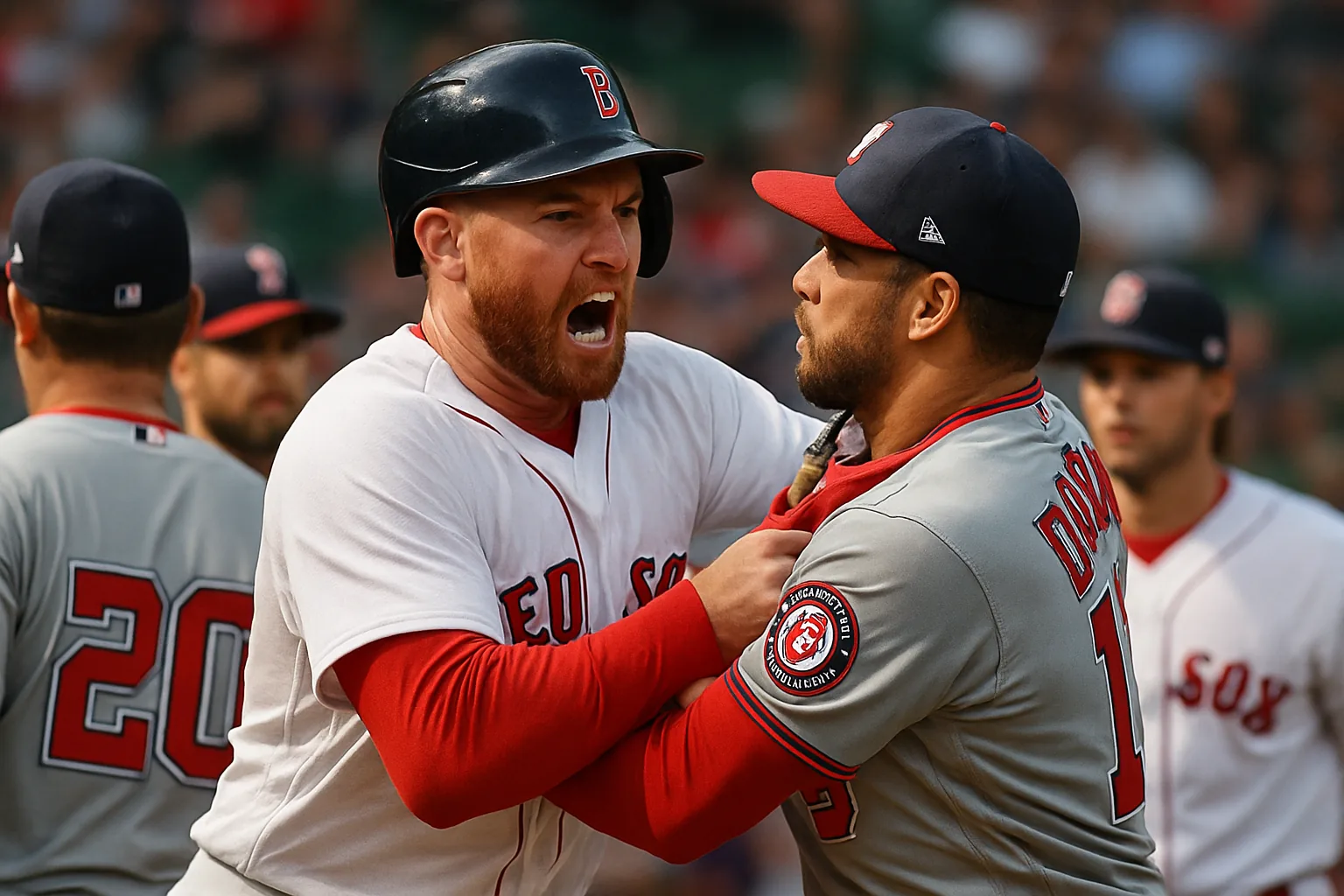
Major League Baseball issued suspensions to four players after a benches-clearing fight between the Boston Red Sox and Washington Nationals at Fenway Park, with Washington pitcher Cade Cavalli and Boston first baseman Willson Contreras receiving the heaviest initial penalties.
MLB announced seven-game suspensions for Cavalli and Contreras on July 2. Nationals pitcher Miles Mikolas received five games, while Red Sox outfielder Nate Eaton was suspended for three. All four players were also fined undisclosed amounts, according to the discipline announced by MLB senior vice president of on-field operations Michael Hill.
The suspensions were scheduled to begin July 3, when Boston opened a road series against the Los Angeles Angels and Washington hosted the Pittsburgh Pirates. But because players can appeal MLB discipline, the timing did not become final immediately. Cavalli appealed and later had his suspension reduced from seven games to five on July 6. Contreras and Eaton continued to play while awaiting appeal decisions.
What Led To The Brawl
The incident began in the fourth inning of Tuesday night's game at Fenway. Cavalli struck out Contreras looking on a full-count pitch, then shouted toward him. Contreras responded by throwing his helmet at Cavalli and walking toward the mound.
The confrontation escalated quickly. The two exchanged words, both dugouts emptied, and the game moved from a tense at-bat to a full benches-clearing scene.
Contreras, Eaton, Mikolas and Red Sox interim manager Chad Tracy were ejected. Cavalli was not ejected during the game, though MLB later gave him one of the two longest initial suspensions from the incident.
Why The Appeals Matter
In baseball, a suspension is not only a punishment. It is also a roster-management problem. A five-game or seven-game ban can affect bullpen usage, lineup depth, travel plans and the way a manager handles a series. That is why appeals are not a formality.
For pitchers, the practical impact can be especially uneven. A position player suspended for several games is unavailable every day of the ban. A starting pitcher’s suspension can sometimes be timed around the rotation, depending on the schedule and the league’s final ruling. A reliever’s absence may be felt immediately if the bullpen is already stretched.
That makes Cavalli’s reduction from seven games to five meaningful even if it looks modest on paper. Two games can change whether a team needs to cover an extra pitching day, alter a rotation turn, or lean harder on the bullpen in the middle of a series.
For Contreras and Eaton, continuing to play while appeals remain unresolved gives Boston short-term flexibility. It also leaves uncertainty hanging over future games. A team may have its player available today, but still need to prepare for a forced absence once the appeal process ends.
A Small Example Of The Competitive Effect
Imagine a team entering a weekend series with a tired bullpen after two high-scoring games. If a suspended pitcher’s appeal is resolved before that series, the manager may need to protect relief innings, avoid aggressive early hooks, or call up another arm if roster rules allow it. If the appeal is still pending, the club can operate normally for the moment.
That is the odd middle ground created by MLB discipline appeals. The original fight is over, but its competitive effect can show up days later, in a different city, against a different opponent.
Contreras’ Recent Context
The Fenway incident did not happen in isolation for Contreras. He had been ejected the previous game after mimicking an appeal call following a checked-swing strikeout. In that same game, he celebrated a three-run homer off Mikolas with a large bat flip, which he later apologized for.
Contreras also acknowledged that he had been under stress after his native Venezuela was damaged by a pair of devastating earthquakes the previous week. That context does not erase the helmet throw or the confrontation, but it helps explain why the moment carried more emotional charge than a routine strikeout dispute.
MLB’s job in these situations is narrower than explaining every personal pressure behind an outburst. The league is disciplining on-field conduct: the shouting, the thrown helmet, the approach to the mound, the actions once players left the dugouts. Still, for readers and fans, the human context matters because baseball arguments often look sudden only from the outside.
What MLB Is Signaling
The league’s discipline separates the incident into levels of responsibility. Cavalli and Contreras received the strongest initial penalties. Mikolas and Eaton received shorter bans. That suggests MLB viewed the central confrontation differently from the actions of players who joined or escalated the wider scene.
The fact that Cavalli was not ejected but still received a major suspension is also worth noting. Umpire decisions during a game and league discipline after video review do not always match. MLB can weigh actions after the fact, review angles unavailable in real time, and punish conduct that was not fully addressed on the field.
For teams, the lesson is blunt: benches-clearing incidents rarely end when the dugouts empty and the game resumes. The league office can still reshape the consequences days later, and appeals can stretch the uncertainty into the next series.
What To Watch Next
The remaining appeal decisions will determine when Boston loses Contreras and Eaton, if their penalties are upheld or reduced. Those rulings will matter less as a moral judgment on the fight than as a practical question for the Red Sox roster.
Washington already received some relief with Cavalli’s suspension reduced to five games. Boston is still waiting on clarity for two players who were directly affected by MLB’s initial ruling.
The bigger issue for both clubs is avoiding carryover. A rivalry does not need a long history for one series to become tense, and MLB generally has little patience for repeat flare-ups after suspensions have already been handed down.
For now, the Fenway brawl is a reminder that baseball’s emotional flashpoints can carry consequences well beyond the inning that produced them. The most important part may no longer be who shouted first, but when each club is forced to play short-handed.