
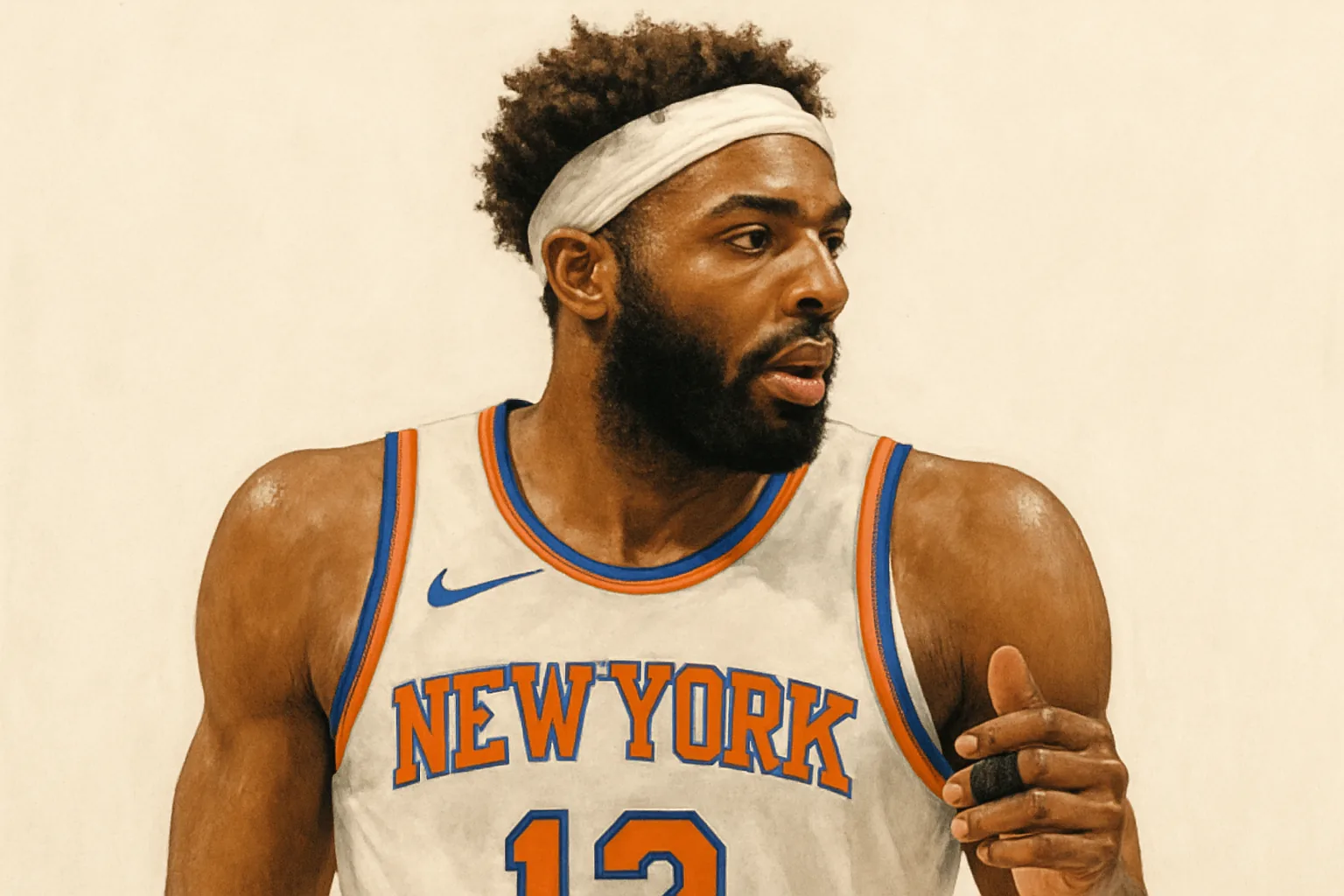
Mitchell Robinson was available for Game 1 of the 2026 NBA Finals despite undergoing surgery last week on a broken right pinkie finger, and the Knicks used him in a limited but meaningful role during their 105-95 road win over the San Antonio Spurs.
Robinson finished with two points on 1-for-2 shooting and six rebounds in 13 minutes. That line will not lead any Finals recap, but it answered the immediate question around New York’s frontcourt: the Knicks did not have to open the series without one of their most important interior players.
The team announced Robinson’s availability shortly before tipoff on June 4, after he had been listed as questionable. In the days before Game 1, he had been seen shooting with his right hand wrapped, and reports indicated he planned to play while wearing protection on the injured hand.
What the injury changes
Robinson’s injury is not a vague hand issue. He had surgery to repair a fractured fifth metacarpal in his right hand, the bone tied to the pinkie side of the hand. Neither Robinson nor the Knicks have said exactly how it happened. Knicks coach Mike Brown said only that Robinson did not injure the finger in a game or during practice.
That detail matters because Robinson’s value is unusually physical. He is not a center whose contribution is built around high-volume scoring or perimeter creation. His usefulness comes from screens, rebounds, rim protection, second chances, and the kind of contact-heavy work where hands are constantly hit, pulled, slapped, or jammed.
A brace can protect the injury, but it can also affect touch, grip, and comfort. For a player who catches in traffic, fights for loose balls, and needs to secure rebounds through contact, even a small limitation can show up quickly.
Game 1 suggested New York was willing to accept that tradeoff. Robinson did not need to play starter minutes to matter. Six rebounds in 13 minutes gave the Knicks a stretch of frontcourt stability while keeping his workload controlled.
Why a small role still matters in the Finals
The Finals are often decided less by full reinventions than by whether a team can keep its normal options available. Robinson’s return gave the Knicks one more answer against San Antonio, especially in the minutes when size, rebounding, and defensive possessions become more valuable than clean offensive spacing.
That is particularly important because Robinson had not played since May 25, when New York completed its second straight postseason sweep with a Game 4 win over the Cleveland Cavaliers. In that game, he had eight points and 10 rebounds in 18 minutes off the bench.
In other words, the Knicks were not trying to bring back a decorative depth piece. They were trying to preserve a real playoff role after more than a week away from game action and after hand surgery.
A simple possession shows the practical meaning. If Robinson boxes out, tips a missed shot, or forces a second attempt at the rim to come from a worse angle, that may never look as dramatic as a late three-pointer. But in a Finals game where the Knicks won by 10 on the road, those low-visibility possessions help explain why a 13-minute appearance can be more important than the scoring column suggests.
The Knicks avoided a larger rotation problem
Robinson being cleared also kept New York from having to solve two problems at once: matching San Antonio’s size and doing it with a shortened frontcourt. In a Finals opener, that kind of forced adjustment can ripple through the entire rotation.
Without Robinson, the Knicks would have had fewer ways to absorb interior minutes. That can mean heavier workloads elsewhere, different defensive assignments, or lineups that solve one problem while creating another. His availability gave Brown a more familiar tool, even if the minutes had to be managed.
The timing also adds weight. New York is in the Finals for the first time in 27 years, and Game 1 was not a soft landing. The Knicks were on the road against the Spurs, with Robinson coming off surgery and a questionable listing. The result was not just that he played; it was that New York won while getting usable minutes from him.
What to watch next
The next question is not only whether Robinson can keep playing. It is whether his role expands, stays capped, or changes based on how the hand responds after contact.
- Minutes: Game 1 kept him at 13. Any increase would signal more confidence in his conditioning and comfort.
- Rebounding security: The injured hand matters most when Robinson has to secure the ball in traffic.
- Finishing around the rim: He attempted only two shots in Game 1, so touch and catching will remain worth watching.
- Defensive physicality: If the brace limits his ability to contest, hold position, or recover after contact, San Antonio will test it.
For now, the Knicks got the best realistic version of the Game 1 news. Robinson was not merely announced as available; he actually played, contributed on the glass, and helped New York start the series with a road win.
That does not erase the injury. It reframes it. The broken pinkie is still part of the series, but after Game 1 it is no longer just a pregame availability question. It is a live tactical variable in a Finals matchup where every frontcourt minute has value.