
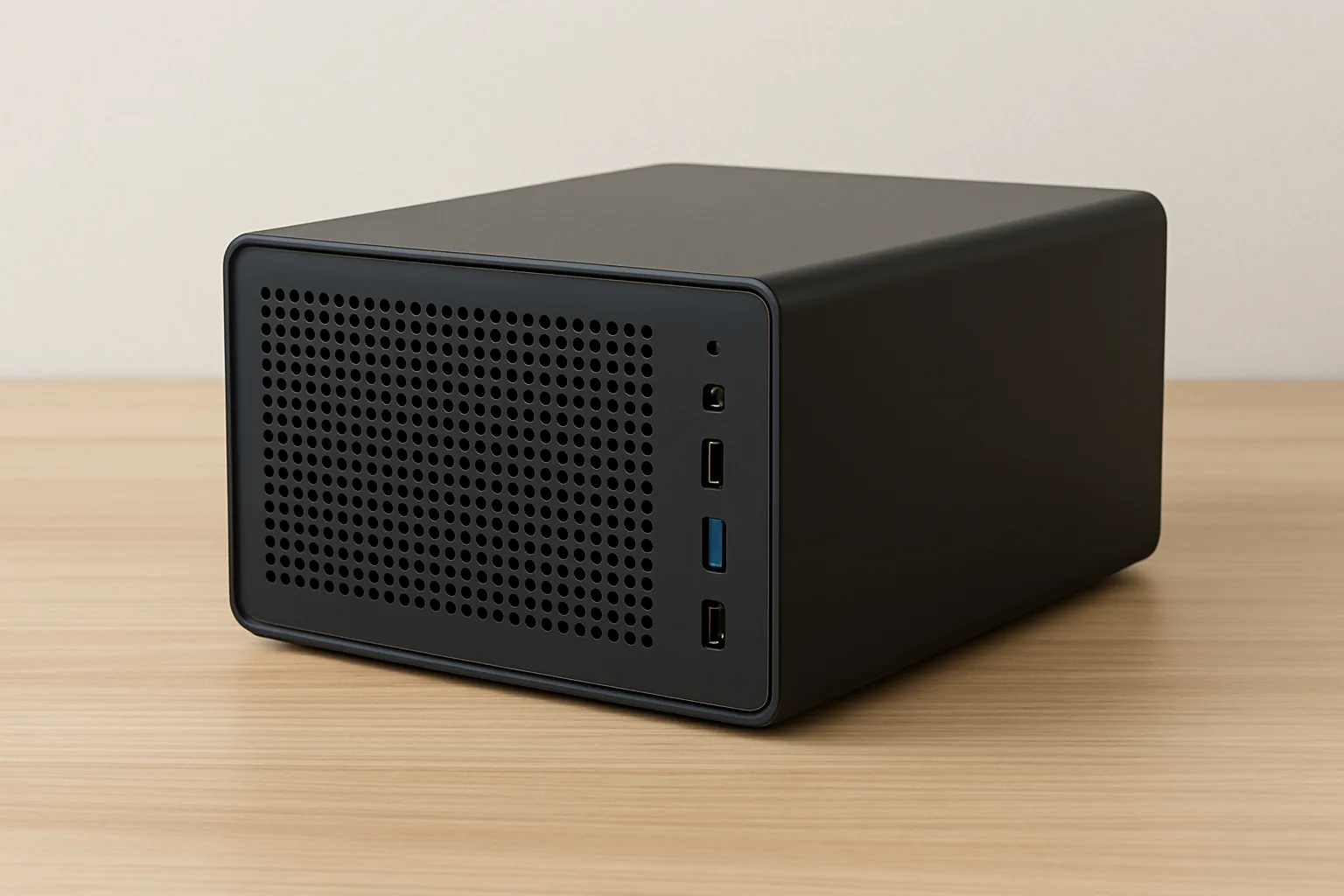
Microsoft has unveiled the Surface RTX Spark Dev Box, a compact Windows developer PC built around Nvidia’s RTX Spark superchip and aimed at teams that want to prototype, fine-tune, and run AI models locally before sending heavier work to the cloud.
The announcement, published by Microsoft on June 2, 2026, pairs the new desk-side machine with the previously introduced Surface Laptop Ultra. Together, they mark a sharper Surface strategy: not just thinner consumer hardware, but purpose-built systems for developers, creators, and technical professionals working with larger models, longer jobs, and agent-based workflows.
The Dev Box is the clearer signal. Microsoft describes it as a local-first AI development machine, with up to 1 petaflop of AI compute and 128GB of unified memory. Nvidia’s RTX Spark platform combines an Arm CPU with a Blackwell RTX GPU, giving Windows hardware makers a new base for laptops and compact desktops designed around local AI workloads rather than only general productivity.
What Microsoft Is Actually Shipping
The Surface RTX Spark Dev Box is not being pitched as a mainstream mini PC. It is aimed at developers who need sustained AI performance on a desk: local inference, fine-tuning, long-running training jobs, and agentic pipelines that may not justify a cloud GPU every time they run.
Microsoft says the system can run 120-billion-plus-parameter models with a 1 million token context locally at interactive speeds, based on Nvidia’s performance claims. It is also designed to fine-tune models that previously required cloud GPU instances. Those claims will need independent testing once hardware ships, but the intended use case is specific: give developers enough local headroom to do meaningful work before scaling up elsewhere.
The hardware story is matched by a software image tuned for developers. Surface RTX Spark Dev Box ships with Windows 11 Pro configured with developer defaults, including Developer Mode, PowerShell 7 as the default shell, WSL 2 with GPU passthrough and CUDA support, plus VS Code, GitHub Copilot, Git, Python, and Node.js installed.
Microsoft is also tying the box into its AI toolchain: AI Toolkit for VS Code for model conversion, fine-tuning, and evaluation; Windows ML with TensorRT and Windows Copilot Runtime for local inference; and Microsoft Foundry for moving from local prototyping toward production deployment.
Why Local AI Hardware Matters
The practical problem Microsoft is addressing is not that the cloud is going away. It is that cloud-first AI development can make small experiments expensive, slow, or awkward.
A developer building an internal support agent, for example, may need to test prompt changes, evaluate retrieval quality, tune a smaller model, and run the same workflow hundreds of times against proprietary documents. Sending every iteration to a frontier model can be wasteful if the task is really about plumbing, evaluation, and product behavior. A local machine with enough memory and GPU capability lets that team reserve cloud calls for final benchmarking, high-end reasoning, or production-scale workloads.
That distinction matters for startups and enterprise teams alike. The cost of AI development is not only the model bill. It includes latency, security review, data handling, and the friction of waiting on shared cloud infrastructure. A desktop box cannot replace frontier-scale compute, but it can change the economics of everyday iteration.
The Windows on Arm Angle
RTX Spark also gives Microsoft another route into Windows on Arm performance. The platform’s combination of an Arm CPU, Blackwell GPU, CUDA support, and unified memory is important because developers have historically judged new PC architectures less by launch claims than by whether their tools actually work.
That is why the preconfigured developer image is more than a convenience feature. WSL 2 with GPU passthrough, CUDA support, Python, Node.js, Git, VS Code, and common Microsoft AI tools are all meant to reduce the cold-start problem. If developers have to spend days discovering which libraries, drivers, or workflows are fragile, the hardware story weakens quickly.
App compatibility will still be one of the main tests. Microsoft says developers can work on either the Windows side or WSL, and Nvidia is promoting RTX Spark as a platform for Windows PCs built for personal AI agents. But the market will judge it through ordinary developer friction: package installs, containers, frameworks, IDE extensions, local databases, browser tooling, and build systems.
What Makes This Different From Another AI PC
Most AI PC marketing has centered on consumer-facing features: assistants, image tools, battery life, and local acceleration for everyday tasks. Surface RTX Spark Dev Box is narrower and more credible because it starts with developer pain points.
- Memory: 128GB of unified memory is relevant for larger local models and agent workflows.
- Thermals: A compact desktop can be designed for sustained work in ways a thin laptop cannot.
- Tooling: CUDA, WSL 2, VS Code, Copilot, and Microsoft’s AI stack are central to the pitch, not afterthoughts.
- Security: Microsoft is emphasizing local handling of models, proprietary data, and IP, with Secured-core PC architecture, BitLocker, Defender, Entra ID, and Intune support.
The strongest version of this product is not a replacement for a workstation, a cloud GPU cluster, or a consumer laptop. It is a development appliance: powerful enough to keep AI builders in flow, integrated enough to fit into Windows shops, and local enough to reduce the number of experiments that need to leave the desk.
What To Watch Next
Microsoft says Surface RTX Spark Dev Box will be available later this year in the United States through Microsoft.com. Nvidia has also said RTX Spark laptops and compact desktops are coming from several OEMs, including Asus, Dell, HP, Lenovo, Microsoft Surface, and MSI, with Acer and Gigabyte models to follow.
The missing pieces are pricing, real-world performance, compatibility, and availability. If RTX Spark machines are priced like niche workstations, they may appeal mainly to AI teams and technical departments. If they land closer to premium developer hardware, they could become a more common middle layer between a laptop and cloud GPU rental.
The more important question is whether local AI development becomes a normal part of the Windows developer workflow. Microsoft is betting that it will. Surface RTX Spark Dev Box is the first concrete Surface product built around that bet, and its success will depend less on the headline petaflop figure than on whether developers can sit down, run their models, keep their data local, and get useful work done without fighting the stack.