
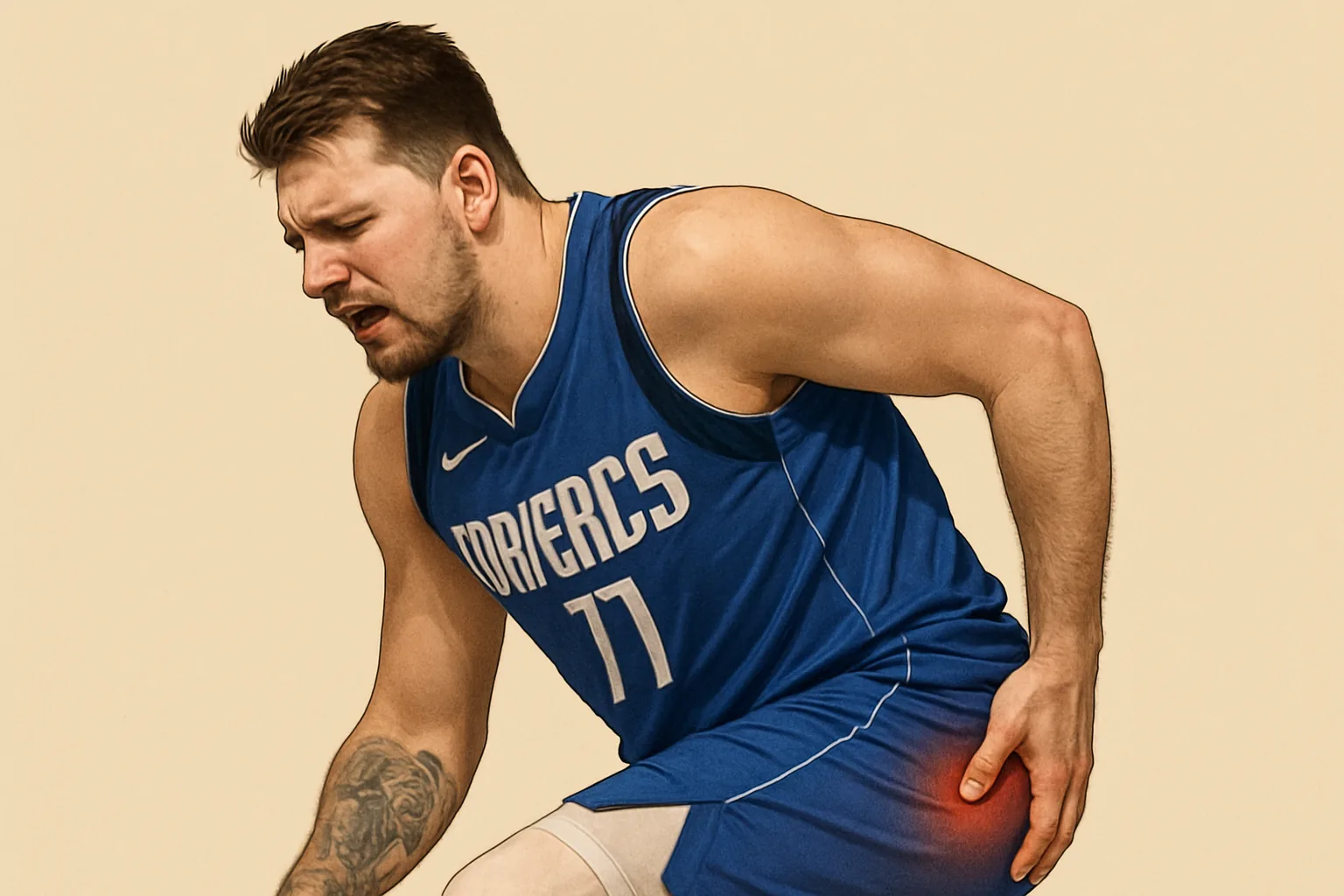
Luka Dončić’s late-season hamstring injury has pushed the Lakers into a problem they do not have much time to solve.
After Dončić exited the April 2 loss to Oklahoma City, the Lakers announced on April 3 that he had suffered a Grade 2 strain in his left hamstring and would miss the rest of the regular season. That immediately ruled him out for the team’s final five games. It also turned what might have been a simple seeding push into something more fragile: a playoff team trying to protect its structure without one of its central creators.
The regular-season part is straightforward. The harder question is what comes next. By April 6 and 7, multiple reports said Dončić had traveled to Spain for an injection and specialized treatment intended to accelerate recovery. Those same reports noted that Grade 2 hamstring strains often carry roughly a four-to-six-week timetable. That does not automatically rule him out for the playoffs, but it creates real uncertainty around the opening stretch, which is the part of the postseason when teams are supposed to be tightening rotations, not redesigning them.
What the Lakers actually lose
The obvious loss is shot creation. Dončić is the kind of player who can slow a game down, pull a defense into awkward help decisions, and generate efficient offense even when a possession starts badly. Replacing his points is difficult enough. Replacing his control is the bigger issue.
The Lakers do still have answers. LeBron James and Austin Reaves can handle more of the offense, and coach JJ Redick said Marcus Smart could return after missing time with a right ankle injury. But those are not clean substitutes. More responsibility for James and Reaves can keep the offense functioning, yet it also raises the physical and decision-making load on both players right before the playoffs.
That matters because this is not just about one absent star. It is about how many tasks shift to everyone else at once. Who initiates? Who absorbs pressure against aggressive perimeter defense? Who keeps the offense organized when the first action fails? Those are playoff questions, and the Lakers now have to rehearse them under deadline.
Why the timing is so damaging
If this injury had happened earlier in the season, the Lakers could have treated the next few weeks as a long adjustment period. They do not have that luxury. The remaining regular-season games are now less about building rhythm with Dončić and more about finding a version of the team that can survive without him, at least temporarily.
That is a very different objective.
The problem with a Grade 2 hamstring strain is not only missed time. It is uncertainty. Hamstrings are notorious for demanding caution, especially when a player’s game relies on deceleration, change of pace, and sudden bursts into space. Even if Dončić returns early in the playoffs, the Lakers would still have to manage the difference between a player being available and a player being fully himself.
That distinction can decide a series.
A practical example of the ripple effect
Take a simple late-game possession. With Dončić healthy, the Lakers can put the ball in his hands, use James as a secondary decision-maker, and force the defense to pick which star it wants to expose. If Oklahoma City or another playoff opponent sends extra help at Dončić, he can punish it with a skip pass or a short-roll read. If the defense stays home, he can hunt the mismatch.
Without him, that same possession likely starts with James or Reaves initiating. That is still credible offense, but the geometry changes. The defense can load up differently, the help rotations become easier to script, and the Lakers lose one layer of improvisation. Over a game, that may be manageable. Over a playoff series, it becomes a pressure point opponents can keep attacking.
The depth question is now unavoidable
The LA Times report pointed to a backcourt already under strain when Dončić got hurt. Smart had missed six straight games, and the team could be pushed toward even more ballhandling from James and Reaves while using Bronny James as an additional guard off the bench.
That is where this story becomes less about star power and more about roster tolerance. A contender can usually survive one missing piece for a short stretch if the surrounding lineup is stable. It gets harder when the injury lands in a position group that was already stretched.
Bronny James’ recent run of appearances is relevant here not because the Lakers suddenly want him carrying major postseason creation duties, but because it shows how quickly emergency minutes can become part of the conversation. In April, teams do not want developmental minutes. They want dependable ones.
What to watch over the next several days
The most important thing is not the final five games by themselves. It is what those games reveal about the Lakers’ fallback identity.
- Can Austin Reaves handle an even larger creation burden without the offense becoming predictable?
- How much does LeBron James need to ramp up, and what does that cost physically?
- Does Marcus Smart return, and if he does, can he steady the perimeter rotation quickly?
- Do the Lakers defend well enough to survive a temporary drop in offensive control?
Those are the questions that matter because Dončić’s status is now linked to something bigger than a medical update. It is tied to whether the Lakers can reach the playoffs with a functioning version of themselves still intact.
The larger meaning
The Lakers are not dealing with a routine late-season absence. They are dealing with a timing problem that alters what the final week of the regular season is for. Instead of tuning up a star-driven playoff attack, they are stress-testing secondary options and hoping the calendar gives Dončić enough room to recover.
There is no clean way to frame that as good news. A Grade 2 hamstring strain this close to the postseason leaves very little margin for optimism and even less margin for error. The Lakers can still remain dangerous if James and Reaves stabilize things and if the rotation around them holds. But the short-term goal has changed.
It is no longer about entering the playoffs at full strength. It is about staying organized long enough for that possibility to return.