
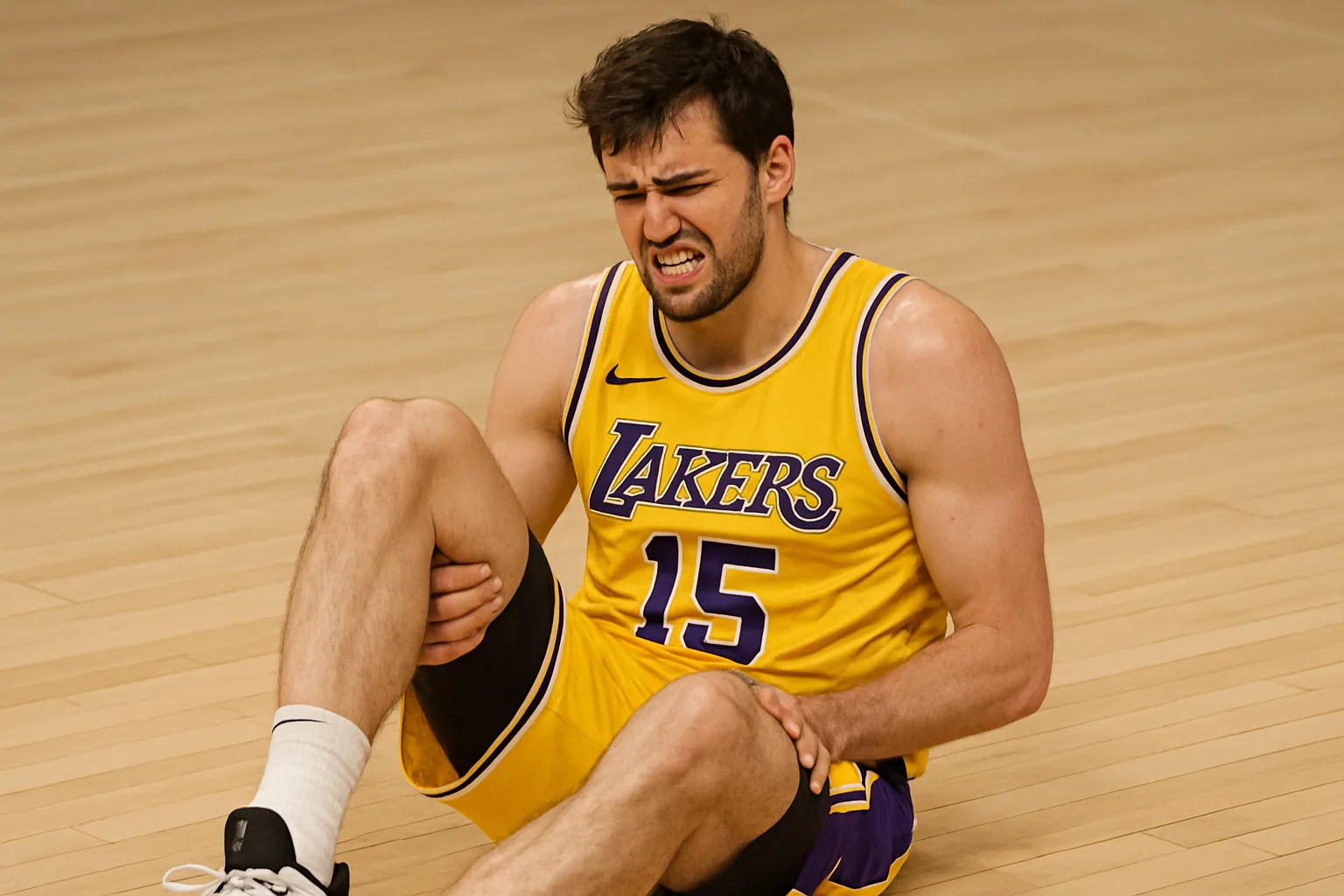
The Lakers did not just lose two starters. They lost a large share of the offensive structure that got them to 50-27 and a Pacific Division title.
Between April 3 and 4, the team announced that Luka Dončić has a Grade 2 left hamstring strain and Austin Reaves has a Grade 2 left oblique strain. ESPN reported that Dončić traveled to Spain for a hamstring injection intended to promote healing and speed his return. Reaves is expected to miss four to six weeks. With the playoffs beginning April 18, both injuries point in the same direction: Los Angeles is likely to open the postseason without two of its most important perimeter creators.
What happened, and why the timing is so damaging
The immediate facts are straightforward. Dončić and Reaves were both injured in the first half of the Lakers’ April 2 loss to Oklahoma City, though both returned to that game. Dončić was later diagnosed with what the source describes as his second significant hamstring injury this season. Reaves underwent an MRI and was ruled out for the remainder of the regular season with a Grade 2 oblique strain.
Those details matter because neither injury usually belongs to the quick-turnaround category. The AP report noted that both conditions often take a month or more to heal properly. The Lakers have not gone beyond the next five games in public projections, but the practical issue is obvious: even the optimistic outcome is not simply getting one or both players back. It is getting them back healthy enough to handle playoff pace, playoff contact, and playoff minutes.
That is a very different question.
Regular-season absences can be managed with rest days, looser scouting, and a wider spread of opponents. The playoffs narrow everything. Opponents attack weak points possession by possession. Rotations shrink. Every missing ballhandler or shot creator changes the geometry of the game. That is what makes these injuries more serious than the phrase out for the rest of the regular season might initially sound.
The problem is not only star power. It is possession-by-possession function.
Dončić’s injury gets the headline, and fairly so. A Grade 2 hamstring strain for a lead creator this close to the playoffs is a major event on its own. The ESPN report that he sought specialized treatment in Europe underlines how urgent the situation is. Hamstrings are especially difficult because they affect not just top-end speed, but stopping, starting, changing direction, and generating force in tight spaces. Those are the movements Dončić uses constantly, even though his game is not built on straight-line burst.
Reaves’ injury may be easier to underrate, but the Lakers do not really have that luxury. The AP report describes him as a vital offensive option next to Dončić and LeBron James, and the production backs that up: 23.3 points, 5.5 assists, and 4.7 rebounds in 51 games. He is not just a secondary scorer. He is one of the players who keeps possessions from stalling when the defense loads up on the first option.
Lose Dončić, and the offense loses a central organizer. Lose Reaves too, and the fallback plan is damaged as well.
A simple playoff example makes the point. Imagine a late first quarter in Game 1. James brings the ball up, the defense shades extra help toward him, and the next action needs someone who can either break down a defender, hit a pull-up, or make the right pass one step early. That is normally where Dončić or Reaves changes the possession from manageable to dangerous. Without both, the Lakers are not just missing points. They are missing solutions.
Why this changes the Lakers' playoff profile
Before the injuries, the Lakers looked like a team with enough shot creation to pressure almost any defense. After them, they look much thinner. Not hopeless, but thinner in a way that matters against postseason scouting.
The shift is especially stark because Los Angeles had built a strong regular season around multiple offensive hubs. That kind of balance matters in April because it gives a team ways to survive a bad shooting night, a foul problem, or a defense built to remove the first action. If the Lakers open the playoffs with James carrying a larger share of initiation and fewer proven creators around him, the burden on every possession rises.
That does not mean the season is over. It does mean the margin for error is much smaller than it was a week ago.
The schedule matters here too. The regular season can absorb injuries by offering time and volume. The playoffs do the opposite. They force teams to reveal whether their depth is structural or cosmetic. The Lakers now have to answer that question under pressure, likely before either injured player has had normal recovery time.
What to watch next
The next phase is less about official labels and more about usable availability. Even if Dončić returns sooner than expected after treatment, the meaningful question is whether he can move freely enough to survive playoff targeting. A compromised hamstring is not just a medical concern; it becomes a tactical one. Opponents will test it in transition, in switches, and in repeated half-court actions.
Reaves’ timeline may be even more straightforwardly restrictive. If the four-to-six-week expectation holds, the start of the playoffs is likely out of reach. For the Lakers, that means the opening games of a series could be spent trying to stay afloat long enough for the roster to get closer to full strength.
There are a few practical implications to keep in view:
- LeBron James' workload changes immediately. Even if the Lakers try to spread creation duties around, the natural pull will be toward more on-ball responsibility for their most trusted initiator.
- Lineup flexibility shrinks. It is harder to mix offense and defense cleanly when two high-usage perimeter options are missing.
- Game 1 matters more than usual. If the Lakers are opening a series short-handed, falling behind early could force even riskier return decisions later.
The larger point is not that injuries happen. It is that these particular injuries hit the exact functions the Lakers could least afford to lose at this point in the calendar. One removes an offensive centerpiece. The other removes a critical release valve. Together, they change the feel of the postseason from one of upside to one of triage.
That is the real development here. The Lakers still have star power, and they still have a playoff berth. But the version of the team that earned its record and division title is no longer the version heading into April 18. Until Dončić and Reaves are back and moving well, Los Angeles is not just waiting on two players. It is waiting on the return of its offensive shape.