
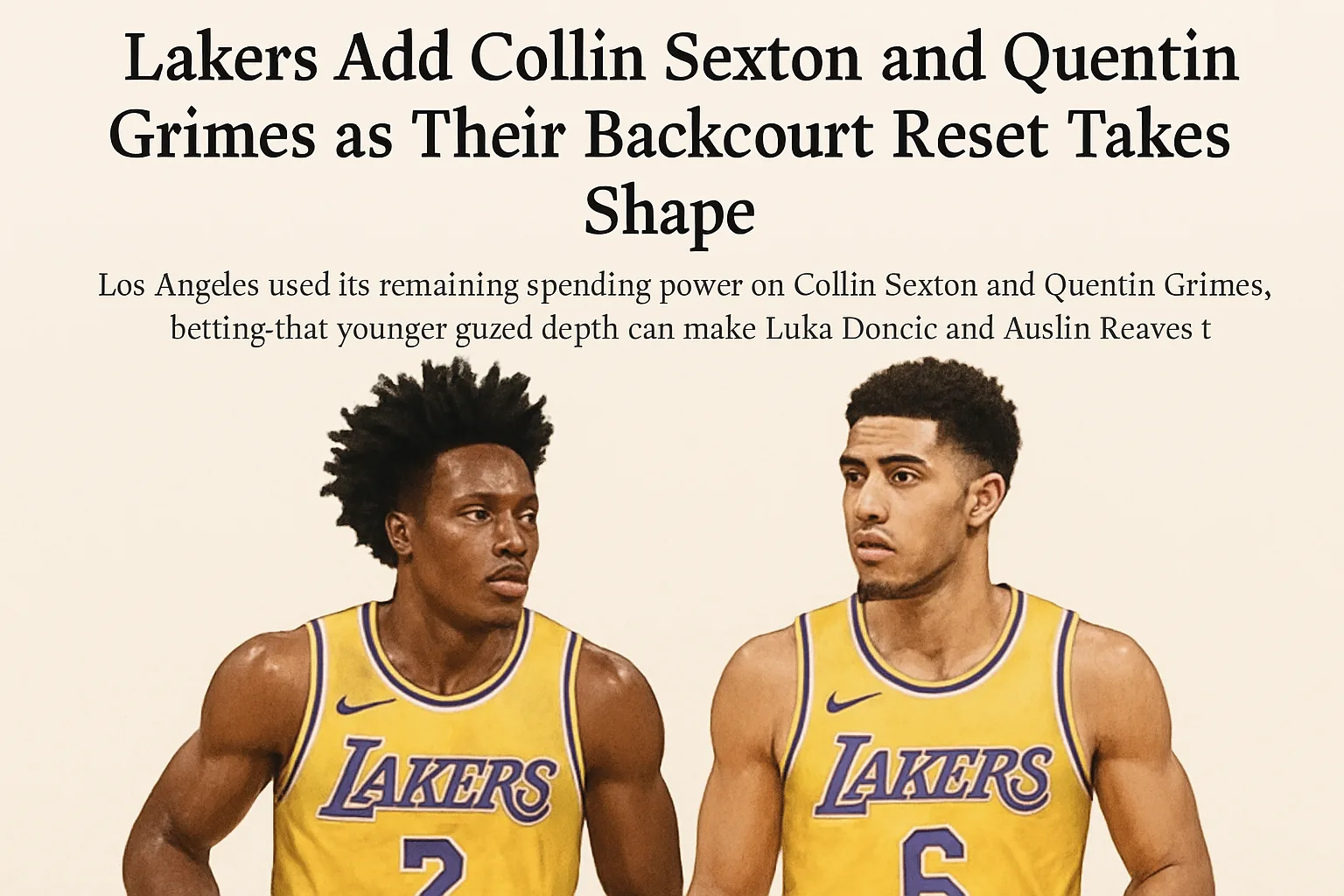
The Los Angeles Lakers moved quickly in free agency, agreeing to deals with guards Collin Sexton and Quentin Grimes as part of a broader roster overhaul that also included frontcourt additions such as Walker Kessler and Sandro Mamukelashvili.
According to the reported terms, Sexton is headed to Los Angeles on a two-year, $19 million deal. Grimes agreed to a four-year, $60 million contract that includes a player option in the fourth season. The Lakers’ use of the room mid-level exception on Sexton also matters: it leaves them without meaningful spending power beyond veteran minimum signings, barring trades.
That makes these moves more than routine depth signings. The Lakers have effectively made their main free-agency bet. They are choosing younger, rotation-ready guards who can support Luka Doncic and Austin Reaves without demanding that either star solve every possession alone.
What the Lakers added
Sexton gives the Lakers a direct scoring guard, the kind of player who can attack a tilted defense, pressure the rim and supply offense when a lineup needs pace. His Lakers connection has existed in rumor form for years, but the reported two-year price is modest enough to make the fit easier to understand now.
Grimes fills a different need. At 26, he fits the “entering his prime” part of the roster-building argument. The appeal is not just that he can score; it is that he gives Los Angeles another guard-sized wing option with two-way utility. For a team built around high-usage creators, players who can defend, space the floor and avoid hijacking the offense tend to age well inside the rotation.
The broader pattern is important. Kessler addresses the frontcourt. Mamukelashvili adds another frontcourt piece. Sexton and Grimes deepen the perimeter. The Lakers did not spend free agency chasing one dramatic name. They moved across several rotation slots quickly, with an obvious emphasis on age, versatility and playable depth.
Why the Sexton contract changes the Lakers’ next steps
The Sexton deal reportedly uses the Room Exception. In plain terms, that means the Lakers have spent their available above-minimum money. From here, roster improvement gets more complicated.
They can still sign players to veteran minimum contracts, but those deals usually target specialists, older contributors or players trying to re-establish value. If the Lakers want a more substantial upgrade after these signings, they will likely need to use trades involving players already under contract.
That constraint sharpens the evaluation of the Sexton and Grimes additions. Los Angeles cannot treat them as placeholders while saving another major free-agency swing. These are intended rotation pieces. If they work, the roster starts to make more sense around Doncic and Reaves. If they do not, the Lakers may have to spend trade assets to fix problems they hoped free agency had already addressed.
A more practical backcourt around Doncic
Doncic-centered teams need a specific kind of support. They need shooting, secondary handling, defensive cover and players who can punish defenses for loading up on the primary creator. Reaves already supplies some of that, but asking one guard to carry every secondary duty is risky across a long season.
Grimes can reduce that burden by taking difficult perimeter assignments and spacing the floor. Sexton can give the Lakers another player who can create offense instead of simply waiting for the ball. The distinction matters because playoff defenses often force role players to do something uncomfortable.
A simple example: imagine a second-quarter lineup where Doncic sits and Reaves is the lead organizer. Without another pressure guard, the possession can flatten into late-clock jumpers. With Sexton on the floor, Reaves can initiate, Sexton can attack a closeout or run a secondary action, and Grimes can remain available as a spacing and defensive piece. That does not make the lineup elite by itself, but it gives the coaching staff more ways to survive non-Doncic minutes.
The trade-off: depth now, flexibility later
The Lakers’ aggressive start gives them a cleaner rotation outline, but it also narrows their margin for error. Using the remaining spending tool on Sexton means the front office has less room to react if another need appears in camp or early in the season.
The practical implications are straightforward:
- Veteran minimums become the next free-agency lane. Any remaining signings are more likely to be low-cost depth than major rotation upgrades.
- Trades become the real upgrade path. If the Lakers need another meaningful piece, they will probably have to reshape salary through players already on the roster.
- Fit matters immediately. Sexton and Grimes are not luxury additions; they are part of the planned 2026-27 rotation.
There is also a stylistic question. Sexton’s value is tied to activity and scoring aggression, while Doncic-led offenses often demand patience, spacing discipline and quick decisions away from the ball. That fit can work, especially if Sexton is used to jolt bench units or attack weaker defenders. But it will require role clarity.
Grimes is the cleaner theoretical fit because two-way wings and guards are easy to plug into high-usage systems. His contract is longer and larger, however, so the Lakers are making a more durable bet on him as a core rotation player rather than a short-term experiment.
What to watch next
The Lakers’ next moves should reveal how complete they believe this roster is. If they add only minimum-contract veterans, it would suggest the front office is comfortable letting the new group reach training camp largely intact. If trade noise builds, it may mean the free-agency burst was only the first stage of a larger reshuffle.
The most important on-court question is not whether Sexton or Grimes can produce in isolation. It is whether they make the Lakers’ best players easier to manage. Doncic needs outlets. Reaves needs help with creation and defensive workload. The frontcourt needs guards who can keep the ball moving and defend well enough to stay on the floor in serious games.
Los Angeles has now paid for that idea. The rest of the offseason is about whether the roster has enough balance around it.