
Khris Middleton agreed to return to the Washington Wizards on a three-year, $17.6 million deal, but the transaction quickly became more complicated than a standard free-agent signing.
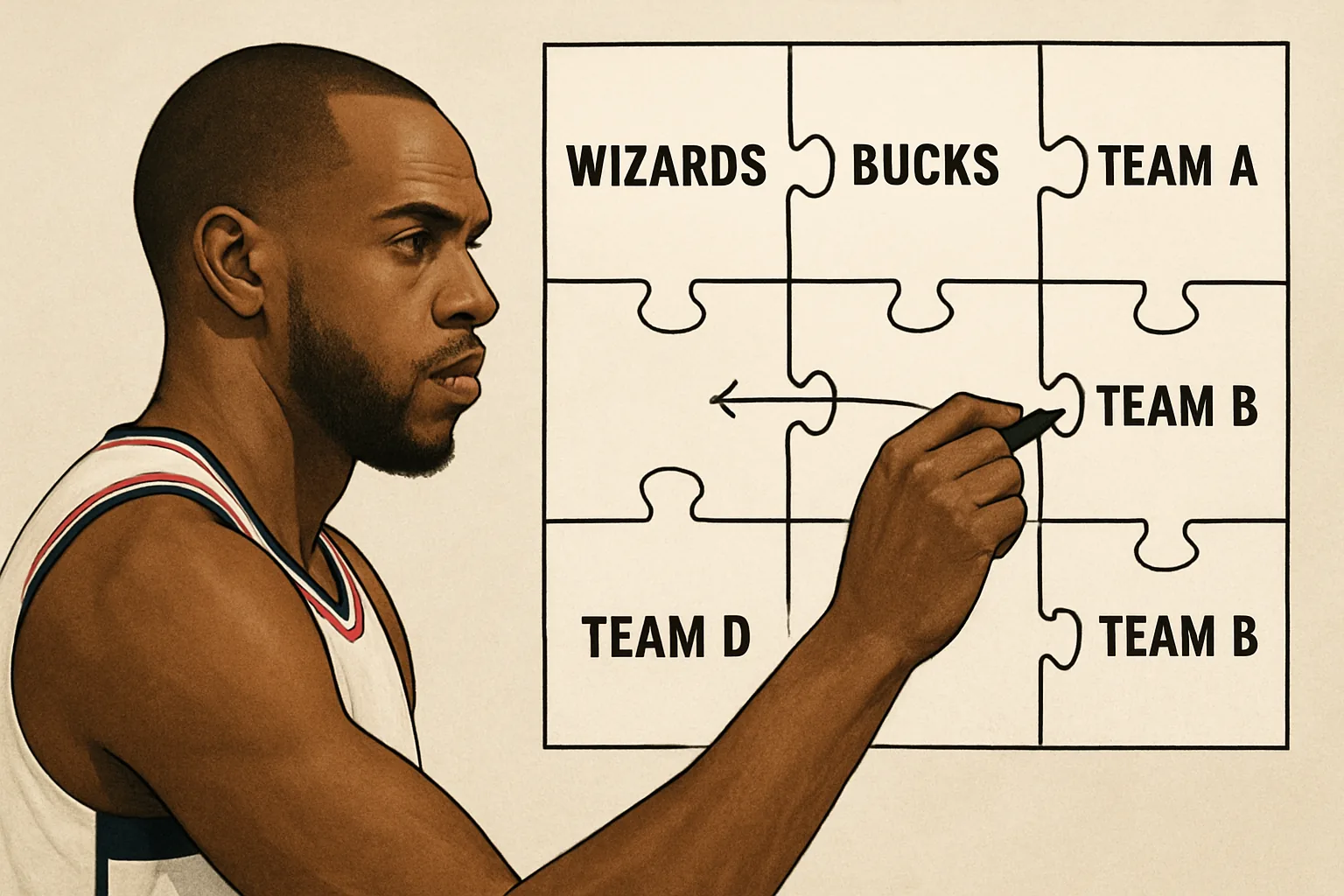
According to CBS Sports, Middleton’s agreement was folded into a rare six-team sign-and-trade involving the Wizards, Dallas Mavericks, Los Angeles Clippers, Memphis Grizzlies, Detroit Pistons and Milwaukee Bucks. The broader framework included 10 players and several moves that had initially been reported as separate transactions, including D’Angelo Russell going to Memphis.
The headline name was Middleton, but the real story was structure. Teams used one large trade framework to make multiple pending deals work more efficiently under the NBA’s salary-cap rules.
Why a simple signing turned into a six-team trade
Middleton’s return to Washington could have been handled in a more ordinary way. CBS Sports noted that the Wizards could have signed him using the mid-level exception. Instead, Washington had a $13.4 million trade exception that was expiring on July 8, 2026.
That mattered because trade exceptions can be used to absorb salary without sending matching salary back, subject to the rules. Washington was able to fit Deandre Ayton’s $8.1 million salary in a separate deal and then use the remaining structure to absorb Middleton as part of the larger transaction.
For a rebuilding team, that is not a minor bookkeeping choice. Using a trade exception instead of an exception slot can preserve other tools, improve flexibility, and let the front office handle several pieces of offseason business without wasting usable cap mechanics.
The timing also helped explain the complexity. Several parts of the deal had been reported before or during the NBA’s July moratorium, when teams and players can agree to deals but many transactions cannot yet become official. That gap gives front offices time to compare structures and ask a practical question: can these separate agreements be combined into a cleaner or more beneficial transaction?
In this case, the answer was yes. What looked to fans like a sudden six-team mega-trade was, in large part, a packaging exercise.
The players are important, but the cap math drove the deal
The deal’s unusual scale can make it sound like all six teams were chasing one shared basketball idea. That is not really how these transactions work.
Some teams were completing moves they already wanted. Memphis added D’Angelo Russell and had a previously reported move involving Stewart. Other elements, including Collins and Aldama, had also first surfaced as separate transactions. Folding them together did not necessarily mean every team’s basketball priorities changed overnight.
Instead, the six-team format let each front office pursue narrow advantages inside one official structure. That can mean creating or preserving trade exceptions, routing salary through the right team, avoiding less useful cap outcomes, or making a sign-and-trade possible without forcing an awkward one-for-one exchange.
A useful way to think about it: imagine three teams have already agreed to separate furniture swaps, but the delivery truck can take a more efficient route if all the items are moved in one coordinated trip. The furniture is still going where it was supposed to go. The route is what changed. In NBA terms, the route can create real value because salary slots, exceptions and apron restrictions shape what teams are allowed to do next.
That is why a Middleton deal that might have seemed routine became attached to one-fifth of the league. The NBA transaction market is no longer just about which player goes where. It is also about how the paperwork affects the next trade, the next signing, and the next restriction a team may face.
What Washington gets from the move
For the Wizards, Middleton’s contract is modest by veteran-wing standards: three years and $17.6 million. The basketball case is straightforward. Washington brings back an experienced forward who already spent time with the team and can provide shooting, decision-making and professional stability around a roster still being shaped.
The cap case is the more interesting part. By using the expiring trade exception rather than simply signing Middleton into the mid-level exception, Washington extracted value from a tool that was about to disappear. Trade exceptions are only useful if a team actually uses them before the deadline. Letting one expire is common, but it is also a missed chance when a suitable salary can fit.
That does not mean the transaction should be judged as a major on-court swing. Middleton is no longer being acquired as the same kind of franchise-shifting piece he once represented in Milwaukee. The point is that Washington turned a reunion with a veteran into a cleaner cap outcome while participating in a broader market-clearing deal.
Why these trades are becoming easier to misunderstand
Large NBA trades often read like one dramatic event, but many are assembled from smaller, previously agreed pieces. Fans see the final transaction. Front offices see a worksheet.
That difference matters because the league’s cap system rewards precision. A team that sends a player into another team’s trade exception may generate a more useful exception of its own. A team that avoids using a certain signing mechanism may keep more optionality for later in the offseason. A team near a spending apron may need a specific sequence to avoid triggering limits that affect trades, aggregating salaries, or taking back money.
The public-facing transaction can therefore look bigger than the basketball stakes. A six-team trade sounds historic; in practice, it may be the official container for a handful of smaller objectives.
That does not make it meaningless. It means the value is partly hidden. The immediate player movement is only one layer. The second layer is what each team can still do after the deal is complete.
What to watch next
The next question is not only how Middleton fits in Washington. It is whether the teams involved gained enough flexibility to make additional moves.
- Washington: The Wizards used an expiring trade exception instead of letting it lapse, which is the kind of marginal transaction work rebuilding teams need to get right.
- Memphis: Russell’s arrival gives the Grizzlies another veteran guard option, but the larger construction of the deal may matter as much as the name value.
- The rest of the market: Other teams may keep combining agreed-upon moves when the cap math makes one large framework more useful than several smaller ones.
The Middleton sign-and-trade is a reminder that NBA free agency is partly a player market and partly a rules market. The public conversation tends to focus on who won the trade. For front offices, the better question is often narrower: did the structure preserve one more path for the next move?