
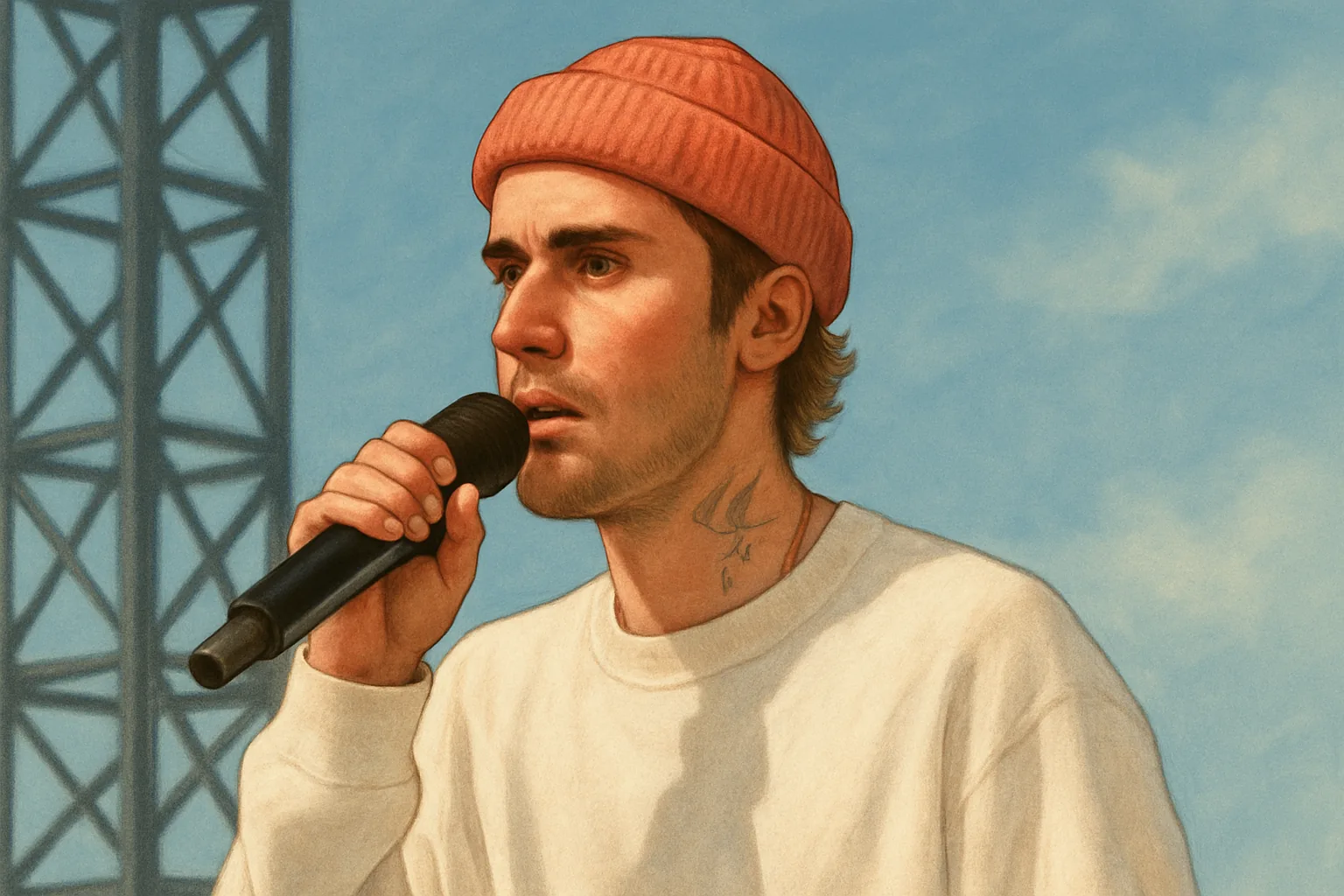
Justin Bieber’s Coachella set did what a lot of major festival moments are supposed to do: it got people talking, then it got them listening.
According to Billboard, Bieber’s music was streamed 24.6 million times in the United States on April 12, the day after his April 11 performance at Coachella. That was a 54% jump from April 11’s 15.9 million streams and a 74% lift from April 10’s 14.1 million. Compared with the previous Sunday, April 5, his catalog was up 211%.
That made April 12 Bieber’s biggest streaming day of 2026 and his strongest day since July 18, 2025, the week after the release of Swag.
Why that matters
The interesting part is not just that Coachella gave Bieber a bump. Big live moments often do. The interesting part is that the bump arrived after a performance that was being argued over in public almost immediately.
Between April 12 and April 15, social platforms filled with “Bieberchella” posts, and mainstream coverage picked up both the hype and the backlash. Some viewers praised the event-level spectacle and the built-in nostalgia. Others focused on the unusual choice to lean on YouTube-screen visuals and older clips during the show.
That split matters because it complicates the old idea that a performance has to be broadly well-reviewed to work. In this case, the public conversation itself appears to have been part of the engine. People did not need to agree on whether the set was great. They only needed a reason to reopen Bieber’s catalog.
Billboard’s track-level numbers make that point even clearer. Newer material from Swag moved, with “Yukon” and “Daisies” each pulling about 1.3 million streams on April 12. But the rebound was not limited to the current era. “Beauty and a Beat,” released in 2012, reached 1.2 million streams and was up 76% day over day. “Baby” and “Sorry” also posted large gains.
That looks less like a standard album promo effect and more like a full-catalog rediscovery cycle. A festival headline moment can compress years of fan memory into one weekend. One performance, one argument, one flood of clips, and listeners start sampling the old and new versions of the artist at once.
The performance was the trigger. The platform loop did the rest.
Bieber’s set did not end at the stage. It kept running through clips, reactions, reposts, side-by-side comparisons and fan edits. That is where the “Bieberchella” framing matters. Once a performance turns into a named online event, it stops behaving like a one-night concert and starts behaving more like a searchable media object.
That shift helps explain why backlash does not necessarily cancel demand. Online attention is not a review score. It is distribution.
A concrete example: a casual listener who sees a short clip of Bieber singing along with an older video might not come away with a settled opinion on the set itself. But they may still open Spotify or Apple Music to replay “Beauty and a Beat,” then jump to “Daisies,” then revisit “Sorry.” From the artist’s standpoint, that sequence still counts as a win. The live show creates the prompt; the catalog does the monetizable work.
That also helps explain why older songs can surge harder than newer ones after a culturally noisy performance. Nostalgia is quicker to activate. A viewer who half-remembers a 2012 hit can act on that impulse in seconds. There is less friction than there is with a newer track they have not fully absorbed yet.
What the numbers say about Bieber’s current position
The post-Coachella spike does not prove that every part of the performance landed. It does show that Bieber still has unusual recall power. Few artists can pull listeners back into multiple eras of their catalog in a single day, especially after a set that was not met with uncomplicated praise.
That is the business value of a deep catalog. When the artist becomes the story, the listening does not have to stay confined to the latest release. It spreads across the whole body of work. For Bieber, that meant Swag cuts benefiting alongside songs released more than a decade earlier.
There is another detail worth noting from Billboard’s report: Bieber’s digital song sales rose too, climbing to 3,000 downloads on April 12 from 1,000 the day before. Streaming remains the headline metric, but the sales lift suggests this was not just passive playlist traffic. At least some of the renewed interest translated into more deliberate listener behavior.
What to watch next
The immediate question is whether this was a sharp one-day rebound or the start of a longer post-Coachella cycle. Billboard noted that the impact would be reflected in charts dated April 25, based on the April 10 to April 16 tracking week. That is the next useful checkpoint because it shows whether the conversation had enough weight to carry through a full measurement period.
It is also worth watching which songs hold up. If the catalog continues to lean heavily toward legacy tracks, that would suggest the festival moment worked primarily as a nostalgia reset. If Swag songs keep climbing with the older hits, the set may end up functioning as a stronger bridge between Bieber’s past and present than the first wave of commentary suggested.
For now, the cleanest reading is simple. The loudest response to Bieber’s Coachella set was not an opinion piece or a viral joke. It was 24.6 million U.S. streams in one day.
That does not settle the argument over the performance. It does answer a different question: whether the set cut through. It clearly did.