
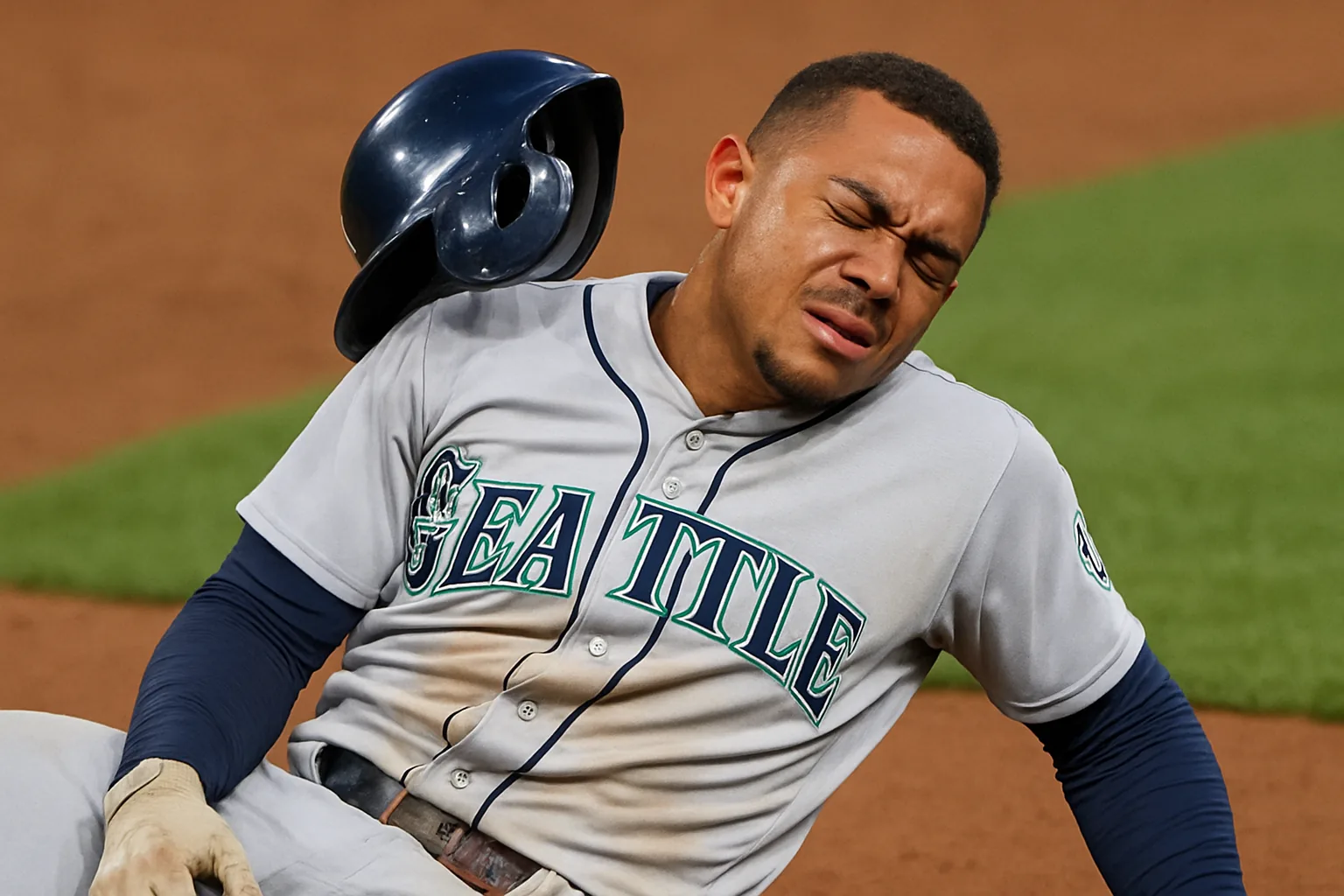
The Seattle Mariners placed Julio Rodríguez on the seven-day concussion injured list Friday, July 3, 2026, one day after their All-Star center fielder was struck in the back of the helmet by a throw during a 1-0 win over the Los Angeles Angels.
The injury happened in the first inning after Rodríguez drew a walk and tried to advance to second on a grounder by designated hitter Dominic Canzone. Angels first baseman Nolan Schanuel attempted to start a double play, but his throw to second hit Rodríguez as he slid into the bag. The ball was clocked at 78.2 mph and ricocheted off Rodríguez’s helmet, allowing him to advance to third.
Rodríguez initially remained in the game. After reaching third, he crouched down, prompting Mariners head athletic trainer Kyle Torgerson and manager Dan Wilson to check on him. He later played center field in the top of the second inning, but after the Angels went down in order, Rodríguez spoke with Torgerson in the dugout and headed to the clubhouse. Victor Robles replaced him in the lineup.
After the game, Seattle said Rodríguez had entered concussion protocol and would be evaluated again Friday. Wilson later said the decision to place him on the injured list came after Rodríguez “just wasn’t feeling like himself.”
Why the seven-day IL matters
Baseball’s seven-day concussion injured list exists for cases exactly like this: a player absorbs a head impact, may not immediately look seriously injured, but needs time and medical monitoring before returning to game speed. Unlike a sore hamstring or bruised shoulder, concussion symptoms can be delayed, subtle, or inconsistent. A player can finish an inning and still be unavailable the next day.
That distinction matters for teams as much as for players. The Mariners do not have to carry Rodríguez as an unavailable active-roster spot while waiting to see how he responds. They can replace him temporarily, and Rodríguez gets a medical runway that is not tied to the normal rhythms of a series or road trip.
The timing is still difficult. Seattle loses its center fielder ahead of a series against Toronto, and the club now has to account for his absence both defensively and in the batting order. Rodríguez is not just another outfielder on the roster; he changes how the Mariners cover the middle of the field and how opposing pitchers navigate the lineup.
The play shows why concussion decisions are rarely clean
The sequence also illustrates an uncomfortable reality in baseball: a player’s immediate reaction is only one data point. Rodríguez was checked after the throw, stayed in, and played defense. Then, after another half-inning, the situation changed enough for him to leave.
That kind of timeline can look confusing from the outside, but it is common in head-injury management. The first question is whether the player has obvious symptoms that require immediate removal. The next question is whether symptoms develop or become clearer once adrenaline drops and the player sits in the dugout.
A simple way to understand the roster impact: imagine a center fielder takes a similar throw in the first inning of a Thursday game, says he feels steady enough to continue, then reports dizziness or fogginess afterward. If the team waits without using the concussion IL, it may be short a regular player for several days while still needing to cover innings in the outfield. If it uses the seven-day list, the club can bring in a replacement and stop treating the player’s return as a day-to-day guessing game.
That is the practical value of the rule. It gives teams a specific mechanism for uncertainty, which is often the defining feature of concussion cases.
What Seattle has to solve now
Victor Robles replaced Rodríguez on Thursday, making him the immediate name attached to the vacancy. The larger question is how Seattle handles center field and lineup balance while Rodríguez works through protocol.
The Mariners will need to manage several short-term issues:
- Center-field coverage: Rodríguez’s absence affects range and positioning in one of the most demanding defensive spots.
- Lineup shape: Removing an All-Star bat changes how Seattle builds run-scoring opportunities, especially in close games like Thursday’s 1-0 win.
- Return timing: The seven-day IL sets a minimum absence, not a guarantee that Rodríguez will be ready as soon as eligible.
The most important detail is that concussion protocol, not competitive urgency, controls the next step. Rodríguez will have to be evaluated and cleared before returning, and the Mariners’ public language so far points to caution rather than a fixed timetable.
What to watch next
The key update will be whether Rodríguez’s symptoms improve quickly and whether the Mariners provide a clearer return window after further evaluation. Because the injury came from a direct helmet impact and not a collision with another player or the wall, the video may make the play look isolated. The medical process is still the same: symptoms, testing, and progression determine availability.
For Seattle, the immediate task is to get through the Toronto series without overextending the roster or rushing its best center fielder. For Rodríguez, the next meaningful development is not whether he can play through discomfort. It is whether he can clear the steps required to return without lingering concussion concerns.