
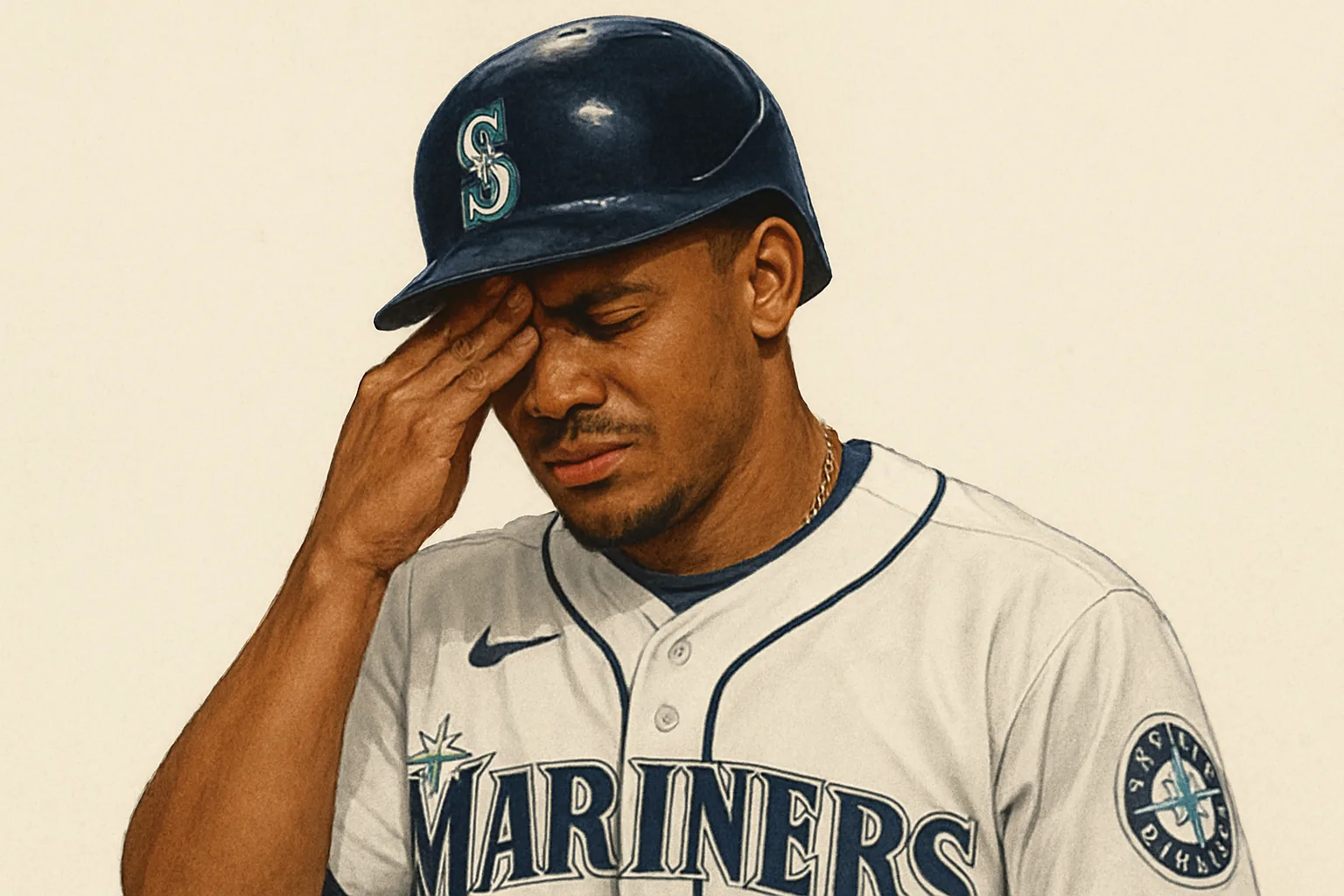
The Seattle Mariners placed center fielder Julio Rodríguez on the 7-day injured list Friday after he suffered a concussion when he was struck in the back of the helmet by a throw during Thursday night’s game against the Los Angeles Angels.
The move removes one of Seattle’s most important players for at least a week and reshapes the club’s outfield alignment ahead of its series against the Toronto Blue Jays. It also puts the Mariners in the familiar but uncomfortable position of treating a head injury as a medical timeline first and a baseball problem second.
Rodríguez was hurt in the first inning of Seattle’s 1-0 win over the Angels. He was running from first to second on a ground ball when Angels first baseman Nolan Schanuel fielded the ball and attempted to throw to second to start a double play. The throw missed its target and hit Rodríguez in the back of the head. The errant throw allowed him to advance to third, but he later left the game and was replaced in center field by Victor Robles in the third inning.
Mariners manager Dan Wilson described the situation plainly Friday: “With head injuries, you have to be so careful.” He added, “Tough break, but we’ve been through it before.”
What Seattle Changed on the Roster
To cover the roster spot, the Mariners selected the contract of infielder/outfielder Miles Mastrobuoni from Triple-A Tacoma. Mastrobuoni had been designated for assignment on June 19 and has appeared in eight major league games this season, hitting .217 with one RBI in 21 at-bats.
That transaction matters because it signals Seattle is not simply replacing one center fielder with another. Mastrobuoni’s value is flexibility: he can help cover multiple positions while the Mariners rework daily lineups around Rodríguez’s absence. Robles started Friday night’s game against Toronto in center field, giving Seattle an immediate defensive answer at the position.
The club’s challenge is not just filling innings in the outfield. Rodríguez is a three-time All-Star who had played in 87 games this season, batting .259 with 15 doubles, 14 home runs, 40 RBIs and 12 stolen bases. Last season, he played a career-high 160 games, which underlined his usual availability as much as his production.
Why a 7-Day Concussion IL Move Is Different
A 7-day injured list stint can sound minor compared with longer baseball injuries, but concussions do not follow the rhythm of a sore hamstring or a bruised wrist. The shorter IL mechanism exists because teams need a way to remove a player quickly without forcing a longer absence, yet the return still depends on symptoms and medical clearance.
That is why Wilson’s comment is the central point. The Mariners may hope Rodríguez misses only the minimum, but the important variable is not the schedule. It is how he responds in the days after impact.
For a player like Rodríguez, that caution carries extra weight. His game depends on timing at the plate, acceleration on the bases, and reads in center field. Those are not marginal skills. They are the core of his value. A player returning too quickly from a head injury could be physically present while still not fully ready to handle the speed and reaction demands of major league play.
The Practical Baseball Impact
Seattle’s short-term adjustment is straightforward on paper: Robles takes over center field, and Mastrobuoni gives the bench another option. In practice, the Mariners lose a middle-of-the-order-caliber player, a stolen-base threat, and their regular center fielder at the same time.
A simple game situation shows the difference. With Rodríguez active, Seattle can have an All-Star center fielder who can turn a single into first-and-third pressure, punish a mistake pitch, and cover ground defensively in the same inning. Without him, the Mariners may still defend the position competently with Robles, but the lineup loses one of its most dynamic pieces. That can change how opposing pitchers attack the order and how often Seattle can manufacture runs in tight games like Thursday’s 1-0 win.
The timing also matters because the Mariners had to make the move before facing Toronto. Even a one-week absence can feel larger when it intersects with a competitive series, bullpen management, and the daily grind of keeping the lineup balanced.
What Mastrobuoni’s Addition Says
Mastrobuoni’s promotion is not framed as a one-for-one replacement for Rodríguez’s production. His major league sample this season is small, and his offensive line does not suggest he is being asked to carry the lineup. The more realistic read is that Seattle needed a usable, flexible player while the outfield plan shifts around Robles.
That kind of move is common when a star goes out unexpectedly. Teams often prefer the player who lets the manager cover several contingencies: a late-game defensive change, a pinch-running decision, an infield need, or an outfield reshuffle if the game gets weird. In a concussion situation, where the exact return date can be uncertain, roster flexibility has real value.
It also protects Seattle from overextending the rest of the bench. If Rodríguez’s absence lasts only the minimum, the Mariners need to survive a week cleanly. If symptoms linger, they need a roster shape that can stretch without another immediate move.
What to Watch Next
The first thing to watch is not a batting-practice report or a projected return date. It is whether Rodríguez progresses through concussion protocols without setbacks. The 7-day designation creates the earliest possible window, not a guarantee.
On the field, Robles’ usage in center will show how Seattle wants to stabilize the defense while Rodríguez is out. Mastrobuoni’s playing time will also be telling. If he appears mainly as a bench piece, the Mariners are likely trying to minimize disruption. If he starts moving around the diamond more often, the injury may be forcing a broader roster shuffle.
For Seattle, the best-case outcome is simple: Rodríguez recovers properly, misses only a short stretch, and returns without the injury becoming a lingering concern. Until then, the Mariners have to accept a tradeoff every team faces with head injuries. The standings matter, but the player’s clearance has to matter more.