
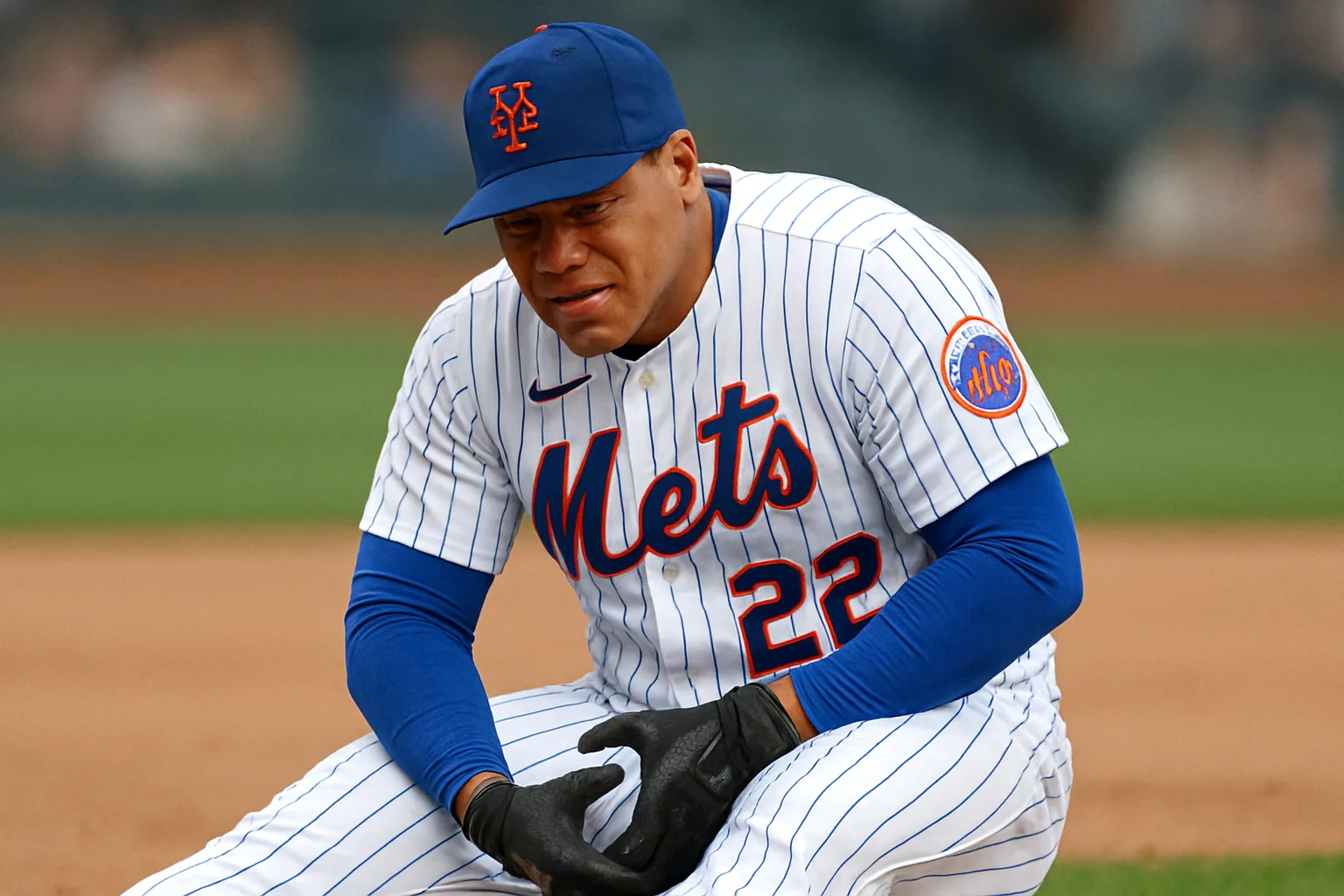
The Mets have placed Juan Soto on the 10-day injured list with a right calf strain, retroactive to April 4, after he was hurt running the bases against the Giants on April 3. The expected absence is roughly two to three weeks. For most clubs, that would be an annoying early-season setback. For the Mets, it is a quick stress test of how much lineup stability they really have when a central hitter disappears.
Soto had started the season exactly the way a team wants a franchise bat to start it: productive immediately, hitting .355/.412/.516 with 11 hits and a home run. Those are tiny-sample numbers, and April stats can mislead. But the important part is simpler than the slash line. He was already functioning as a lineup anchor, and now the Mets have to patch over that absence before the season has had any time to settle.
What happened, and what the Mets actually did
The injury itself appears manageable rather than catastrophic. The reporting around the move describes the strain as minor, with the club initially hoping a few days off might be enough before deciding Soto needed the full injured-list stint and then some. That matters because it frames this less as a season-defining event and more as a reminder that even a routine baseball injury can distort the first few weeks of a team’s plan.
The Mets recalled Ronny Mauricio when Soto went on the IL, but the recall does not mean Mauricio is a direct one-for-one replacement in the batting order or in left field. The team had already been using Tyrone Taylor and Brett Baty in the mix, and the active roster also includes Carson Benge and Jared Young. In other words, the corresponding move adds options, not a duplicate version of Soto’s role.
That distinction is important. Teams do not replace players like Soto with one bench call-up. They redistribute the lost plate appearances, defensive innings, and lineup protection across several players and hope the cumulative damage stays manageable.
Why this matters in April
April injuries are easy to wave away because the calendar is forgiving. A two-week absence in early April feels smaller than a two-week absence in September, and in one sense that is true. But early-season injuries also arrive when roles are still being established, workloads are still being sorted out, and clubs are trying to avoid making reactive decisions based on a handful of games.
Soto’s absence pushes the Mets into exactly that kind of reactive stretch. The lineup now needs extra coverage. The bench gets thinner once a depth piece becomes an everyday necessity. Matchup-based decisions become more important sooner than expected. If someone else is also dealing with a nagging issue, the margin for comfort gets narrow fast.
That is the practical difference between losing a star and losing a useful regular. A star does not just provide good production. He simplifies the rest of the roster. He lets a manager deploy complementary players in cleaner, narrower jobs. Take that away, and the entire lineup card gets messier.
A concrete example of the squeeze
Imagine a normal week in which the Mets would prefer to use a player like Taylor for defensive value and selected matchups, while Baty can be deployed according to health and form. With Soto active, that is a depth advantage. Without him, those same players can become coverage requirements.
That changes the bench immediately. A late-game substitution that would have been easy becomes more expensive. A platoon decision becomes harder to make because there are fewer fallback options left behind it. Over a two- or three-week stretch, that does not just affect one lineup spot. It affects how aggressive the club can be everywhere else.
This is why even a modest IL stay for a star draws attention. The production lost is obvious. The loss of roster flexibility is the quieter issue.
The Mets’ bigger question is depth, not panic
There is no evidence here of a long-term emergency. The reported timeline suggests a normal recovery window, and the Mets are not being forced into a dramatic roster overhaul. But the situation still reveals something useful about how the club is built.
The Mets committed enormous money to Soto because elite hitters change a team’s baseline. They raise the offense on their own, but they also make everyone around them easier to place. When that kind of player is unavailable, the burden shifts from star performance to roster construction. Can the club survive a short absence without overextending role players? Can it avoid turning a temporary injury into a month of lineup improvisation?
That is the real story of the next two weeks. The question is not whether the Mets can find somebody to stand in left field. They can. The question is whether they can preserve the shape of the roster while waiting for Soto to heal.
What to watch next
The first thing to watch is whether the recovery stays within the reported two- to three-week range. Calf injuries are tricky mostly because teams do not want a player returning at 85 percent and aggravating the issue while running or changing direction. The Mets’ handling of the timeline will matter as much as the original diagnosis.
The second thing is how the playing time shakes out around the replacement mix. Mauricio is back on the roster, but the reporting makes clear that the Mets were already leaning on other players for lineup coverage. That suggests the club sees this as a distribution problem, not a prospect-savior moment.
The third is whether the offense can hold its shape without Soto’s on-base ability. A hitter who gets on base at his level changes how innings develop, how pitchers attack the middle of the order, and how often pressure carries from one plate appearance to the next. Even in a short absence, that effect can be hard to fake.
None of this means the Mets are in trouble because of one April IL move. It means the first real test of their season has arrived earlier than expected. If Soto returns on schedule and the lineup stays intact enough to avoid a skid, this will fade into the background as a routine injury blip. If the replacement mix starts exposing thin spots, the conversation around the Mets will shift from one player’s calf to the sturdiness of the roster behind him.
That is why this matters. The injury may be minor. The information it forces the Mets to reveal about themselves is not.