
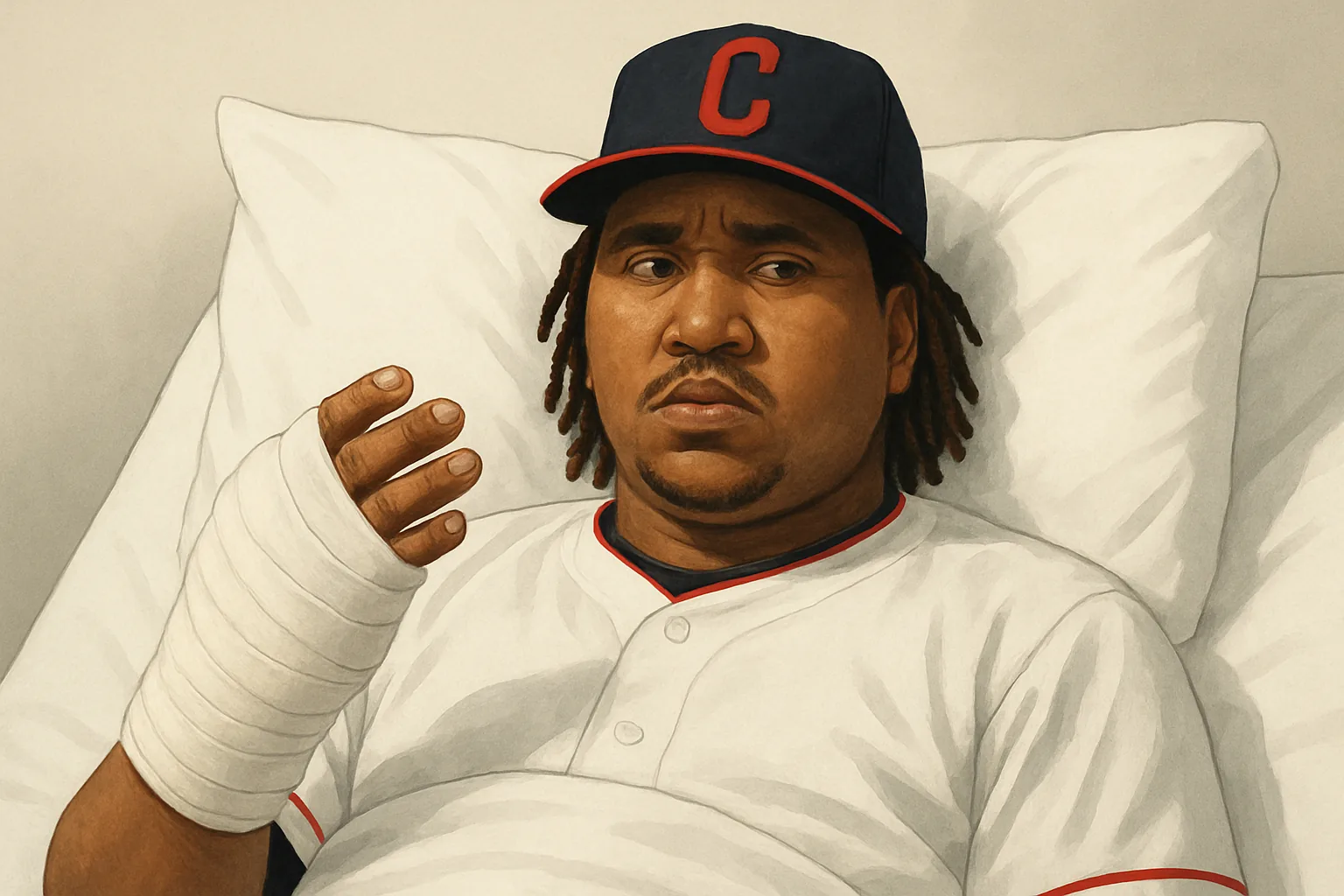
Cleveland Guardians third baseman José Ramírez underwent surgery on June 16 to remove the hook of a fractured left hamate bone in his left hand, a procedure the club said went as planned. The six-time All-Star is expected to miss roughly six weeks, with reports around the injury placing the likely absence in the 5-to-7-week range.
The injury happened during Saturday’s 3-1 win over the Detroit Tigers, when Ramírez felt something wrong on a swing in the fifth inning. A scan later confirmed the fracture. He tried to stay in the game, but manager Stephen Vogt said afterward that Ramírez could not squeeze his glove well enough to continue.
Ramírez was placed on the injured list Sunday, ending a run in which he had appeared in all 72 of Cleveland’s games this season. At the time of the injury, he was hitting .239 with 10 home runs, 33 RBIs and a .757 OPS.
What Cleveland Knows Now
The important part for the Guardians is that the uncertainty has narrowed. Before surgery, Cleveland knew Ramírez had a broken hamate bone. After the procedure, the club had a working return window: about six weeks if recovery follows the expected course.
Vogt said Ramírez was able to have the surgery earlier Tuesday. The team announced that Dr. Thomas Graham performed the procedure in Lehigh Valley, Pennsylvania.
That does not make the absence easy, but it does give the front office and coaching staff a clearer planning problem. Cleveland is not managing a day-to-day injury or waiting for swelling to settle before deciding what comes next. It is preparing for a stretch without the most important hitter in the middle of its order while the Guardians continue their push near the top of the American League Central.
Why A Hamate Injury Matters For A Hitter
The hamate is a small wrist bone, but for hitters the issue is not small. The hook of the hamate sits in an area tied closely to grip, bat control and the force a player can generate through the hands. Cleveland’s announcement focused on the surgical removal of the fractured hook, not a long list of medical projections, so it is worth keeping the interpretation modest: the immediate problem is that Ramírez needs time before he can swing, field and absorb game speed again.
That matters because Ramírez’s value is not only in home runs or RBI totals. He changes how a lineup feels to opposing pitchers. Even in a season where his batting average sat at .239, his presence forced opponents to account for a switch-hitter with power, experience and a track record of doing damage in leverage spots.
A middle-of-the-order hitter can protect the players around him without recording a hit every night. Pitchers may be less comfortable expanding the zone against the batter in front of him. Managers may think differently about bullpen matchups. A lineup with Ramírez in it has a pressure point that cannot be treated as ordinary.
The Practical Lineup Problem
Cleveland now has to replace two things at once: production and shape.
Production is the visible part. Ten home runs and 33 RBIs through 72 games gave the Guardians a dependable source of run creation. Shape is the less obvious part. Ramírez’s daily availability let Cleveland build lineups with a stable anchor at third base and in the heart of the batting order. Losing a player who had appeared in every game changes how the club handles rest, matchups and late-game substitutions.
Consider a basic game situation. Cleveland has a runner on second with one out in the sixth inning of a close divisional game. With Ramírez due up, the opposing pitcher has to balance aggression with risk: challenge him and risk extra-base damage, or pitch carefully and possibly create traffic for the next hitter. Without him, that same inning may become easier to manage. The replacement hitter might be capable, but the opposing dugout is no longer solving the same problem.
That is the gap star players leave. The box score can show who took the at-bat. It does not fully show how the absence changes the choices available to the other team.
Timing Makes The Injury More Costly
A six-week absence in April can be absorbed with more schedule in front of a club. A six-week absence in mid-June lands differently. Cleveland is already deep enough into the season that divisional position matters, but not so late that the trade market has fully clarified every seller and buyer.
That puts the Guardians in a narrow operating lane. They need enough short-term stability to avoid giving away ground in the AL Central, but the expected return timeline also makes it harder to justify a panic move purely to cover third base or middle-order offense. If Ramírez returns close to the projected window, Cleveland is trying to survive a stretch, not replace a season.
The club’s response will likely be measured in smaller details: who gets the highest-leverage at-bats, how the batting order is arranged, how much offense Cleveland can squeeze from the bottom half of the lineup, and whether the defense remains steady while Ramírez is out.
What To Watch Next
The first thing to watch is whether the six-week timeline holds. The team said the procedure went as planned, but a return to baseball activity is not the same as a return to normal production. Ramírez will need to regain comfort swinging and fielding with his left hand after surgery.
The second is how Cleveland’s offense behaves without its most established everyday presence. A short slump can be survivable. A month of thin run production can reshape a division race.
- Lineup depth: Cleveland needs more from hitters around the middle of the order while Ramírez is out.
- Run prevention: If the offense loses force, pitching and defense carry more of the margin.
- Standings pressure: The Guardians’ place in the AL Central will influence how urgently they look for outside help.
The injury does not end Cleveland’s season, and the projected timeline is not catastrophic. But it removes the player who most consistently defined the Guardians’ lineup. For the next several weeks, Cleveland’s question is blunt: can the club play winning baseball without the hitter opponents least wanted to face?