
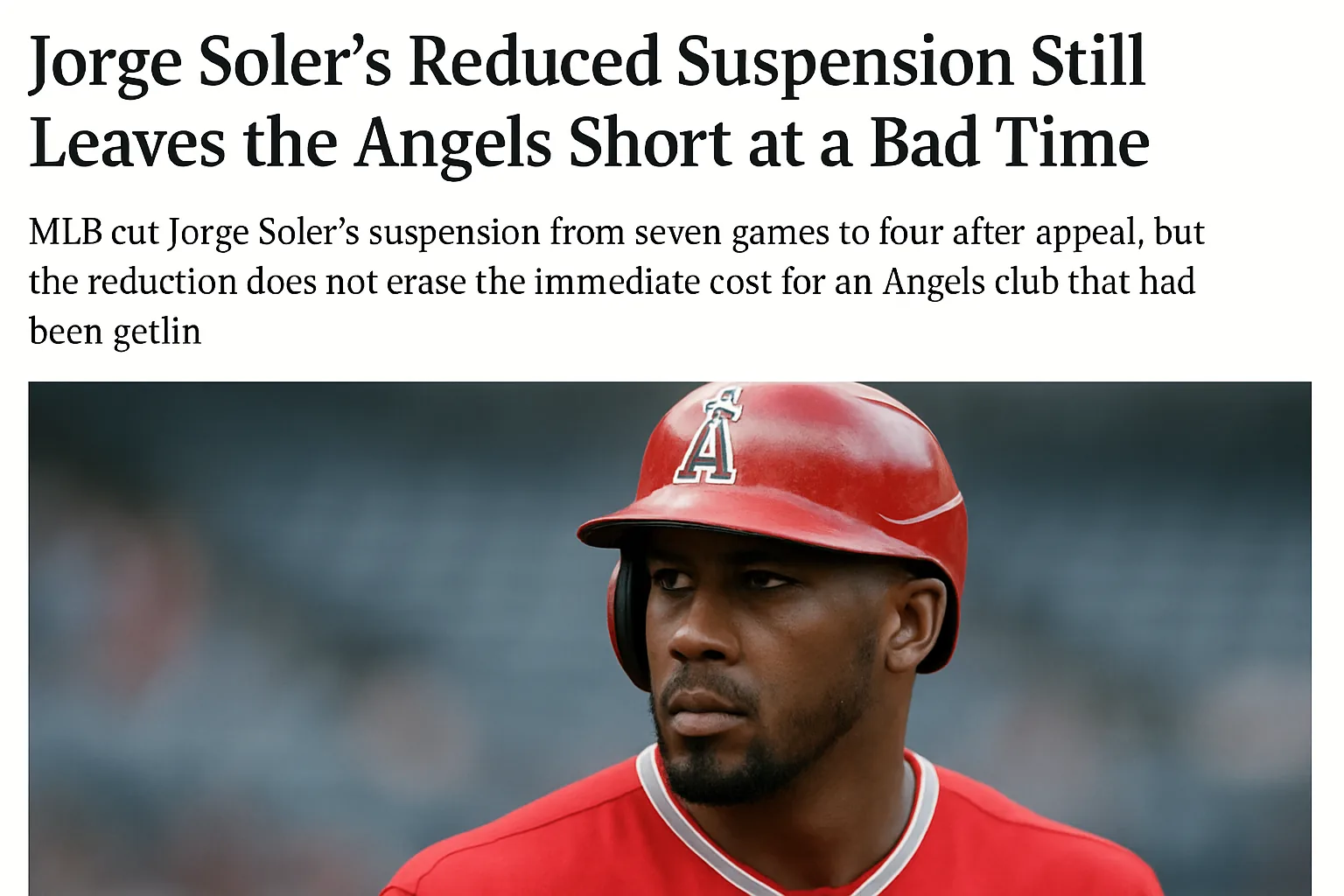
MLB cut Angels outfielder Jorge Soler’s suspension from seven games to four on April 15, and the timing matters almost as much as the ruling itself.
Soler began serving the suspension against the Yankees and will be out until Sunday, when the Angels finish a three-game set with the Padres. That is a meaningful reduction on paper, but it still removes one of the Angels’ hotter bats from the lineup at a moment when, by Soler’s own account, the club feels like it is moving in the right direction.
"I don't feel good," Soler said through interpreter Jobel Jiménez. "I feel sad because the way the team is playing right now. We're on a good track, and it’s a shame to not be part of the team right now."
The suspension came out of the April 7 benches-clearing fight between the Angels and Braves at Angel Stadium. Soler had homered off Atlanta starter Reynaldo López in his first at-bat, was hit by a pitch the next time up, then stared at López after a high pitch in the fifth inning of the Braves’ 7-2 win. Soler charged the mound and threw punches. López threw punches back while still holding the baseball, knocking off Soler’s helmet with the ball still in his hand. Both benches emptied and a larger melee followed down the first-base line.
Soler later said López’s response after he asked whether everything was OK pushed the confrontation over the line. "I asked him if everything was OK and the answer he gave me, I didn’t like it," Soler said through Jiménez. "That’s why I went out there."
What changed after the appeal
The key development is not that MLB reversed itself. It did not. The league still upheld the basic case for punishment, but the appeal reduced the length from seven games to four.
That distinction matters because it says something about how these cases often work in practice. An appeal is not only about trying to erase a suspension; it is also about reducing it to something the league, the union, and the player can all live with. Earlier in the week, López’s own seven-game suspension was trimmed to five through an agreement involving MLB and the MLB Players Association. Soler’s case ended with a similarly softer outcome.
What emerges is a familiar pattern: the original discipline establishes MLB’s authority over on-field fights, while the appeal process adjusts the penalty to reflect circumstance, precedent, or negotiation. The punishment remains real. The edges get sanded down.
Why this matters for the Angels right now
The obvious reason is lineup value. Soler is not serving this suspension while slumping through a forgettable stretch. According to the source material, he batted .280 with four home runs, two doubles and 10 RBIs over his previous seven games. Losing that kind of production for even four games has a different feel than losing a cold bat.
This is where the reduced suspension still stings. Four games sounds manageable until you place it inside a short MLB week. The Angels lose Soler against the Yankees, then remain without him into the Padres series. In a long season, those are still only a handful of games. In the short run, though, a suspension can strip away one of the lineup’s better current sources of power and RBI production just when a club is trying to hold its momentum.
A concrete example makes the point clearer. If a hitter has been driving extra-base damage over the previous week, his absence does not only remove his own at-bats. It changes how the rest of the lineup gets pitched. A middle-order bat who has recently hit four home runs forces opposing pitchers to work differently in key spots. Take that player out for four games, and the effect spreads: fewer dangerous plate appearances, more room for pitchers to attack around the remaining threats, and more pressure on replacement options to deliver immediately.
That does not guarantee the Angels will struggle without him. It does explain why a reduced suspension can still carry real competitive cost.
The disciplinary angle is straightforward, even if the outcome is negotiated
There is not much ambiguity in the central baseball issue. Soler charged the mound. Once a player leaves his position and starts a fight at the mound, a suspension is expected. The league does not need to prove a perfect punch landed cleanly to justify discipline. The escalation itself is enough.
At the same time, the details in the source help explain why both suspensions were reduced rather than simply left untouched. The sequence involved a home run, a hit-by-pitch, a high pitch, a stare, words exchanged, then a charge to the mound. That does not excuse the fight, but it does place the confrontation inside a chain of escalating moments rather than a completely isolated act.
That context tends to matter in appeals, especially when both sides absorb punishment. López ended up with five games after starting at seven. Soler landed at four after starting at seven. The penalties were still significant, but no longer identical, which suggests the league and the appeals process viewed their roles in the incident somewhat differently.
What readers should watch next
The immediate question is simple: how much does Soler’s absence show up in the Angels’ offense before he returns Sunday?
The longer-view question is slightly different. Suspensions after fights are supposed to close the book on the incident. They do not always close the emotional part of it. What matters now is whether Soler returns as a productive middle-order bat and the story shifts back to performance, or whether the fight lingers as one of those early-season flashpoints that keeps resurfacing whenever the teams or players are mentioned again.
There is also a quieter lesson here about baseball discipline. Fans often read a reduced suspension as a sign that the original ruling was excessive. Sometimes it is simply evidence that the system is built to land on a middle number. MLB signals that charging the mound and clearing benches will draw punishment. The appeal process then calibrates the exact cost.
For the Angels, the practical issue is less philosophical. Soler is out now, even if not for as long as first announced. And because he was producing at the plate, those four games are not empty calendar space. They arrive at a moment when the club would have preferred to keep every available bat in motion.