
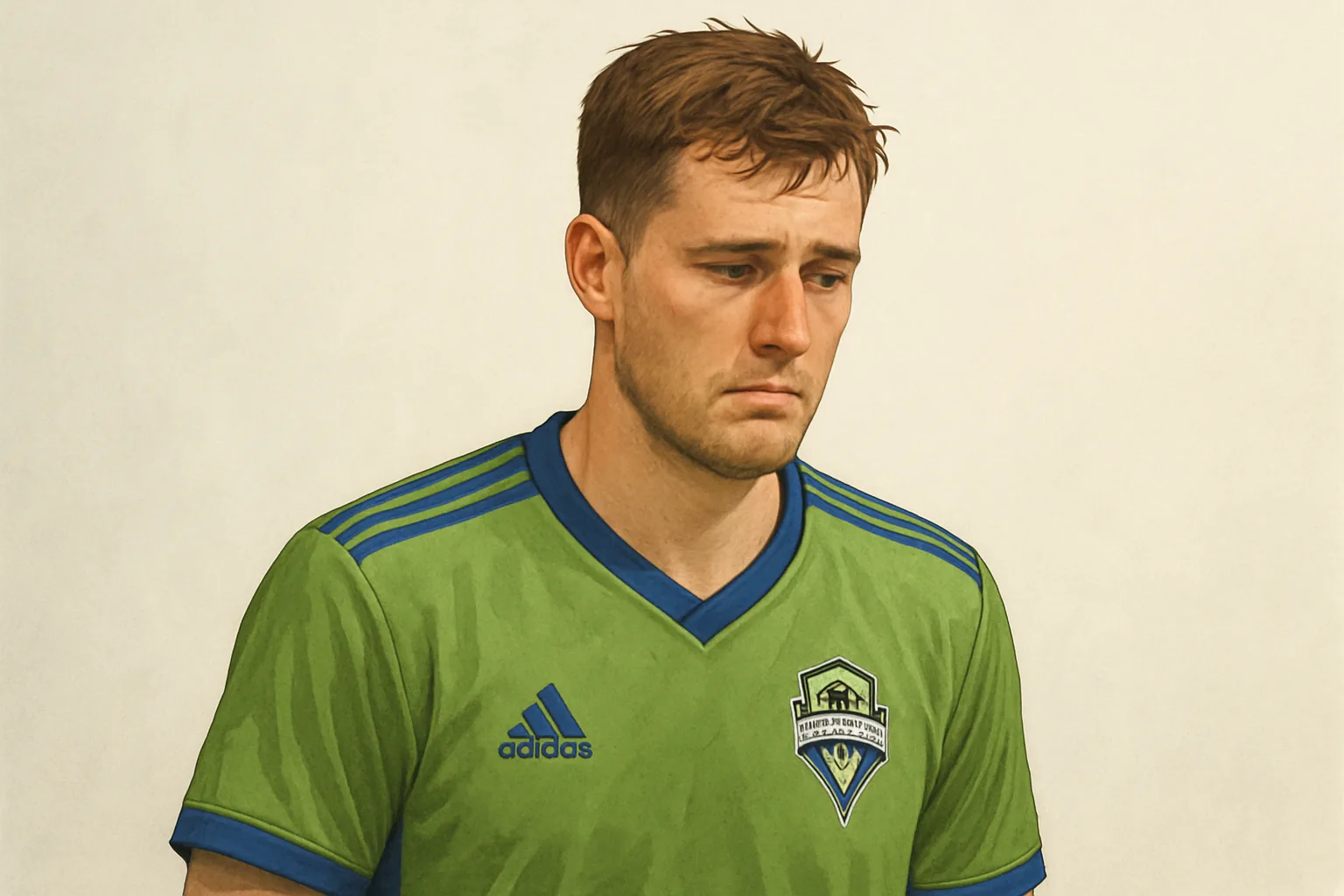
Jackson Ragen’s late dismissal against Austin FC carried an unusually expensive consequence for the Seattle Sounders: the center back was unavailable for the next two matches, first against the Philadelphia Union and then for the rivalry trip to Portland.
The sequence requires a little unpacking. Ragen’s first booking in Austin took him to the league’s caution-accumulation threshold. He then received a second yellow in stoppage time for bringing down Myrto Uzuni as the Austin attacker broke through midfield. That produced a dismissal and a separate suspension.
The second-caution ban applied to the Philadelphia match, while the accumulation suspension carried into the following fixture at Portland. MLS’s official disciplinary summary listed the Portland absence as a yellow-card-accumulation suspension.
One late challenge therefore cost Seattle more than the final moments of a 3-1 defeat. It removed a starting center back from consecutive road games while the club was already trying to stop a four-match regular-season losing streak.
A suspension made worse by the injury list
Ragen’s absence would have been manageable in a settled squad. Seattle did not have one.
Ahead of the Philadelphia match, local coverage listed Pedro de la Vega, Kim Kee-hee, Jordan Morris, Nikola Petković, Alex Roldan and Cristian Roldan as out through injury. Ragen joined them through suspension. Center backs Yeimar Gómez Andrade and Ryan Sailor were considered questionable with hamstring issues.
That left Seattle with only eight healthy and available senior-roster outfield players, according to the match preview from Sounder at Heart. The number explains why one disciplinary absence mattered so much: this was not a routine case of moving the next defender up the depth chart.
Ragen’s suspension intersected with shortages in several parts of the team. The Sounders were missing attacking options, experienced midfielders and multiple defenders at the same time. Any replacement decision could create another problem elsewhere.
The practical cost of losing a center back
A center-back change affects more than one position on a lineup graphic. Partnerships in central defense shape how high a team can hold its line, who attacks the first ball, how opponents are passed between markers and where possession begins.
Consider a simple match scenario. If an inexperienced defender replaces Ragen, Seattle may ask a midfielder to stay closer to the back line as protection. That can help against counterattacks, but it also leaves one fewer player available to receive passes higher up the field. A defensive substitution has then altered the team’s buildup and attacking support before kickoff.
The same trade-off appears on set pieces. Changing one central defender can require new marking assignments at both ends, especially when other regular starters are also absent. These details are manageable when a team changes one player. They become harder when the lineup is being reconstructed across several units.
Seattle had already shown signs of defensive instability. The Sounders conceded late goals in the 86th and 92nd minutes against Austin before Ragen was dismissed in the 95th. That result followed a 5-1 home defeat to Portland. The immediate need was greater control; the available personnel made continuity difficult.
Why the second yellow was especially damaging
Ragen was already set to serve a suspension after his first booking in Austin. The second came with Seattle two goals behind and only stoppage time remaining. It did not materially improve the team’s chance of recovering the match, but it created an additional selection problem for the following week.
That is the central competitive lesson from the incident. Discipline has a different value when a roster is depleted. A tactical foul that might be absorbed by a healthy squad can become far more costly when the replacement options are injured, questionable or inexperienced.
The timing also magnified the damage. Portland had beaten Seattle 5-1 shortly before the return meeting. Entering that rematch without Ragen reduced the Sounders’ ability to restore a familiar defensive structure against their closest rival.
A test of Seattle’s depth, not just its replacements
Depth is often discussed as the quality of a team’s substitutes. Seattle’s situation demanded something broader: the ability to preserve a coherent way of playing when several first-choice players were missing at once.
For the coaching staff, the important questions extended beyond who would occupy Ragen’s position:
- Could the replacement defense hold its line without becoming overly cautious?
- Would Seattle continue trying to build through the back or play more directly?
- Could younger players handle larger roles without the rest of the team becoming too conservative?
- Would any returning defender be ready for significant minutes rather than merely a place on the bench?
Those choices determine whether an injury crisis produces a temporary lineup change or forces a tactical reset.
What the episode leaves behind
Ragen’s return could solve one selection problem, but it would not answer the larger questions raised by the two-match absence. Seattle still needed injured starters to recover, reserve defenders to show they could carry meaningful minutes and the team as a whole to regain control late in matches.
The disciplinary record looks simple: one suspension for a second caution, followed by another for accumulated yellow cards. Its effect was not. In a week when Seattle’s senior options were already severely reduced, the incident turned one moment of frustration into two matches of additional strain.