
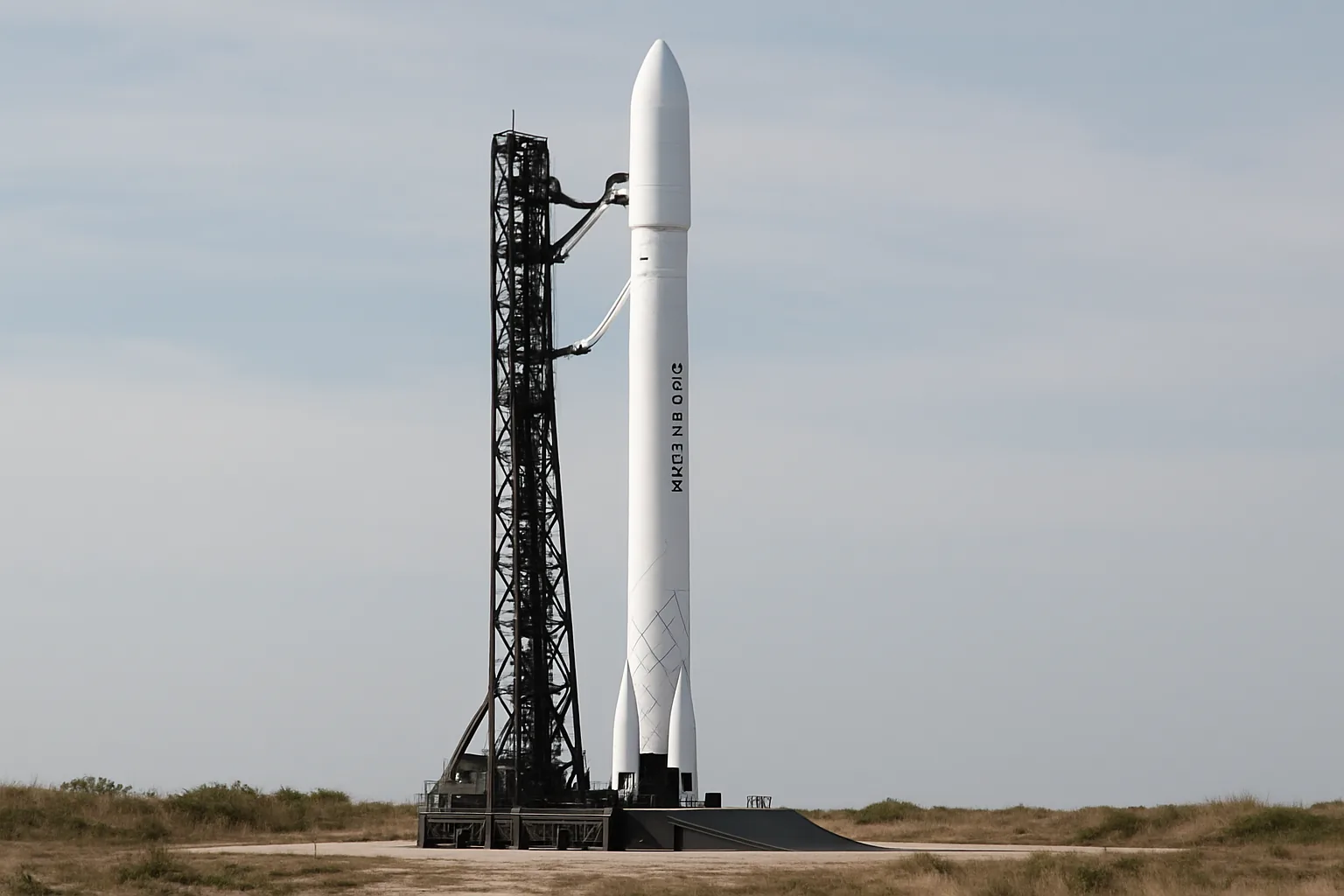
Isar Aerospace’s second attempt to launch its Spectrum rocket from Norway’s Andøya Spaceport was called off on March 25 after an unauthorized vessel entered the downrange safety zone, forcing a hold that pushed the countdown beyond the day’s launch window.
On one level, that is a routine launch scrub. On another, it is a sharp illustration of where Europe’s new launch effort still looks fragile. The obstacle this time was not propulsion, avionics, or weather. It was range control.
Spectrum matters because Isar is trying to do something symbolically and operationally important: help deliver an orbital launch from European soil. That makes every delay carry more weight than a normal schedule slip at a mature launch site. A scrub at this stage is not just about one company missing a window. It exposes how much has to work around the rocket before the rocket even gets a chance to fly.
What happened
According to Isar Aerospace, the countdown was halted because an unauthorized boat entered the danger area. After the countdown reset, the remaining time no longer fit within the planned launch window, so the attempt was scrubbed.
The launch had been scheduled from Andøya Spaceport in Norway at 21:00 CET on March 25. Space.com reported the scrub in an update published the same day, noting that Isar had not announced a new target date as of March 25.
The source material also cites Norwegian media reports saying the boat may have had trouble retrieving a line and therefore did not leave the safety area in time. That point appears to come from local reporting rather than a formal company statement, so the hard fact is narrower: a vessel entered the restricted zone, and the delay consumed the window.
Why this matters beyond one missed launch
Launch companies like to present the rocket as the whole story. In practice, launch is a chain. The vehicle, payload integration, telemetry, weather, pad readiness, airspace and maritime closures, and public safety procedures all have to line up at once. A boat in the wrong place is enough to stop the entire sequence.
That is especially relevant for emerging spaceports and newer launch operators. Established ranges build muscle memory over years of managing closures, local traffic, public notices, enforcement, and last-minute conflicts. Newer sites have less margin for disorder because every launch is still part test, part operational rehearsal.
Europe’s launch ambitions have often been discussed in terms of industrial strategy, sovereignty, and competition with the United States. Those themes are real, but this event points to a more practical truth: independent launch capacity is not just about building a rocket in Europe. It also requires dependable local launch operations on European ground and in nearby waters.
A small example that makes the issue concrete
Consider one of the payloads mentioned for the mission, Norway’s student-built FramSat-1. For a student satellite team, launch is rarely a simple handoff. It can be the endpoint of years of design work, sponsor coordination, testing, licensing, and schedule planning.
If a launch slips because a safety zone is breached, the consequence is not only a missed spectacle on launch day. It can mean extended logistics, additional waiting for mission partners, and more uncertainty for a payload team that has little control over the range environment. That does not make the scrub unusual; safety holds are normal in launch. But it shows how operational friction travels outward from the pad to everyone attached to the mission.
What this says about Isar and Europe’s launch race
The easy reading would be that a scrub is a bad sign. That is too simplistic. Range violations happen in launch. The more useful reading is that Europe’s path to regular orbital missions from its own territory still looks early, exposed, and operationally demanding.
For Isar, the immediate problem is delay. For Europe, the longer-term question is repeatability. Can launch providers and spaceports create a system where maritime and public safety controls are strong enough that a narrow launch window is not lost to a preventable incursion?
That question matters because Europe is not trying to prove only that one rocket can fly once. It is trying to build a launch market that customers can trust. Reliability in that context means more than vehicle performance. It means launches happen when ranges are secured, procedures hold, and customers can plan against something firmer than aspiration.
There is also a reputational layer here. Spectrum is tied to a milestone narrative: the possibility of becoming the first rocket to reach orbit from European soil. Milestone missions attract attention, but they also magnify every operational stumble around them. A scrub caused by a boat does not say the rocket is unsound. It does, however, underline how exposed headline missions are to mundane failures in coordination.
What to watch next
The first thing to watch is simple: when Isar names a new launch date. As of March 25, the company had not formally announced one, though media reports cited in the source suggested March 28 as a possible next attempt.
After that, the real test is not just whether Spectrum leaves the pad, but whether Isar and Andøya can show tighter launch execution around the vehicle itself. That includes the basics:
- keeping the danger area clear for the full count sequence
- managing the reset risk that comes with narrow windows
- showing that launch-day procedures can work under real public-range conditions
If the next attempt proceeds cleanly, this scrub will likely be remembered as a frustrating but ordinary lesson in range operations. If similar interruptions keep happening, the story changes. Then the issue is no longer a single delayed countdown but whether Europe’s emerging launch ecosystem is mature enough to support routine orbital access from its own soil.
That is why this delay is worth more than a one-line launch update. It is a reminder that the hard part of building a space industry is often not the part on the poster. Rockets matter. So do boats, boundaries, and the unglamorous discipline of running a range without surprises.