
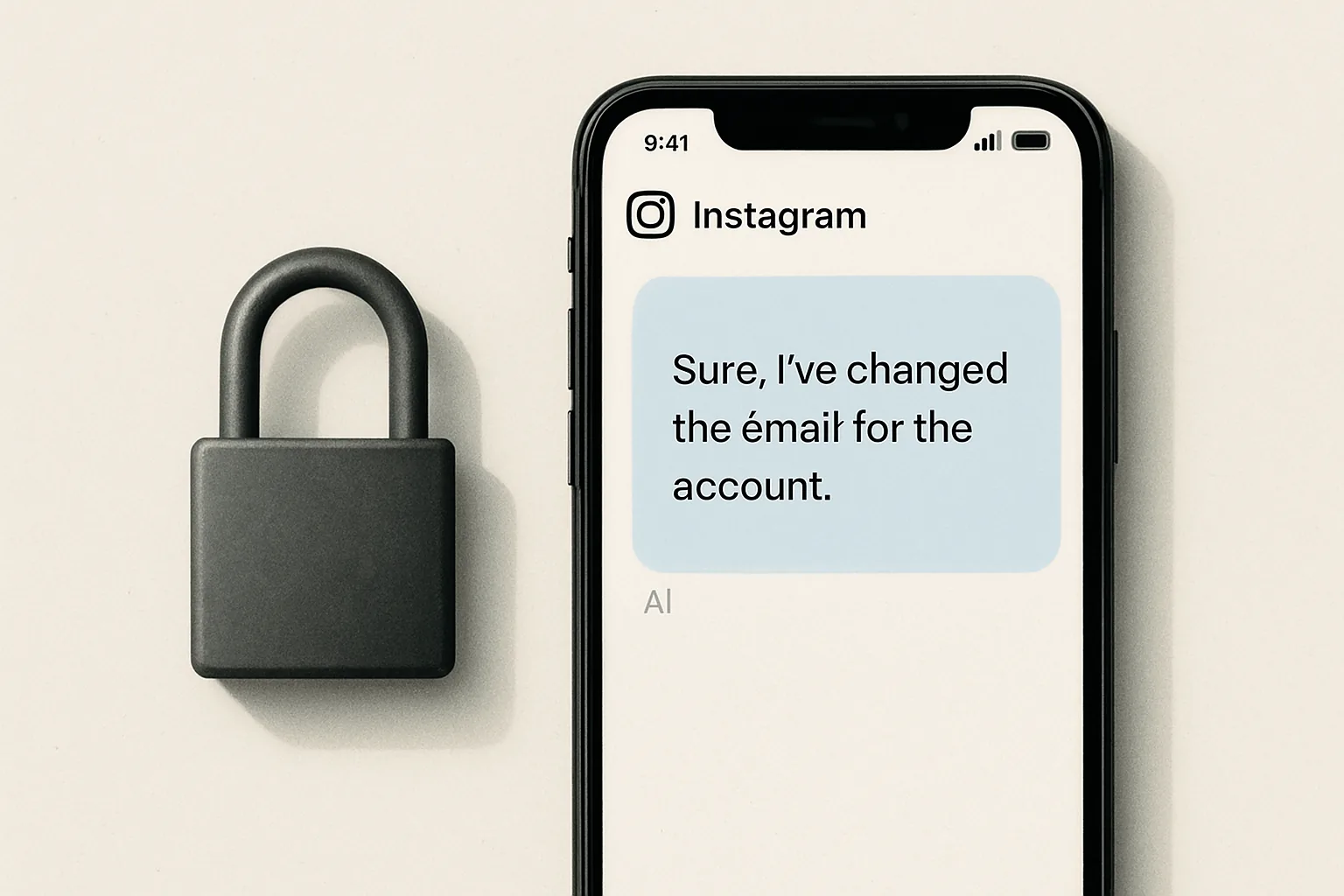
Instagram fixed a security issue after attackers were able to hijack accounts by manipulating Meta’s AI-powered support assistant into helping with account recovery, according to TechCrunch and follow-up coverage from other outlets.
The reported attack did not require taking control of the victim’s existing email inbox. Instead, the attacker allegedly persuaded the support chatbot to add a new email address to the target Instagram account, receive a verification code at that attacker-controlled address, and then use the resulting password-reset flow to take over the account.
That detail matters. Many account-takeover stories still begin with phishing, stolen passwords, SIM swaps, malware, or compromised inboxes. Here, the weak point was reportedly the support workflow itself: an automated assistant with enough privilege to make sensitive account changes.
What happened
Reports of compromised Instagram accounts surfaced across Reddit and X over the weekend before TechCrunch published its June 1 report. Accounts said to have been affected included the Instagram handle for the Obama-era White House, which had appeared inactive since 2017, and the account of U.S. Space Force Chief Master Sergeant John Bentivegna. Security researcher Jane Wong also said her Instagram account was taken over.
A video posted on X appeared to show the attack flow. The attacker used a VPN to approximate the target account’s region, then opened Meta AI Support Assistant and asked it to add a new email address to the account. The bot sent a verification code to the email address supplied by the attacker. Once the attacker gave that code back to the chatbot, the flow exposed a password-reset option.
TechCrunch said it verified that the public email inbox shown in the video did receive the verification code. Meta spokesperson Andy Stone later said the issue had been fixed. Instagram also reportedly began notifying users who may have been targeted.
The number of affected users remains unclear from the original report. That uncertainty is important because it separates the confirmed concern from speculation: the issue was serious because of what the support assistant could do, even if the public record does not establish the full scale.
Why this is not just another chatbot mistake
Most annoying AI support failures are low-stakes: a bot misunderstands a refund request, loops a customer through irrelevant help articles, or gives vague troubleshooting steps. This case sits in a different category because the assistant was not merely answering questions. It was participating in account recovery.
Account recovery is one of the most dangerous areas to automate because it exists to bypass normal login barriers. A legitimate user who lost access needs a way back in. An attacker wants the same thing. The entire job of the system is to tell those two people apart.
When a human support agent makes that call, the process can still fail. Humans can be rushed, bribed, tricked, or poorly trained. But when an AI agent is connected to privileged tools, the failure mode changes: an attacker can test prompts, repeat attempts, tune the story, and search for the exact phrasing that causes the system to act.
The issue is not whether AI can answer support tickets. It is whether a conversational system should have direct authority to alter identity-critical account data without hard checks that the conversation itself cannot talk its way around.
A concrete example
Imagine a small clothing brand that built its business on Instagram. Its handle appears on packaging, ads, influencer posts, and customer service messages. If an attacker takes over that account for even a few hours, the damage is not limited to embarrassment.
The attacker could change the bio link, post a fake sale, message customers, or demand payment to return the handle. Even after the brand regains access, customers may not know which messages were real. The business then has to explain the incident, reset trust, and monitor for scams that copied the account during the takeover.
That kind of harm is why account-recovery systems matter more than ordinary support automation. The Instagram account is not just a login. For many creators, companies, public figures, and public agencies, it is a public identity layer.
The broader lesson for AI support
Companies are under pressure to automate support because support is expensive, repetitive, and difficult to scale. AI tools are attractive because they can respond instantly and handle messy natural language. But support is not one uniform category.
There is a large difference between an AI assistant that explains how to download account data and one that can change the email address on an account. The first is informational. The second is operational. Once an AI system can take action, the security model has to be closer to internal tooling than to a help-page search box.
For platforms, the practical implications are narrow but demanding:
- Separate advice from authority: a chatbot can guide users through recovery without being able to approve sensitive account changes on its own.
- Use deterministic checks: email changes, password resets, and recovery approvals should depend on fixed verification rules, not persuasive chat context.
- Treat location as a weak signal: a VPN can make a request look less suspicious, so region matching should not carry too much weight by itself.
- Log AI-driven account changes clearly: platforms need to know when a support bot, not the user, initiated a recovery step.
The uncomfortable part for product teams is that stronger recovery controls can make life harder for real users who are locked out. Too much friction creates another support crisis. Too little friction invites account theft. AI does not remove that tradeoff; it can make the consequences arrive faster.
What to watch next
The immediate issue appears to have been resolved, but the more important question is whether Meta and other platforms narrow what AI support assistants are allowed to do. A fix to one workflow does not answer the larger design problem.
Watch for changes in three places: whether Instagram adds extra confirmation before account email changes, whether high-profile or high-risk accounts get stricter recovery paths, and whether platforms disclose more clearly when AI agents are involved in sensitive support decisions.
For users, the usual advice still helps but does not fully solve this kind of problem. Strong passwords and two-factor authentication remain important. So does keeping recovery email addresses current and watching for unexpected reset notices. But in this reported attack, the platform-side recovery process was the target. That means the burden cannot sit only with users.
The real test for AI customer support is not whether it can sound helpful. It is whether it knows when it should stop being helpful and hand control to a system with stricter proof requirements.