
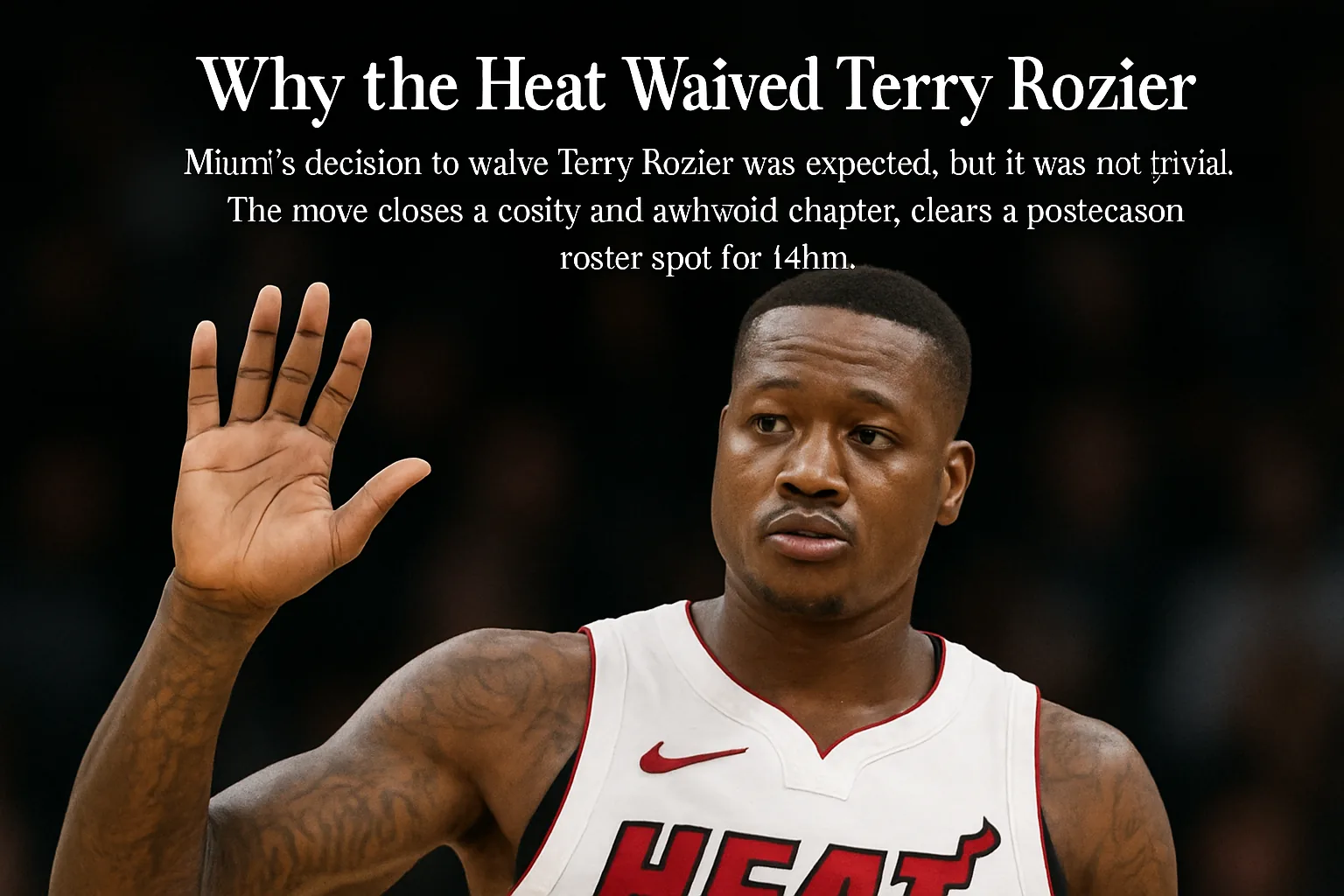
The Miami Heat waived Terry Rozier on April 10 in what the Associated Press described as an expected procedural move. On paper, that sounds minor. In practice, it is the formal end of a strange and expensive situation that had already removed Rozier from Miami’s season and forced the team to carry the consequences right up to the postseason.
Rozier had been with the Heat for only one game this season, the opener at Orlando on Oct. 22, and did not play in it. He was arrested by federal officials the next morning at the team hotel. According to the AP, the charges allege that he offered information to help people win bets on his stat totals in a 2023 game when he was with the Charlotte Hornets. Soon after the arrest, the NBA placed him on leave.
By waiving him now, Miami opens a roster spot before the play-in tournament and potential playoff run. That matters because the Heat plan to convert two-way guard Jahmir Young to a standard contract, which makes him eligible for postseason play. This is the practical point of the move. Miami is not changing course on Rozier’s basketball future so much as finally clearing the administrative blockage that came with carrying a player who was unavailable all year.
Why this is bigger than a routine roster move
Teams make procedural cuts all the time in April. This one stands out because the transaction is tied to three different pressures at once: legal trouble, salary obligations, and postseason roster rules.
First, Rozier’s absence was not a simple injury or performance issue. The reason he was out all season sits in the league’s most sensitive area: gambling-related allegations. Even without getting ahead of the legal process, that changes the texture of the story. Basketball operations can usually work around bad form or a bad contract. A federal case tied to betting allegations is different because it creates uncertainty that a team cannot solve on the court.
Second, Miami still paid for the situation. The AP reports that Rozier collected his $26.6 million salary this season. The Heat had initially paid it into an interest-bearing account, but an arbitrator later ruled that Rozier should continue receiving the money despite the legal issues. So this was not a dormant roster spot in the cheap sense. Miami was effectively carrying a high-salary player it could not use while waiting for legal and labor processes to run their course.
Third, timing matters. The Heat are entering the play-in tournament, with games scheduled for Tuesday or Wednesday, and if they win two play-in games they would open a first-round series against Detroit on April 19. At that stage of the year, a roster slot is not abstract. It can decide which depth players are available when a team suddenly needs another ballhandler, defender, or injury replacement.
The real value of the move is Jahmir Young’s eligibility
Miami’s immediate gain is simple: converting Jahmir Young from a two-way deal to a standard contract makes him available for the postseason. That is the kind of detail that often gets buried beneath the bigger name in the headline, but it is the most relevant basketball consequence.
A two-way player can help a team during the regular season, but postseason eligibility requires a standard NBA contract. By opening Rozier’s roster spot now, Miami turns an unavailable veteran slot into a usable playoff roster spot. That does not erase the damage of the Rozier saga, but it does at least convert dead space into functional depth.
There is also a lesson here about how front offices handle April. By then, the goal is not to preserve optionality around a player who has been absent all season. It is to make sure every eligible roster spot can help in the next game. The Heat’s move reflects that shift from waiting to acting.
A concrete way to think about it: imagine Miami wins its first play-in game and enters a second high-pressure matchup with foul trouble or an injury in the backcourt. In that moment, the difference between a two-way guard and a standard-contract guard is not technical language in a transaction log. It is whether Erik Spoelstra has another eligible player he can actually use.
The trade fallout did not end with Rozier’s leave
The waiver also puts fresh attention on the original trade that brought Rozier to Miami. The Heat acquired him in January 2024 for Kyle Lowry and a 2027 first-round pick. According to the AP, Miami did not know about the gambling probe at the time of the trade.
That point matters because it helps explain why this story kept extending beyond Rozier’s leave from the team. The Heat were not just dealing with a player becoming unavailable; they were dealing with the possibility that a major piece of transaction information had not been known when the deal was made.
The AP notes that last month the Hornets sent Miami a second-round pick in this year’s draft, calling it a largely unprecedented move and suggesting it was meant to settle the dispute over what was not disclosed during the original trade process. That does not undo the cost of surrendering a first-round pick for a player Miami could not use, but it shows the issue had grown beyond one player’s status. It had become a dispute about transaction risk and disclosure.
That is the part league observers will remember. Not simply that Rozier was waived, but that the aftershocks of the case appear to have reached into how one franchise compensated another after the fact. In a league where teams obsess over medicals, contract language, and long-term pick value, this is an unusually messy kind of uncertainty.
What to watch next
The basketball question is straightforward: whether Young can give Miami useful depth if the Heat extend their season through the play-in and into a possible first-round series with Detroit.
The bigger questions sit elsewhere.
- For Miami: whether the team can extract any practical value from the roster slot now that the Rozier chapter is closed.
- For the league: whether this case leads to more scrutiny around gambling-related risks and how quickly teams are informed about potential issues involving players.
- For roster-building: whether front offices become even more aggressive about safeguarding themselves when off-court investigations could affect player availability after a deal is done.
None of that changes the immediate fact pattern. Rozier is out. Miami has a roster opening. Young is expected to fill it. But reducing this to a procedural waiver misses what made the transaction notable in the first place.
The Heat spent the season carrying the financial weight and competitive inconvenience of a player who was functionally unavailable after opening night. The waiver does not solve the legal case or recover the lost season. It does something narrower and more practical: it allows Miami to stop preserving a spot for a situation that was not coming back in time to help and use that spot on someone who might.
That is why this move matters. Not because waiving Rozier changes Miami’s ceiling by itself, but because it marks the point where the team finally turns an unresolved problem into a postseason decision.