
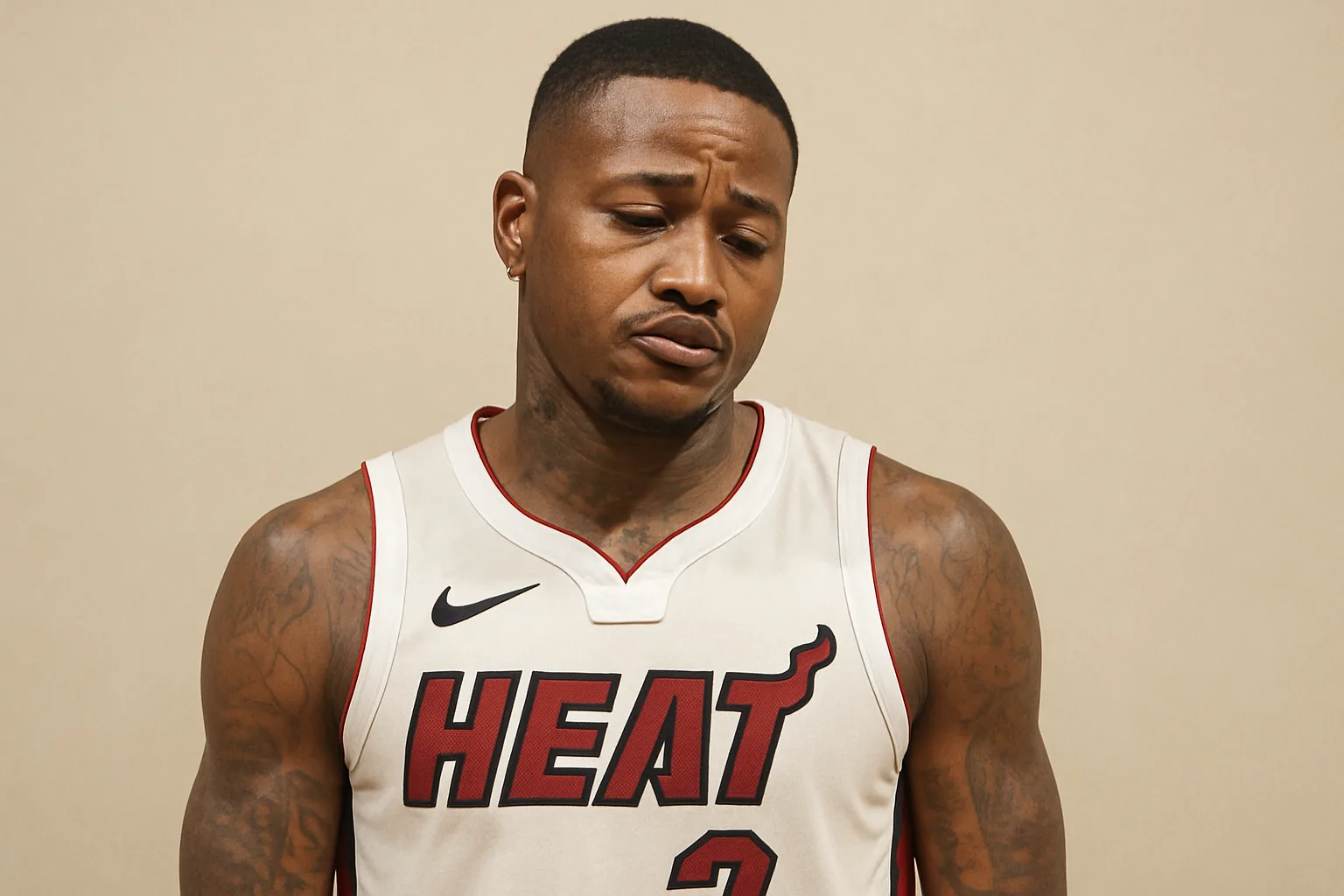
The Miami Heat waived Terry Rozier on April 10 in what the Associated Press described as an expected procedural move. On paper, that sounds minor. In practice, it closes one of the NBA’s oddest dead-roster situations this season and gives Miami something it did not have before the play-in tournament: a usable postseason spot.
Rozier had effectively been absent all year. He was with the Heat for one game, the season opener at Orlando on October 22, and did not play. The following morning, federal officials arrested him at the team hotel. According to the AP report, the charges allege that he offered information to help people win bets on his stat totals in a 2023 game while he was with the Charlotte Hornets.
After that, the basketball part was suspended but never entirely cleaned up. Rozier was placed on NBA leave. He still counted in Miami’s roster and salary picture. He still collected his $26.6 million salary after an arbitrator ruled he should be paid despite the legal case. And the Heat, meanwhile, had to operate around a player who was neither part of the active team nor formally gone.
What changed now
The immediate reason for the waiver is simple: Miami needed the roster spot. The team is converting two-way guard Jahmir Young to a standard NBA contract so he can be eligible for the postseason.
That is the practical significance of the move. This is not really about replacing Rozier’s on-court production, because there was no 2025-26 on-court production to replace. It is about recovering flexibility before games start to matter most. The Heat enter the play-in tournament with a clearer bench, cleaner eligibility rules, and one fewer procedural problem hanging over the roster.
The timing matters too. Miami is set to open play-in action either Tuesday or Wednesday, and if it wins twice, it would open a first-round series against Detroit on April 19. At that stage of the calendar, a standard contract is not paperwork for paperwork’s sake. It determines who can actually suit up.
Why this matters more than it first appears
NBA teams spend the final stretch of a season narrowing the gap between the players they are paying and the players they can trust in a playoff setting. Miami spent this season carrying an expensive disconnect instead. Waiving Rozier does not undo the financial cost, and it does not settle the underlying legal case. But it finally lets the team align its formal roster with its real one.
That distinction matters for more than bookkeeping. A postseason roster spot is valuable even when it goes to a role player. Coaches need lineup options, injury cover, and situational guards who can absorb minutes without forcing a deeper rotation scramble. A dead spot is manageable in January. It becomes harder to justify in April.
A concrete way to think about it: imagine Miami reaches a second play-in game and needs another ballhandler for eight to 12 minutes because of foul trouble, an injury scare, or a matchup shift. A two-way player without a standard deal cannot solve that problem in the postseason. Converting Young gives the Heat one more real choice instead of one more inactive contract.
That is why the move feels procedural on the surface but consequential underneath. It turns an unusable asset into a live option at the exact moment roster edges start to matter.
The longer shadow of the original trade
The waiver also revives the bigger question around how Miami got here. The Heat traded for Rozier in January 2024, sending Kyle Lowry and a 2027 first-round pick to Charlotte. According to the AP report, Miami did not know about the gambling investigation at the time of the trade.
That detail makes this more than a story about one player’s legal trouble. It becomes a case study in what happens when key information about a player’s status or risk does not appear in time for a major transaction. Teams price trades around talent, fit, age, money, and medical history. They are much less equipped to price an unseen legal cloud that can erase a player’s availability altogether.
The AP notes that last month the Hornets sent Miami a second-round pick in this year’s draft, calling it a largely unprecedented step and suggesting it was meant to resolve the dispute over what was not disclosed during the original deal. That does not erase the first-round pick Miami gave up, and it certainly does not restore the lost season. But it does show how unusual the fallout was. NBA teams do not casually revisit completed trades through compensatory draft value unless something has gone badly sideways.
For front offices around the league, that is the lasting business angle here. The Rozier episode is not just about misconduct allegations. It is also about transaction risk, disclosure norms, and how expensive uncertainty can become once a trade is already on the books.
What to watch next
There are really two separate tracks now.
First is Miami’s basketball problem. The Heat have used the waiver to make Jahmir Young postseason-eligible, and the question shifts to whether the team can convert that extra flexibility into actual help in the play-in. Young does not need to become a breakout figure for the move to matter. If he gives Erik Spoelstra one more playable guard option, the transaction has already done its job.
Second is the unresolved legal and league context around Rozier. The waiver ends his Heat tenure in a formal sense, but it does not close the broader story. The charges described by the AP are serious, and the league’s handling of gambling-related cases is now examined more intensely than it was a decade ago. The NBA has strong incentives to protect confidence in the integrity of games, which means even procedural team moves like this one tend to draw outsized attention.
There is also a smaller but important labor angle. Rozier remained entitled to his salary this season after an arbitrator ruled in his favor. That matters because it shows how separate the league’s disciplinary posture, a team’s roster management, and a player’s compensation rights can be. Fans often treat those as one question. They are not. This case split them apart in plain view.
The real meaning of the move
Miami’s waiver of Terry Rozier is not a dramatic basketball turning point. It is something more specific: the official end of an expensive roster limbo.
The Heat are not suddenly better because Rozier is gone; he had not been part of their season in any practical sense. They are better positioned because the franchise can finally use the spot. That is the kind of move that tends to look minor in transaction logs and much bigger inside a coaching room.
It also leaves behind a messier lesson. One legal case tied up salary, roster space, trade value, and postseason eligibility all at once. Even before the broader consequences are settled, the Heat have already paid the price in time, flexibility, and opportunity. Waiving Rozier does not erase that. It simply lets Miami stop carrying the problem into the next game.