
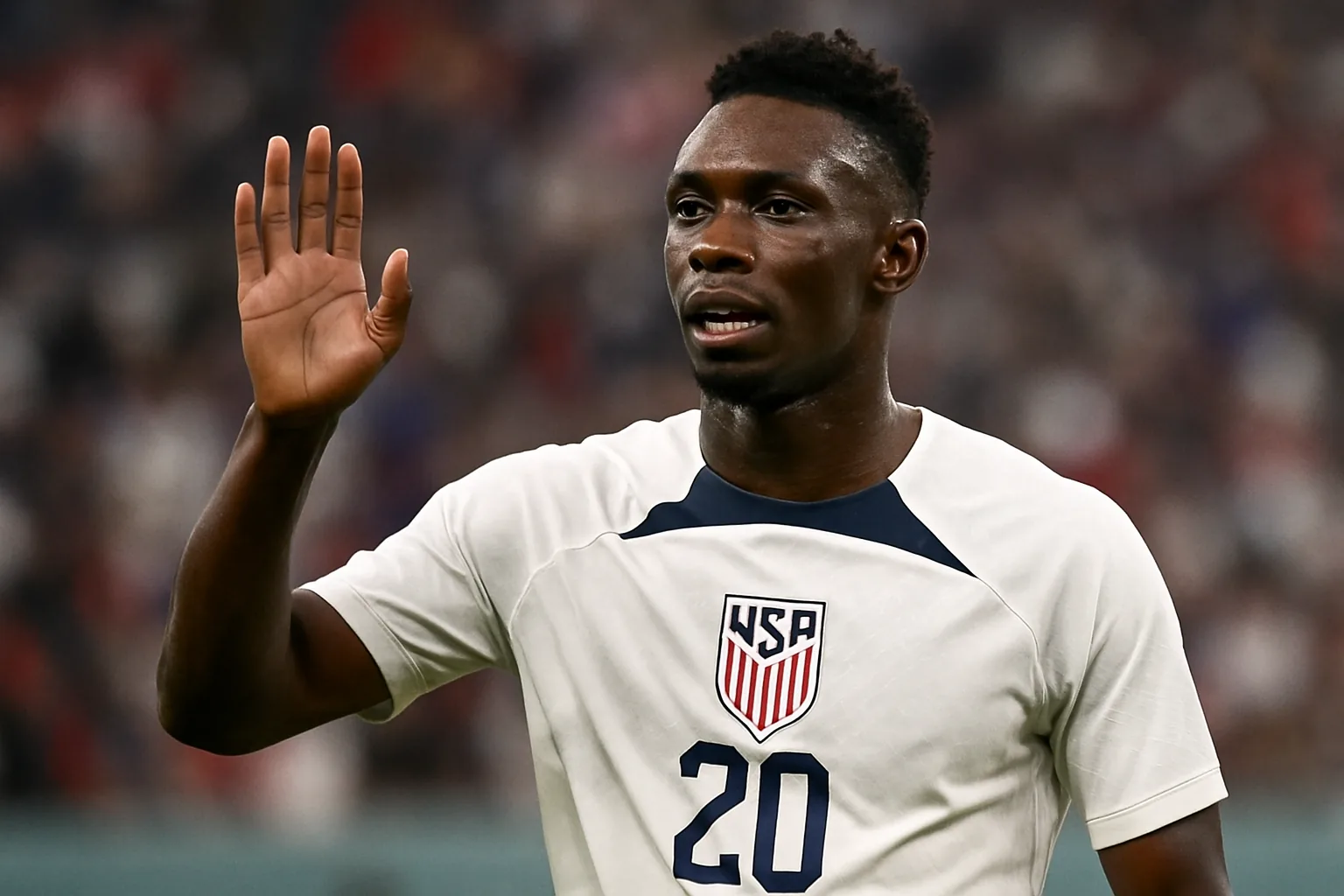
FIFA has suspended the implementation of Folarin Balogun’s one-game ban, making the United States forward eligible for the World Cup round-of-16 match against Belgium on July 6, 2026.
The decision followed Balogun’s red card in the United States’ 2-0 round-of-32 win over Bosnia-Herzegovina on July 1 in Santa Clara, California. The card came after Balogun stepped awkwardly on the right ankle of Bosnia-Herzegovina’s Tarik Muharemovic, triggering an automatic one-game suspension.
What would normally have been a straightforward disciplinary matter became much larger after U.S. President Donald Trump called FIFA President Gianni Infantino and asked FIFA to review the red card. FIFA then announced on Sunday, July 5, that the suspension would not be implemented for the Belgium match.
That leaves Balogun available for one of the biggest games of the U.S. campaign. It also creates a controversy that will outlast a single team sheet.
What changed for the United States
At the simplest level, the United States gets a key attacking player back for a knockout match. Balogun had been set to miss the Belgium game automatically after the red card. Instead, the U.S. coaching staff can plan with him available.
In knockout football, that is not a minor adjustment. One forward’s availability changes pressing assignments, substitution plans, defensive matchups and the way an opponent prepares. Belgium’s staff now has to account for a player it reasonably expected to be suspended.
The timing matters too. FIFA’s decision came one day before the match, leaving little time for Belgium to respond tactically or institutionally. That is part of why the reaction from Belgium’s side was so sharp.
Why Belgium and UEFA are angry
According to the source material, UEFA and the Royal Belgian FA criticized the reversal and described it as a breach of norms. Their objection is not only that a strong U.S. player can now face Belgium. It is that the disciplinary process appears to have changed after pressure from a head of state.
Football’s disciplinary systems depend on predictability. A red card in a knockout match usually brings an automatic suspension unless a formal review process produces a clear reason to overturn or delay it. Teams may dislike individual decisions, but they build plans around the idea that rules will be applied consistently.
This case unsettles that expectation. FIFA’s decision was made under Article 27 of its disciplinary code, according to the source description, but the surrounding facts make the optics unusually sensitive: the U.S. president intervened, the FIFA president was personally contacted, and the American player’s ban was lifted before a high-stakes match hosted in the broader context of a U.S.-involved World Cup.
That does not prove FIFA acted because of politics. It does mean FIFA now has to deal with the perception that access may matter as much as procedure.
The practical problem with exceptions
Disciplinary discretion is not inherently wrong. Sports bodies need room to correct mistakes, especially when a red card might be harsh, technically flawed or inconsistent with video evidence. The problem is that exceptions carry a cost when the reasoning is not clearly explained.
Imagine a similar case later in the tournament. A star player from another country receives a red card in the quarterfinal, and that country’s political leader publicly urges FIFA to reconsider. If FIFA refuses, the federation can point to Balogun and ask why one case received emergency flexibility while another did not. If FIFA agrees again, the disciplinary process starts to look negotiable.
That is the uncomfortable precedent. A single suspension may seem small next to the scale of a World Cup, but knockout tournaments are decided on narrow margins. Availability, rest, opponent preparation and public pressure all affect the competitive environment.
Why this matters beyond one match
The World Cup is both a sporting event and a political stage. Heads of state attend matches, host nations lobby, football executives cultivate relationships, and national teams carry symbolic weight. None of that is new.
What makes the Balogun case different is the proximity between political contact and a disciplinary outcome. The source material says Trump called Infantino after the Bosnia game asking FIFA to review the red card. FIFA later suspended the implementation of the ban. Trump praised the outcome, while Belgium’s team reacted with outrage.
For FIFA, that creates a credibility problem. Governing bodies rarely suffer because fans agree or disagree with one disciplinary call. They suffer when stakeholders believe the process is not insulated from status, access or pressure.
The controversy also lands at a sensitive time for FIFA’s relationship with the United States. The 2026 World Cup is being played across North America, and the U.S. team’s progress is a major commercial and public-interest story. That makes strict neutrality even more important, not less.
What to watch next
The immediate question is whether Balogun plays against Belgium, and if so, how central he is to the U.S. plan. His availability gives the United States more attacking flexibility and gives Belgium one more problem to solve.
The longer-term questions are institutional:
- FIFA’s explanation: Whether FIFA provides a detailed rationale for suspending the ban, beyond the basic disciplinary-code mechanism.
- Belgium’s response: Whether the Royal Belgian FA pursues any further formal complaint or keeps the criticism public and political.
- Future red-card cases: Whether other federations cite this decision when seeking emergency relief for suspended players.
- Perception of neutrality: Whether FIFA can convince teams that the same process would apply without presidential intervention.
The match itself may quickly reclaim attention. If Balogun scores, the controversy will become part of the game’s competitive story. If Belgium wins, the decision may be treated as an ugly footnote. But the governance issue will remain either way.
FIFA has not merely made a player eligible. It has turned a disciplinary ruling into a test of whether World Cup rules are seen as rules, or as decisions that can be reopened when the right person makes the right call.