
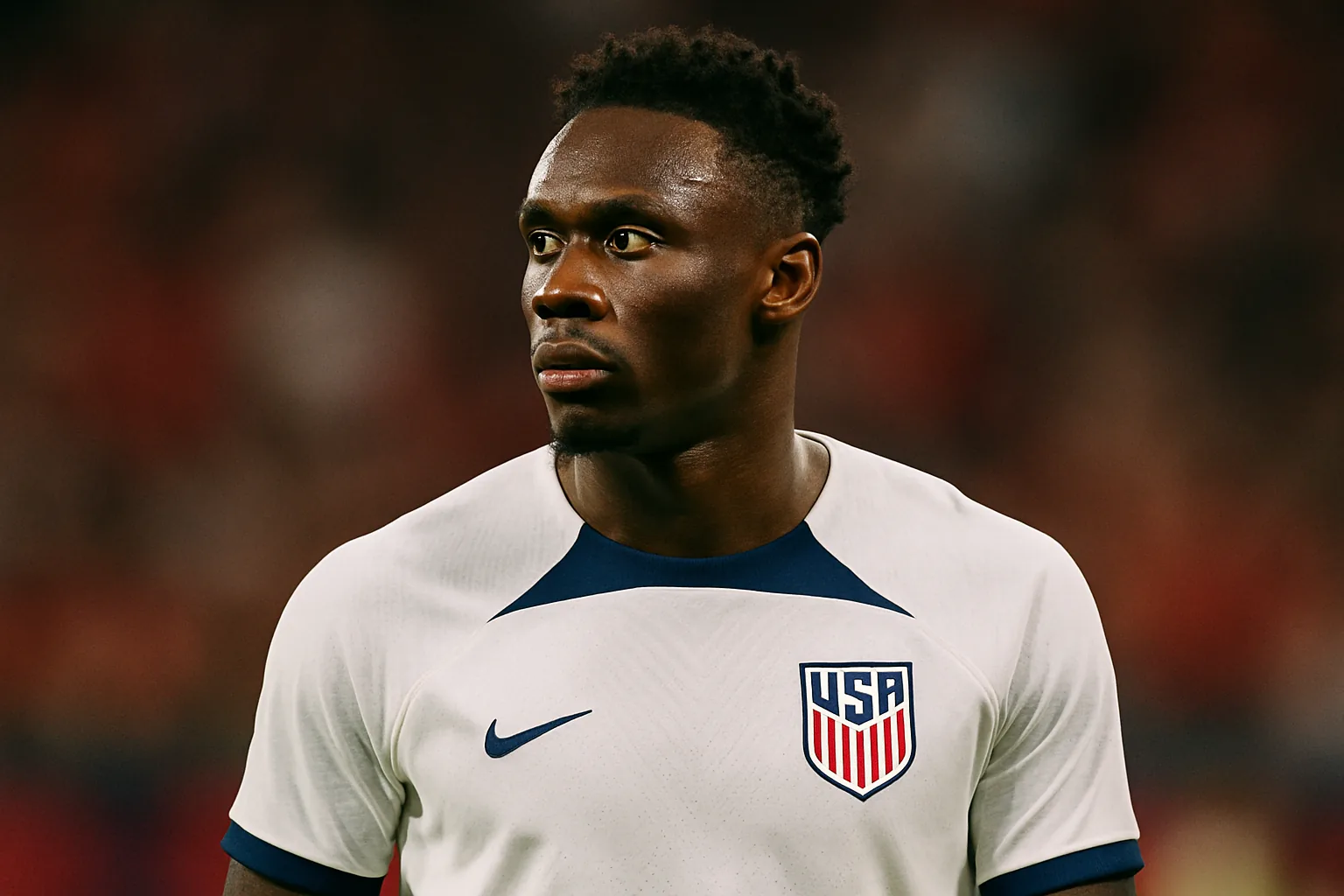
FIFA’s decision to suspend Folarin Balogun’s automatic one-match ban for one year cleared the U.S. striker to play in the World Cup round of 16 against Belgium on July 6, 2026. The ruling followed his red card in the United States’ 2-0 round-of-32 win over Bosnia-Herzegovina on July 1.
On the field, the case was straightforward enough to understand: Balogun stepped awkwardly on the right ankle of Bosnia-Herzegovina’s Tarik Muharemović, referee Raphael Claus showed red, and the sending-off triggered an automatic one-game suspension. Off the field, the matter became far less simple after reporting indicated that President Donald Trump called FIFA president Gianni Infantino after the match and asked FIFA to review the red card.
FIFA then announced on July 5 that Balogun’s suspension would not apply to the Belgium match. Trump praised the outcome. Belgium’s team reacted angrily. UEFA criticism and wider debate followed over whether political pressure had entered a disciplinary process that is supposed to be insulated from outside influence.
Why the decision feels bigger than one player
The immediate competitive impact is obvious. Balogun is a major U.S. attacking option, and knockout soccer often turns on one finishing chance, one pressing action, or one run that stretches a defense. Removing a red-card suspension before a round-of-16 match changes the selection problem for the United States and the scouting problem for Belgium.
But the reason this case drew attention is not only that a player became available. It is that the review came after a head of state contacted FIFA’s president. Even if FIFA believed it had grounds to delay the suspension, the sequence creates a governance problem: when a powerful political figure intervenes, every later decision has to carry the weight of proving it was made independently.
That is difficult in sport because discipline depends on more than written rules. It depends on shared belief that the rules are being applied evenly. Players accept bans they dislike because they expect opponents to face the same standard. Teams build match plans around suspensions because they expect disciplinary outcomes to be predictable. When that predictability appears negotiable, the dispute shifts from “was the tackle worthy of a ban?” to “who gets access to the people making the decision?”
The narrow football issue
Balogun’s red card came in a knockout match the United States won 2-0 in Santa Clara, California, near San Francisco. The incident involved contact with Muharemović’s ankle and was serious enough, in the referee’s judgment, to warrant a sending-off. Under ordinary tournament discipline, that means the player misses the next match automatically unless a later ruling changes the effect of the sanction.
FIFA’s move did not erase the controversy. It postponed implementation of the one-match ban for a year, which made Balogun eligible for Belgium. That distinction matters because it allows FIFA to say the sanction was not simply canceled. For Belgium, though, the practical effect was the same for the game in front of them: the U.S. forward was available when the red-card consequence suggested he would not be.
A concrete example shows why opponents object. Suppose Belgium’s staff spent the days after the U.S.-Bosnia match preparing for a U.S. attack without Balogun. That could affect center-back assignments, pressing triggers, substitution planning, and how aggressively Belgium’s fullbacks push forward. If Balogun is restored late in the process, Belgium is not just facing a stronger U.S. lineup; it is facing a changed tactical problem after the normal disciplinary expectation had already shaped preparation.
The political context FIFA cannot ignore
The optics were already unusually sensitive because Infantino and Trump had appeared together before in a high-profile World Cup setting. AP material notes Infantino awarded Trump the FIFA Peace Prize during the 2026 World Cup draw at the Kennedy Center in Washington on Dec. 5, 2025. That does not prove anything improper about the Balogun ruling. It does explain why the call and the subsequent decision drew intense scrutiny.
In major tournaments, FIFA has to manage two kinds of legitimacy at the same time. The first is legal or procedural: whether the organization can point to a rule, review mechanism, or disciplinary authority that supports the ruling. The second is public legitimacy: whether teams, fans, and confederations believe the process was not bent by status, politics, or host-nation pressure.
This case is mainly about the second kind. FIFA may have internal reasons for delaying the ban, but the public sequence left room for suspicion. A president called. A star player for the president’s country became eligible. The opponent objected. That is enough to make the decision controversial even without evidence that FIFA acted only because of the call.
What changes next
The Balogun decision raises questions FIFA will likely keep facing throughout the tournament whenever discipline intersects with competitive stakes. The closer a case is to a knockout match, the more any exception will be examined for consistency.
Three practical issues now matter:
- Transparency: FIFA can reduce speculation by clearly explaining why the automatic ban was suspended and what standard was applied.
- Consistency: Future red-card cases will be compared with Balogun’s, especially if another team asks for similar relief.
- Access: The hardest question is whether teams without presidential intervention would receive the same review on the same timeline.
For the United States, the ruling was a competitive boost before a major knockout match. For Belgium, it was a grievance with immediate sporting consequences. For FIFA, it is a reminder that disciplinary decisions in a World Cup do not happen in a vacuum. The organization can survive unpopular calls; it has done so many times. What is harder to absorb is the perception that a disciplinary outcome changed after political contact at the top.
That perception will not be settled by the Belgium match alone. It will be tested by the next controversial red card, the next appeal, and the next moment when a team asks whether tournament justice is automatic, reviewable, or available only to those with the right phone number.