
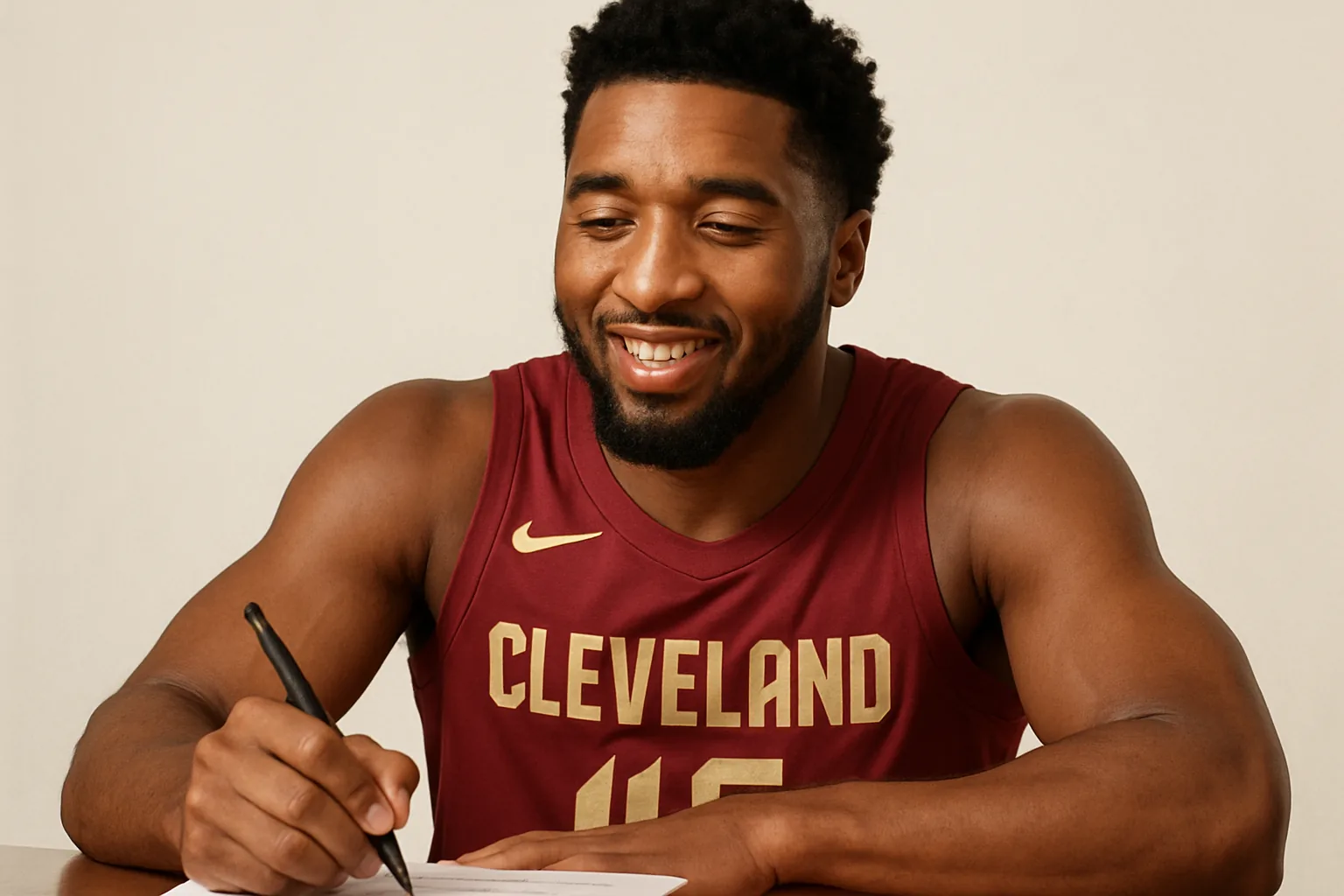
Donovan Mitchell has agreed to a four-year, $273 million maximum contract extension with the Cleveland Cavaliers, a deal that includes a player option for the 2030-31 season and a full trade kicker.
For Cleveland, the agreement is not just a star-retention headline. It is the kind of contract that changes the questions around a franchise. The Cavaliers no longer have to spend 2026-27 managing another year of speculation about Mitchell’s future. They can move into the season knowing their best player is committed through the rest of his prime, with the team’s competitive window now tied clearly to him.
The timing matters almost as much as the number. According to the source material, signing Mitchell this summer helped the Cavaliers avoid a larger potential extension next year, which could have reached five years and more than $350 million, with a final season costing $80 million or more. That difference gives Cleveland a cleaner financial picture, even if the new deal is still enormous by any normal standard.
What Cleveland Actually Bought
Mitchell, 29, is an All-NBA guard coming off a Cavaliers run to the 2026 Eastern Conference finals. That matters because this is not a speculative contract based on future upside. Cleveland is paying for a proven lead scorer who has already pushed the franchise deep into the postseason.
The extension also buys stability. Without it, the Cavaliers would have entered the season with a familiar and uncomfortable storyline: Would Mitchell stay, or would another market eventually pull him away? The source specifically points back to the summer of 2024, when Knicks rumors hovered over the franchise. That kind of noise is not just a media annoyance. It affects how every roster move is interpreted.
If Cleveland had started the season without Mitchell’s long-term commitment, a losing streak in December could have become a referendum on his future. A quiet trade deadline could have been framed as a failure to convince him. Even routine front-office decisions would have carried extra weight.
Now, the Cavaliers have a different problem, but it is the one contenders prefer: how to build the best possible team around a star who is already signed.
The Cap Strategy Becomes More Concrete
The extension gives Cleveland certainty, but not flexibility in the casual sense. A $273 million max deal limits room for error. The Cavaliers can no longer treat Mitchell’s future as a variable. They have to operate as a team whose next several years are organized around maximizing his peak.
That means the front office’s decisions around complementary scoring, defense, shooting, and depth become sharper. Expensive teams can survive one imperfect contract. They usually cannot survive several. When a franchise commits this much to one player, the rest of the roster has to make basketball sense and cap sense at the same time.
A simple example: if Cleveland is choosing between a higher-priced veteran wing and a cheaper rotation shooter, the decision is not only about who helps in November. It is about which player still fits when Mitchell’s salary rises, when playoff matchups punish weak defenders, and when the team needs enough depth to survive injuries without burning future assets.
That is the practical effect of a max extension. It narrows the team’s margin, but it also removes ambiguity. Cleveland’s job is no longer to prove to Mitchell that it is serious. The job is to prove that its roster construction can match the seriousness of the contract.
Why the Player Option and Trade Kicker Matter
The player option for 2030-31 gives Mitchell leverage near the end of the deal. If he is still playing at an elite level, he can decide whether staying on the contract makes sense or whether a different path gives him more control. That is standard star-player business: long-term security now, optionality later.
The full trade kicker also matters because it makes any future trade scenario more complicated and expensive. It does not mean a trade is expected. It means Mitchell’s side protected value in the unlikely event the relationship changes. For Cleveland, that is part of the cost of getting the deal done now.
In practical terms, the Cavaliers secured the commitment they needed, while Mitchell secured both money and leverage. That balance is why star extensions often look simple from the outside but carry long-term strategic consequences.
What Changes Next
The Cavaliers should benefit immediately from a quieter season around their franchise player. Questions about Mitchell’s future will not disappear forever, but they no longer have to dominate the 2026-27 campaign.
The harder evaluation shifts to the team around him. Cleveland reached the 2026 East finals, so the standard is no longer respectability or playoff qualification. The extension makes clear that the Cavaliers are trying to compete at the top of the conference while Mitchell is still in his prime.
Three things now become worth watching:
- Roster spending: Cleveland’s next moves will show how aggressive ownership and the front office are willing to be around a max-salary core.
- Fit around Mitchell: Shooting, defensive versatility, and late-game balance will matter more than collecting recognizable names.
- Pressure after the East finals run: A deep playoff appearance raises expectations. The extension locks in the player, but it also raises the cost of standing still.
This is the cleanest outcome Cleveland could have hoped for once Mitchell became eligible for a major commitment. The Cavaliers avoided a more expensive negotiation next year, prevented another season of public uncertainty, and kept an All-NBA guard through the heart of his prime.
Now the franchise has fewer excuses. The biggest question is no longer whether Donovan Mitchell wants Cleveland. It is whether Cleveland can build a championship-level team around the contract it just gave him.