
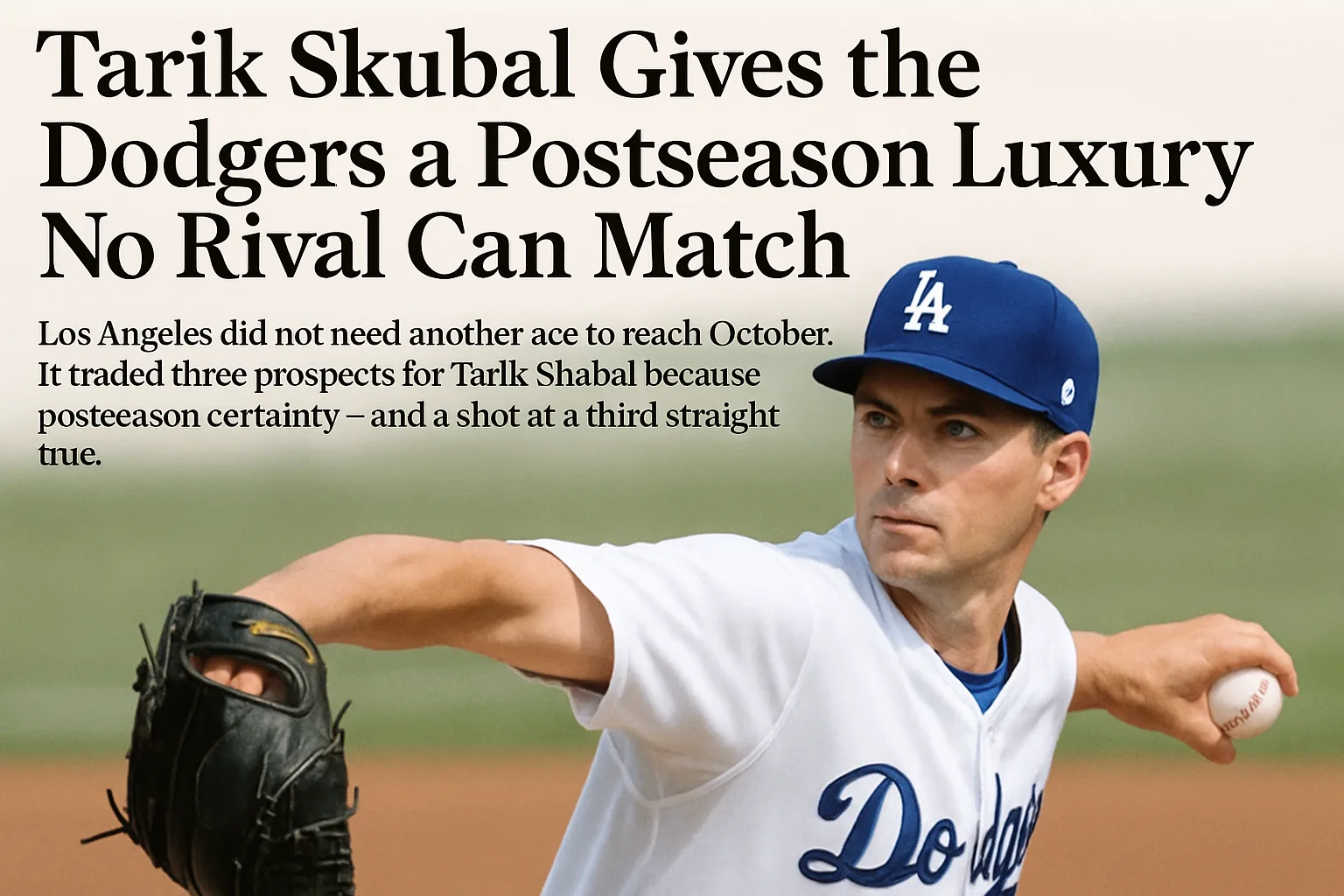
The Los Angeles Dodgers have acquired Tarik Skubal from the Detroit Tigers, adding the two-time reigning American League Cy Young Award winner to a rotation that already led the majors with a 3.36 ERA.
Detroit will receive outfielder Zyhir Hope and right-handed pitchers River Ryan and Brady Smith, according to the Associated Press report, which cited ESPN’s initial reporting of the deal. Skubal learned of the trade Saturday night as the Tigers completed an 8-6 win over the Athletics.
The transaction is striking because Los Angeles was not trying to repair a failing rotation. It was already in first place in the National League West and favored to win a third consecutive World Series. The Dodgers used their organizational depth to make an excellent team harder to beat in the specific environment that matters most: a short postseason series.
An elite arm joins an already crowded rotation
If their starters are healthy, the Dodgers can choose from Skubal, Shohei Ohtani, reigning World Series MVP Yoshinobu Yamamoto, two-time Cy Young winner Blake Snell and Tyler Glasnow. That is not merely rotation depth. It gives the club several credible choices to start the opening games of a playoff series and reduces the damage one injury or poor outing can cause.
Skubal brings current dominance rather than reputation alone. He won the AL Cy Young Award in both 2024 and 2025, becoming the 12th pitcher to win the honor in consecutive seasons. He now leaves the organization that drafted him in 2018 and developed him into its ace.
His arrival also gives Los Angeles a prominent left-hander among a group of high-end starters with different styles. That variety can matter when a playoff opponent’s lineup is particularly vulnerable to one matchup or when the Dodgers want to prevent hitters from seeing similar looks on consecutive nights.
Why add an ace when the rotation was already the best?
Regular-season depth and postseason leverage are not the same thing. Over 162 games, a team needs enough starters to absorb injuries, manage workloads and cover uneven stretches. In October, fewer pitchers throw a larger share of the most important innings.
That makes an upgrade at the top unusually valuable. Skubal does not have to replace an ineffective fifth starter every week to justify the move. He can take innings that otherwise would have gone to a very good pitcher in a game that might decide an entire series.
Consider a seven-game championship series. A healthy Skubal could start early enough to remain available for a second appearance, while Yamamoto, Ohtani or Snell handles another pivotal game. If rain, fatigue or an injury changes the schedule, Los Angeles still has another frontline option rather than asking a lower-leverage starter to move up. The advantage is not simply one additional win in August; it is a better answer to several ways a playoff rotation can break down.
The trade also protects the Dodgers from the limits of projected health. A formidable rotation on paper can thin quickly, especially when several pitchers carry workload or availability questions. Acquiring Skubal allows the club to treat returning arms as options rather than assumptions.
The Dodgers paid for October, not long-term control
Skubal can become a free agent after the World Series. The Dodgers therefore traded three young players for a guaranteed stay of only the final two months of the regular season and the playoffs.
That short window explains both the risk and the opportunity. Detroit could not market multiple seasons of club control, limiting what buyers would surrender. Los Angeles, meanwhile, could value the same brief period aggressively because it is chasing a rare third straight championship.
The financial commitment is substantial but manageable within the Dodgers’ existing scale. Skubal is earning a record $32 million salary through arbitration, and Los Angeles is expected to pay roughly $9.5 million for the rest of the season. The club opened 2026 with a $323.3 million payroll for its 40-man roster and a projected $163.7 million tax bill, bringing the combined figure to approximately $487.1 million.
For the Dodgers, the more meaningful cost is the prospect package. Hope, Ryan and Smith represent years of affordable potential. But a deep farm system creates value only when its talent either helps the major-league club or can be exchanged for someone who will. Los Angeles converted three future assets into the best available starter without dismantling its current roster.
Detroit chose a difficult form of value
The Tigers faced the less comfortable side of deadline economics. Keeping Skubal would have preserved their best pitcher for the stretch run, but it also carried the possibility that he would depart in free agency after the season.
Trading him exchanges a known ace for three players whose major-league value is uncertain. That can look uneven immediately because prospects cannot match Skubal’s résumé at the time of the deal. Detroit’s decision will instead be judged over several seasons: whether Hope develops into an impact position player, whether Ryan or Smith becomes a useful major-league arm, and what the organization builds around them.
The timing makes the choice especially painful. Skubal was not merely a valuable contract; he was a homegrown star and the defining player on Detroit’s pitching staff. His emotional response after learning of the trade reflected that distinction.
What changes now
The trade raises the standard for every other contender approaching the August 3 deadline. Rivals cannot reproduce the move simply by adding any available starter. They must decide whether to counter with pitching, improve another weakness or accept that Los Angeles will enter October with a deeper collection of frontline arms.
Several questions remain:
- How will the Dodgers order and manage a rotation with more qualified starters than postseason spots?
- Which pitchers will be fully healthy and built up for October workloads?
- Will Los Angeles attempt to retain Skubal before or during free agency?
- Can Detroit turn the three-player return into enough long-term production to justify surrendering its ace?
Skubal does not guarantee a championship. Baseball’s short postseason series routinely resist that kind of certainty. What the Dodgers purchased is a stronger set of choices when the margin narrows—and for a club pursuing the first World Series three-peat since the 1998-2000 New York Yankees, those choices were valuable enough to trade part of the future.