
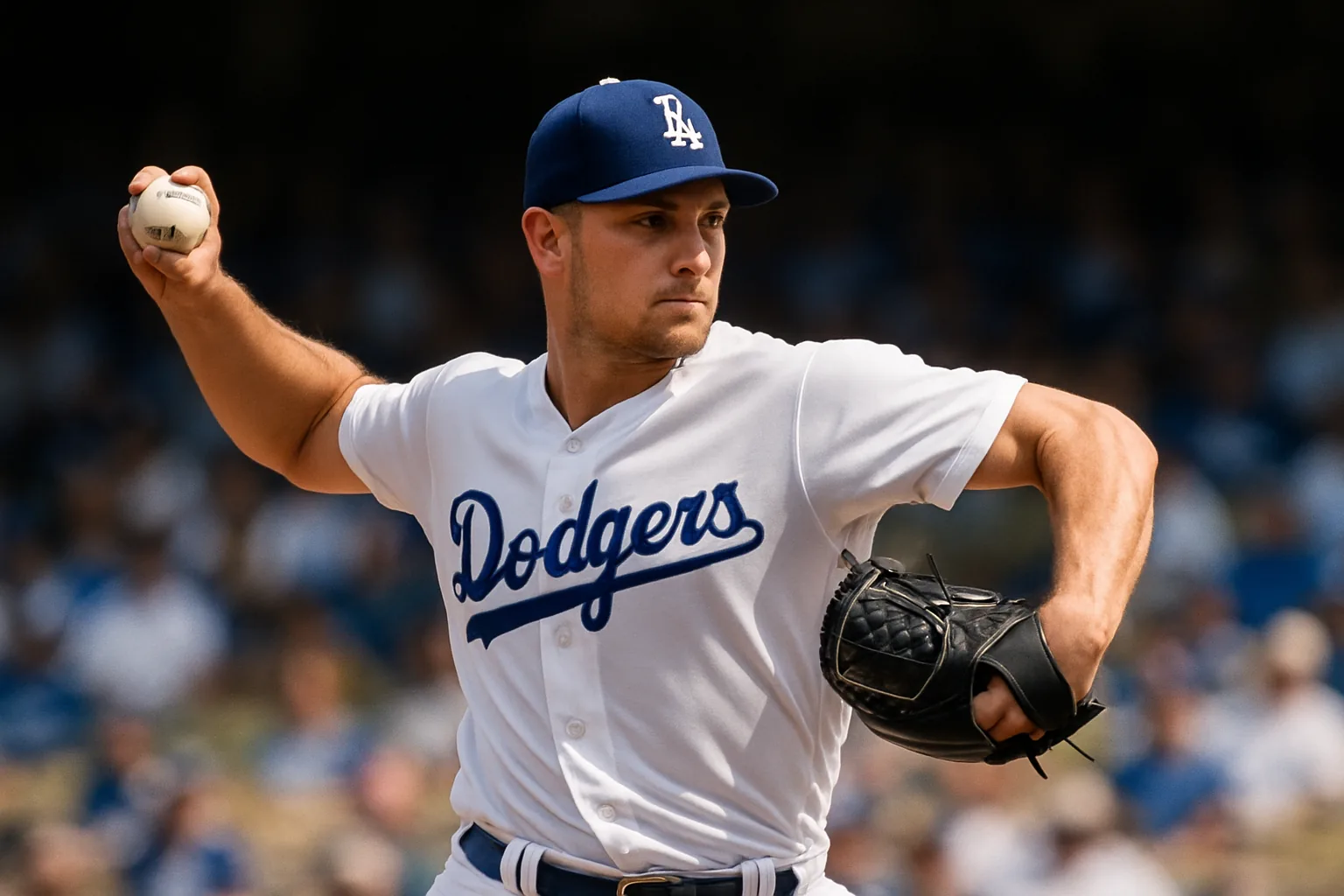
The Los Angeles Dodgers acquired right-handed reliever Seth Halvorsen from the Colorado Rockies on July 20, sending outfielder Landyn Vidourek and right-hander Nick Frasso to Colorado.
The timing makes the deal notable: the 2026 MLB trade deadline arrives at 6 p.m. ET on Aug. 3, but Halvorsen is not an immediate bullpen reinforcement. He is on the injured list with right shoulder inflammation and is expected to report to Triple-A after returning.
This is better understood as a pitching-development bet than a conventional deadline upgrade. Los Angeles gets one of baseball’s hardest throwers, along with the health and control problems that have kept that velocity from producing dependable late-inning work. Colorado gets two prospects whose best attributes remain visible despite significant flaws.
Why the Dodgers are willing to take the risk
Halvorsen’s fastball supplies the obvious attraction. According to MLB.com, he threw 233 pitches at 100 mph or faster from the beginning of 2025 through the trade, the seventh-highest total in the majors. His four-seam fastball has averaged 99.6 mph over his career and 98.8 mph in 2026.
Velocity at that level is scarce. Reliable velocity is scarcer.
Halvorsen walked 38 batters in 71 major league innings across parts of three seasons, a rate of 4.8 per nine innings. In 2026, he recorded a 4.74 ERA with 17 strikeouts and 15 walks in 19 innings for Colorado before landing on the injured list. He also moved between Triple-A and the majors rather than holding a permanent bullpen role.
The Dodgers therefore are not paying for a finished late-inning reliever. They are paying for the possibility that mechanical adjustments, pitch selection or a more controlled role can convert raw arm strength into usable outs. Manager Dave Roberts’ comment that the organization hopes to “unlock some levers” captures the project without pretending the outcome is certain.
Starting Halvorsen in Triple-A gives Los Angeles room to evaluate his shoulder and strike throwing away from a major league pennant race. It also limits the pressure to force him into important innings simply because he was acquired near the deadline.
A practical path into the bullpen
Consider a plausible progression. Halvorsen returns at Triple-A, demonstrates that his shoulder is healthy and reduces the free passes over several appearances. The Dodgers could then promote him initially for lower-leverage situations, asking him to attack with the fastball rather than immediately handle the eighth or ninth inning.
If the walks continue, he remains depth. If the strikes improve, a pitcher who routinely reaches triple digits can quickly become useful against the middle of an opposing lineup. That range of outcomes explains why Los Angeles made the trade without treating Halvorsen as its completed bullpen solution.
The move should not be read as proof that the Dodgers are finished shopping. An injured reliever assigned to Triple-A offers upside, but he does not provide the certainty usually sought for postseason innings.
Colorado acquires two different reclamation projects
Vidourek, 22, was the Dodgers’ third-round selection in the 2025 draft. Baseball America’s evaluation credits him with above-average power, plus speed and a plus-plus arm. Those tools give him several possible routes to value, particularly if his defense and baserunning can support the bat.
The central problem is contact. Vidourek struck out in more than 38% of his Low-A plate appearances in the cited sample, even while drawing walks at a strong rate. That combination matters. He is not simply swinging at everything; he has struggled to connect even when pitches enter the strike zone.
For Colorado, the bet is that a young player with power, speed and arm strength can make enough contact to remain a viable prospect. He does not need to become a high-average hitter, but his current miss rate leaves little margin for the rest of his offensive game.
Frasso, 27, represents a different type of gamble. He once ranked among the Dodgers’ leading pitching prospects, peaking at No. 4 in their system in 2024. Surgery to repair a torn labrum in his right shoulder cost him that season, and he later moved to the bullpen.
The former starter still has a mid-90s fastball that has touched 100 mph and a changeup capable of generating swings and misses. In 24.2 innings during the reported 2026 sample, he struck out 40 batters but walked 17 while posting a 4.74 ERA and 1.66 WHIP.
There is a familiar tension in those numbers: Frasso can miss bats, but not yet with the efficiency required for a stable major league role. Colorado is effectively replacing one high-velocity pitching project with another while adding a toolsy young outfielder.
What the exchange says about deadline value
Neither club is trading certainty. The Dodgers are consolidating two uncertain minor league assets into one arm with major league experience and exceptional velocity. The Rockies are spreading Halvorsen’s risk across two players with different development paths.
That asymmetry makes the trade sensible for both organizations without making it safe for either one. Los Angeles needs Halvorsen to become healthy and throw more strikes. Colorado needs Vidourek to improve his contact or Frasso to recover some of his former prospect trajectory.
The next checkpoints are concrete:
- Whether Halvorsen returns on schedule and how Los Angeles deploys him at Triple-A.
- Whether his walk rate improves enough to earn a major league bullpen role.
- Whether Vidourek’s contact rate moves in the right direction after joining Colorado’s system.
- Whether Frasso’s strikeouts can be retained while reducing walks in relief.
As an opening trade-season deal, it is instructive precisely because it lacks a famous name or guaranteed role. The Dodgers bought a premium physical trait. The Rockies bought two chances to develop something more valuable than the player they surrendered. The winner will be determined by which organization can turn those traits into consistent performance.